Marmarth School District 12, in a Slope County town of roughly 90 people near the Montana border, enrolled four students this year. Two are in third grade. One is in sixth grade. One is in eighth grade. There is no kindergartner, no first grader, no high schooler. Ten of the district's 13 grade levels are empty.
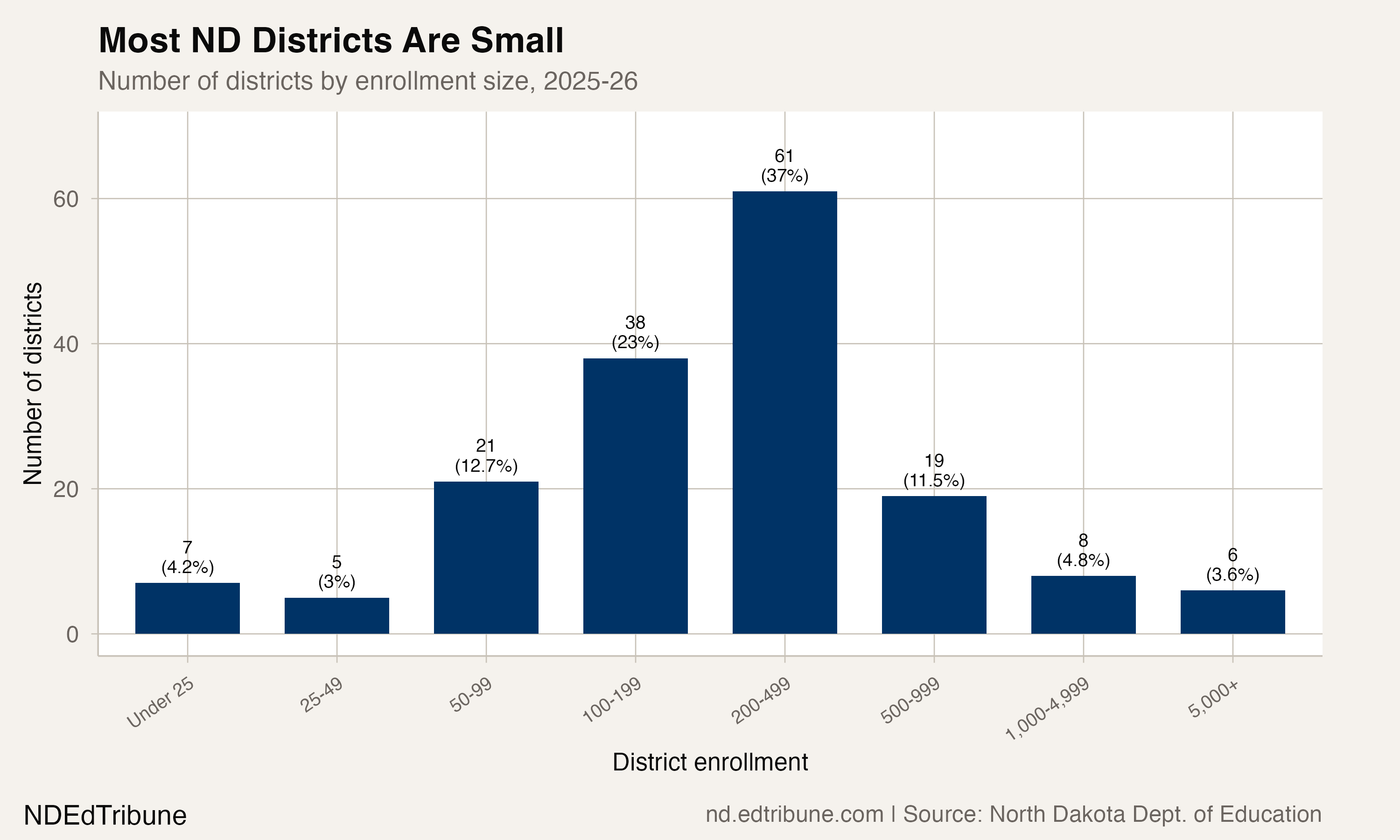
It is the smallest operating school district in North Dakota, a state with 165 of them. Marmarth is not an outlier so much as the end of a long tail. Thirty-three districts enrolled fewer than 100 students in 2025-26. Together they serve 1,941 students, 1.7% of the state's 116,365 total. Bismarck alone enrolls seven times as many.
A cliff, not a slide
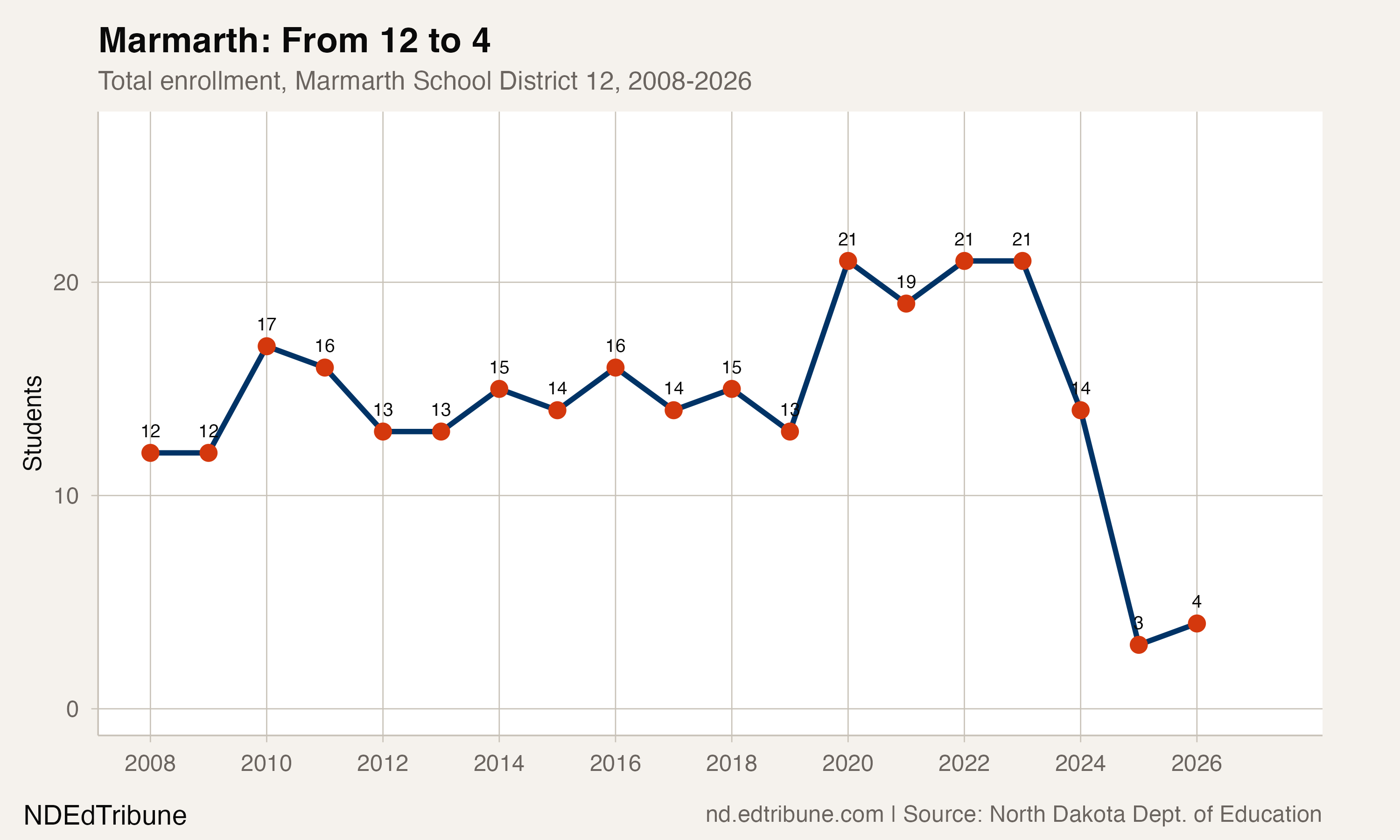
Marmarth's enrollment was never large, but it was stable. From 2008 through 2019, it fluctuated between 12 and 17 students. Then it briefly swelled: 21 students in 2020, 2022, and 2023. The collapse came fast. In 2024, enrollment dropped to 14. By 2025, it was three. This year, four.
That is an 81% decline in three years. It did not follow the slow erosion typical of rural consolidation. Families left or aged out, and nobody replaced them. The district enrolled zero kindergartners in 2025-26. There is no incoming class to stabilize even a single-digit count.
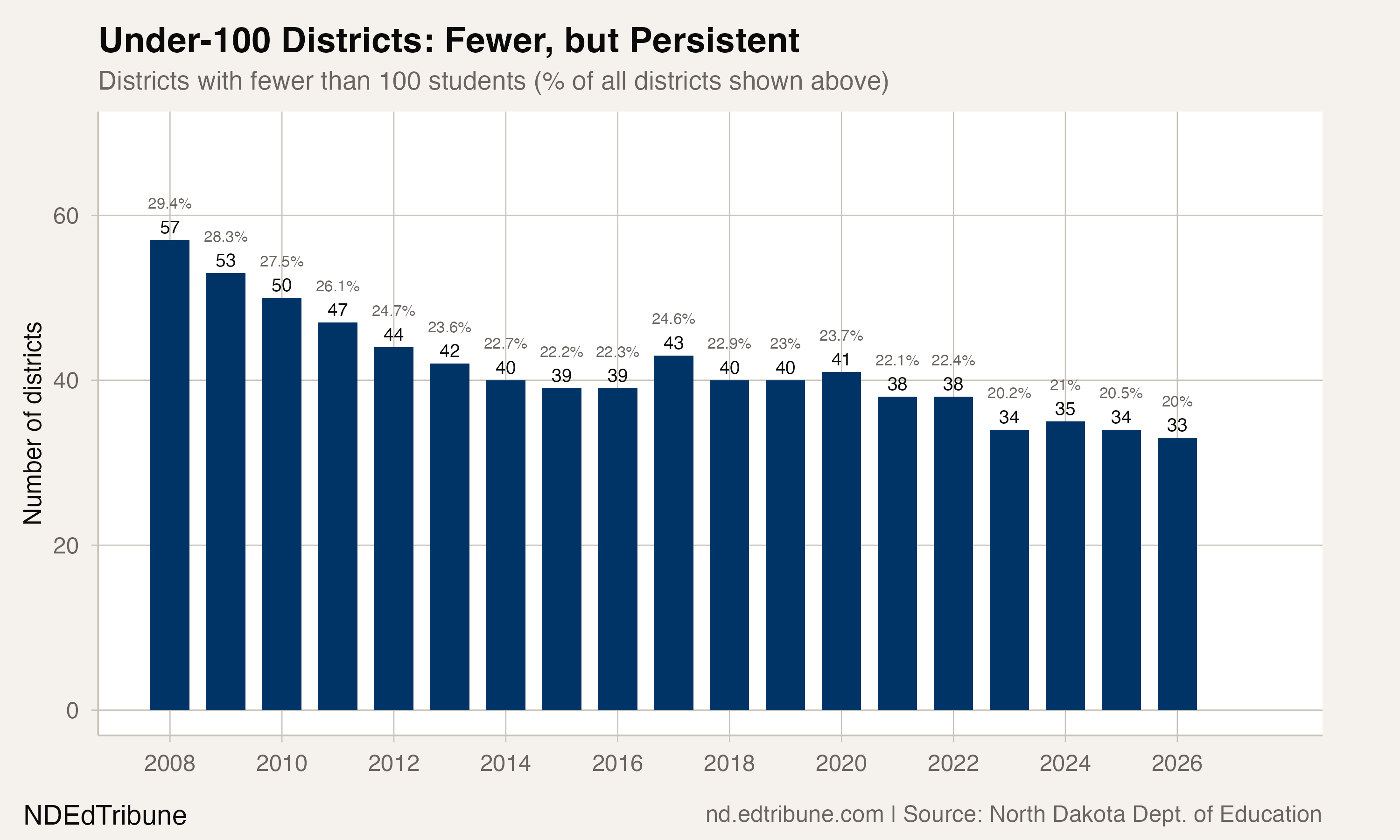
Thirty-three districts, 1,941 students
Marmarth sits at the extreme end of a distribution that tilts heavily toward small. One in five North Dakota districts, 33 of 165, enrolls fewer than 100 students. Seven districts enroll fewer than 25.
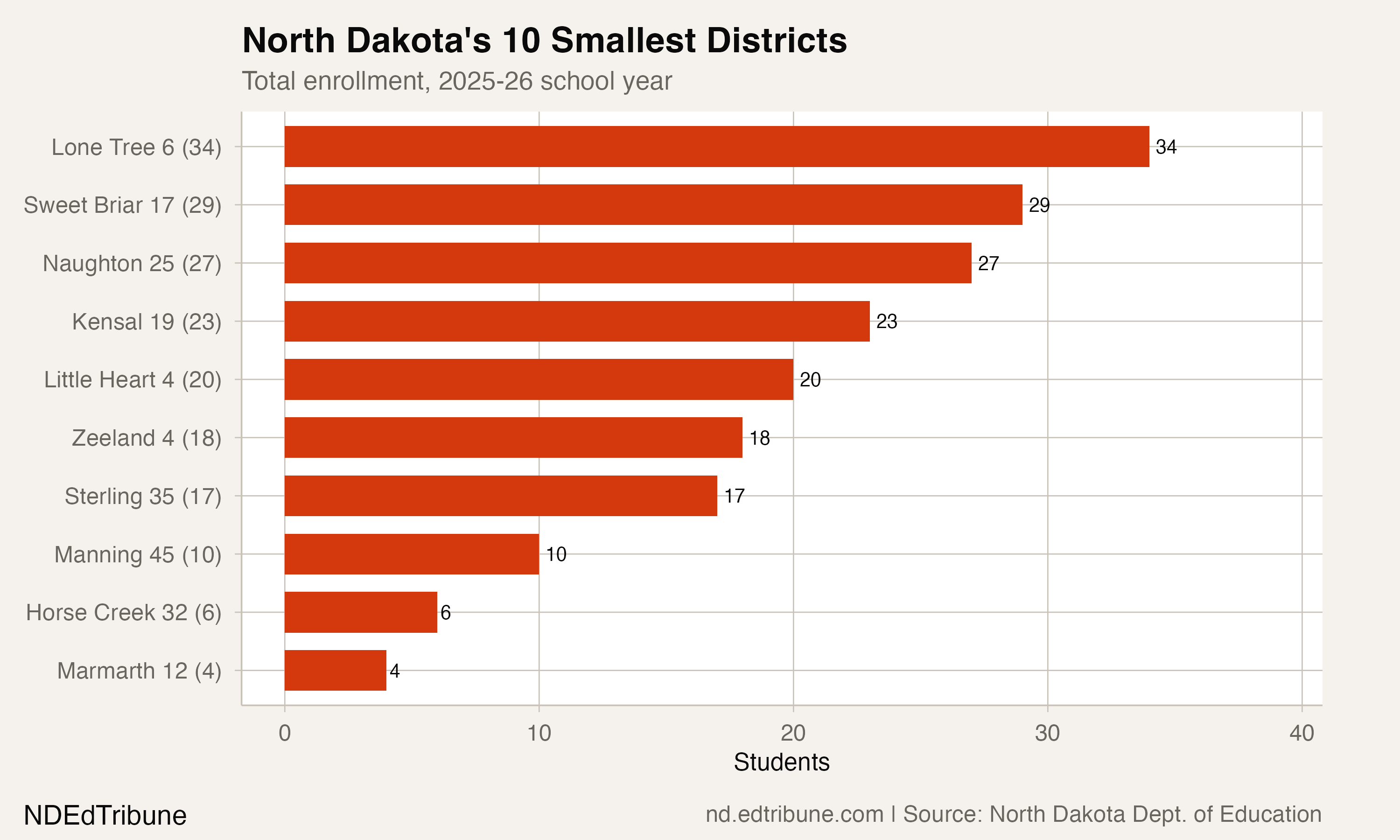
Horse Creek, a one-room school in McKenzie County, has six students. Manning has 10. Sterling has 17. These are not districts in the usual sense of the word. They are elementary-only operations, 21 across the state, that serve K-8 students and send older children elsewhere. Among the 33 sub-100 districts, five enrolled zero kindergartners in 2025-26, and 12 enrolled three or fewer. On average, sub-100 districts have students in 9.6 of 13 grade levels, leaving 3.4 grades empty.
The question is whether instruction holds up with so few students per classroom. When a district enrolls four students across three grade levels, every teacher is a multi-grade instructor by default.
Consolidation's long arithmetic
North Dakota has been losing districts for decades. The state had 194 in 2008. It has 165 today. The 29 that disappeared were small: their final-year enrollment had a median of 26 students. Bakker dissolved in 2024 with two students. Fort Ransom consolidated in 2026 with 11. Edmore closed in 2025 with 17.
Marmarth, at four students, is smaller than all but three districts that have consolidated since 2008: Bakker (two students), Central Elem (two), and Robinson (three). Yet it remains open. North Dakota has no minimum enrollment threshold that forces dissolution. The decision is entirely voluntary, driven by local school boards. State law provides a process for dissolution but no trigger.
That leaves the decision with communities where the school is often the last public institution. Former State Superintendent Kirsten Baesler put it bluntly in a Governing magazine profile:
"The closure of a school is a death to a community."
The same article quoted Mike Heilman, executive director of North Dakota Small Organized Schools, offering a counterpoint: the reason to keep a school open should be "are we meeting the needs of the children?" not nostalgia.
The funding equation
North Dakota pays roughly 80% of per-pupil education costs, with local taxpayers covering the remainder. The state's per-pupil foundation aid is $11,400 for 2025-26. At that rate, Marmarth's four students generate approximately $45,600 in state aid, a sum that must cover the costs of operating a physical school building, paying at least one teacher, and providing administrative overhead.
Per-pupil costs in micro-districts run far above the state average. The fixed costs of running a school building, paying a teacher, covering utilities and insurance, get divided among a handful of students. The state's funding formula weights for small, isolated districts, but the math gets harder with each family that leaves.
State Superintendent Levi Bachmeier, who visited Marmarth in December 2025 as part of a tour of all 165 districts, has acknowledged the tension directly:
"Every student, regardless if they attend our largest or smallest district, deserves a quality education."
Two systems in one state
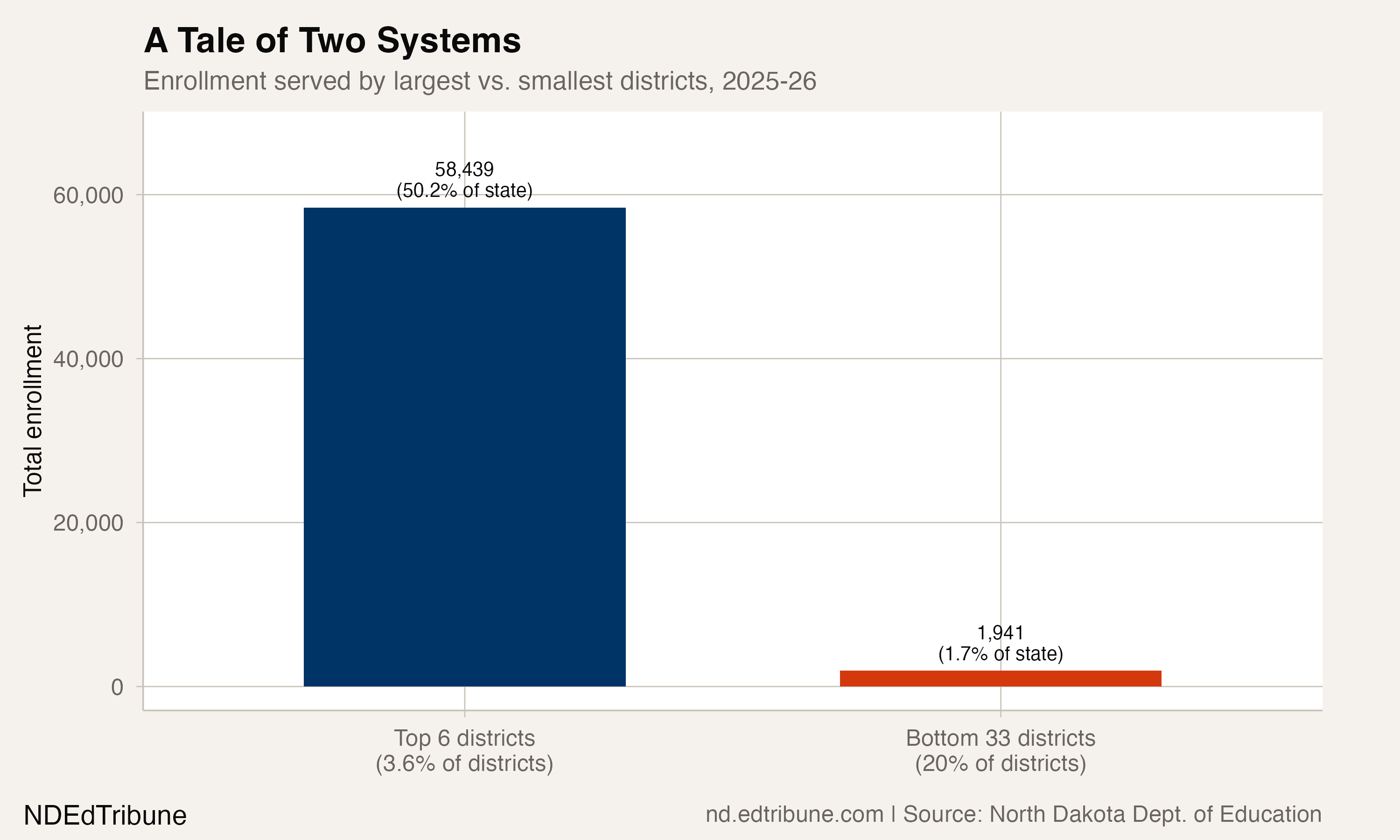
The lopsidedness defines North Dakota's education landscape. Six districts, Bismarck, West Fargo, Fargo, Grand Forks, Minot, and Williston Basin, enroll 58,439 students, 50.2% of the state total. They represent 3.6% of all districts. The 33 sub-100 districts, 20% of the state's districts, serve 1.7%.
The split is not static. Median district enrollment has risen from 187 in 2008 to 239 in 2026, not because small districts grew, but because many consolidated and disappeared. Among districts that existed in both years, 33 were under 100 in 2008 and 33 remain under 100 today. Seven districts that were above 100 in 2008 have since fallen below it. They replaced seven others that were small in 2008 and have since consolidated out of existence.
The oil boom reshaped the other end of the spectrum. Alexander, a McKenzie County district near the Bakken formation, grew from 50 students in 2008 to 315 in 2026, a 530% increase. Williston consolidated with Williams County and surrounding districts in 2022 to form Williston Basin, now the state's sixth-largest district at 5,584 students. These growth stories and the ongoing rural contraction are two sides of the same demographic coin.
Seven districts under 25
Seven North Dakota districts currently enroll fewer than 25 students. Marmarth is the smallest. Among the 33 sub-100 districts, 20 are on active decline streaks, including five on streaks of three or more consecutive years. Five sub-100 districts enrolled zero kindergartners this year.
Bakker dissolved in 2024 with two students. Fort Ransom consolidated in 2026 with 11. Edmore closed in 2025 with 17. Marmarth, at four, is smaller than all of them were at the end. State Superintendent Levi Bachmeier visited all 165 districts in his first months in office, including Marmarth. What he saw in Slope County was a school building in a town of 90, three students in one room, one in another, and no kindergartner expected next fall. The dissolution process is voluntary. The arithmetic is not.
Detailed code that reproduces the analysis and figures in this article is available exclusively to EdTribune subscribers.
Discussion
Sign in to join the discussion.
Loading comments...