In 2018, the graduation gap between Native American and white students in North Dakota had narrowed to 19.4 percentage points, the smallest in at least six years. Native American students were graduating at 72.0%. The numbers looked like they were going somewhere.
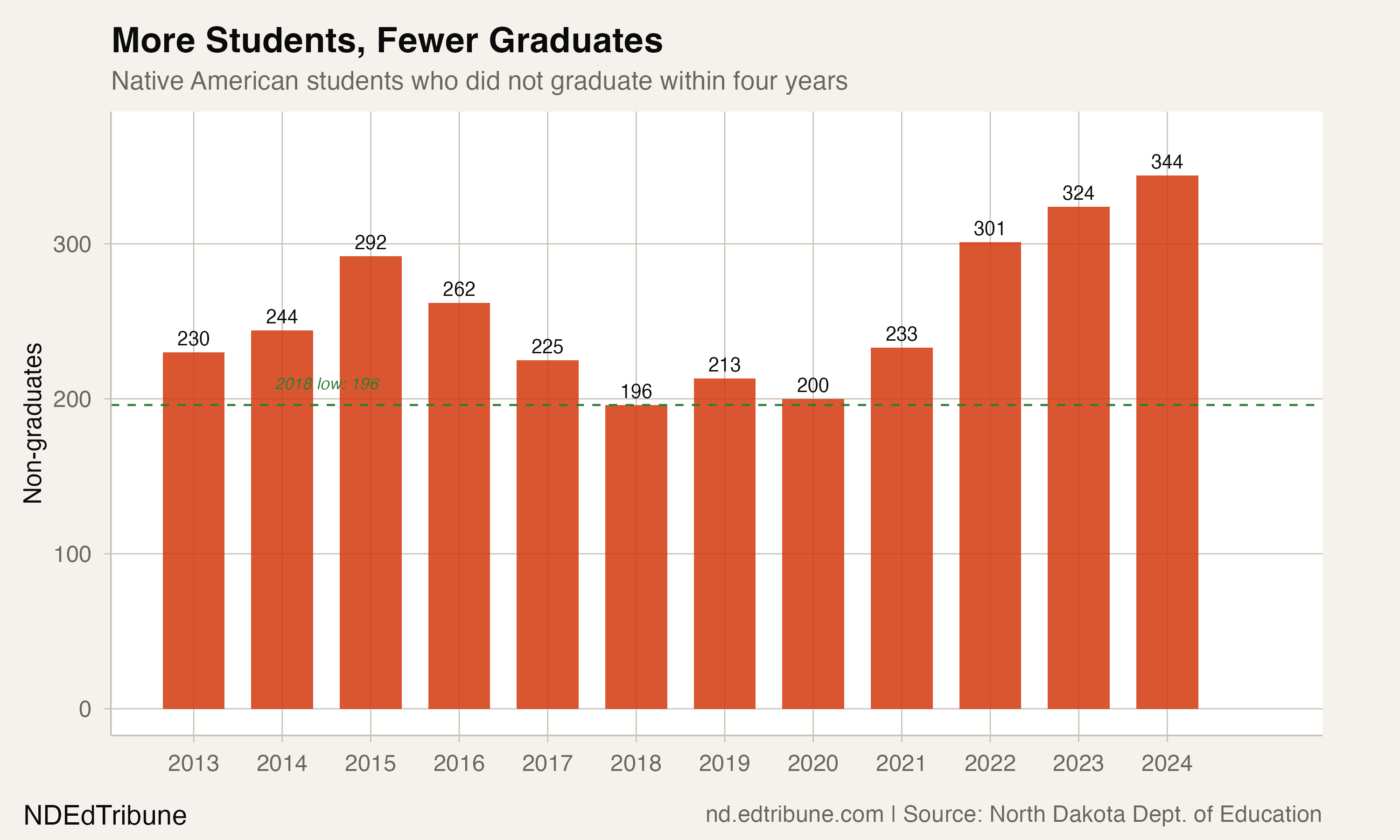
Six years later, the gains are gone. The Native American four-year graduation rate fell to 63.4% in 2024, while the white rate declined more modestly to 87.5%. The gap reopened to 24.1 percentage points, wider than it was in 2013. In raw numbers: 344 Native American students failed to graduate within four years in 2024, up from 196 in 2018. That is 148 more non-graduates per year than six years ago.
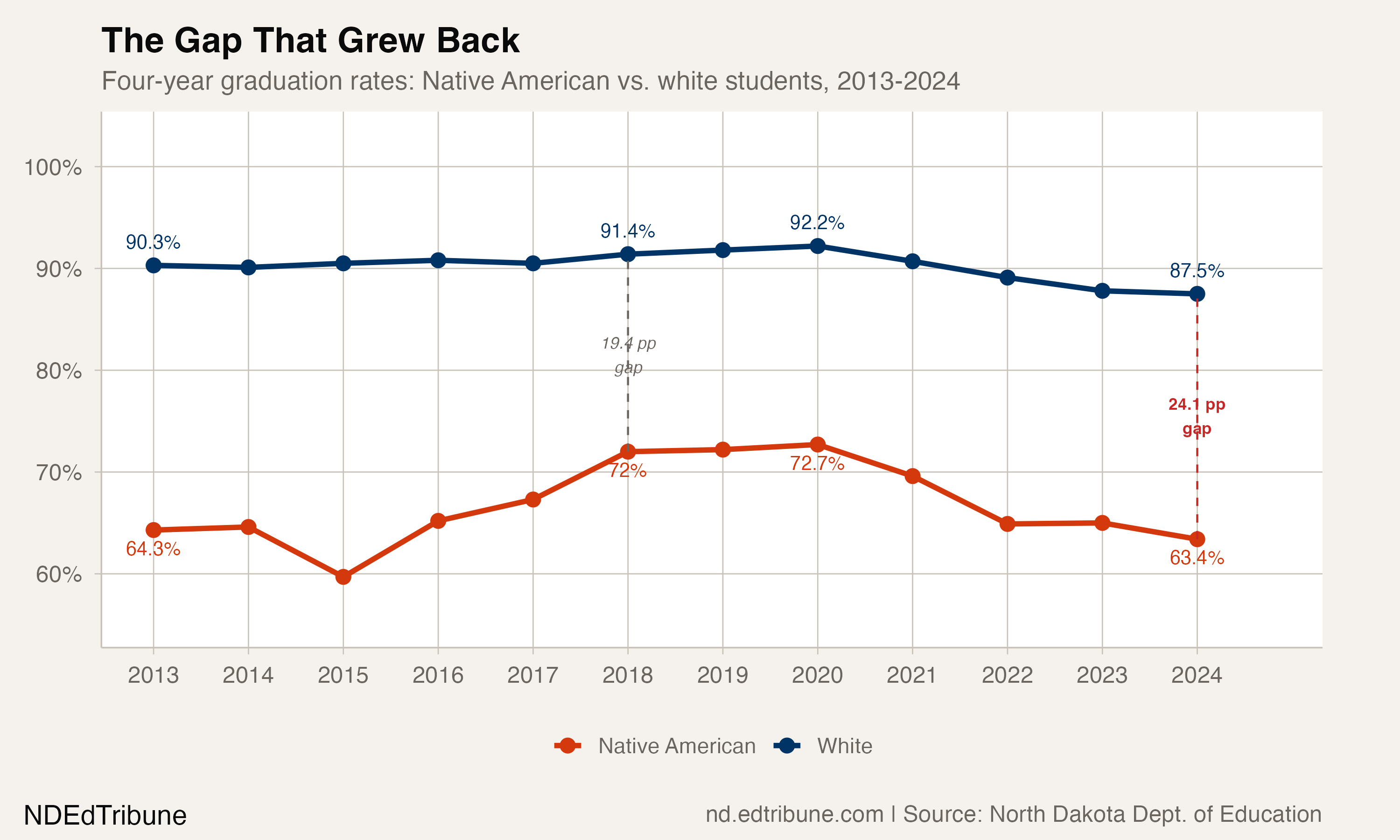
Everyone fell. Native students fell further.
North Dakota's overall graduation rate dropped from 89.0% in 2020 to 82.4% in 2024, a 6.6-point decline that hit every demographic group. White students fell 4.7 points. Black students fell 11.4. Hispanic students fell 9.3. Native American students, starting from a lower baseline, also fell 9.3 points, pushing them further behind a state average that was itself deteriorating.
The decline is not about fewer students reaching senior year. The Native American graduating cohort grew 45.8% between 2013 and 2024, from 644 to 939. More are getting to 12th grade. Fewer are finishing.
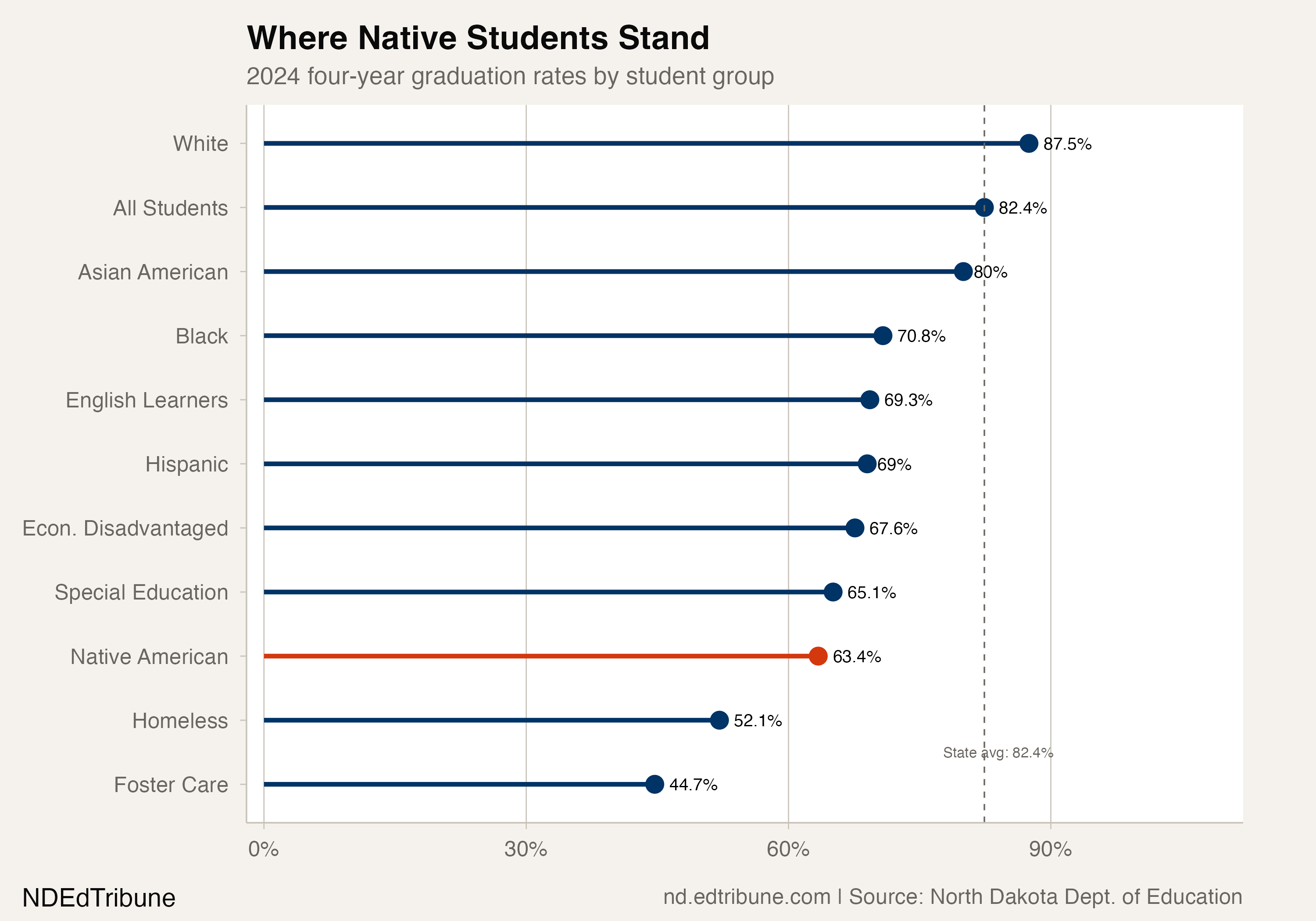
Only students in foster care (44.7%) and students who are currently homeless (52.1%) graduated at lower rates than Native American students in 2024. The rate for Native American students (63.4%) was below economically disadvantaged students (67.6%), below special education (65.1%), and below English learners (69.3%). These categories overlap heavily. Many Native American students fall into multiple service categories at once.
The urban gap is wider than the reservation gap
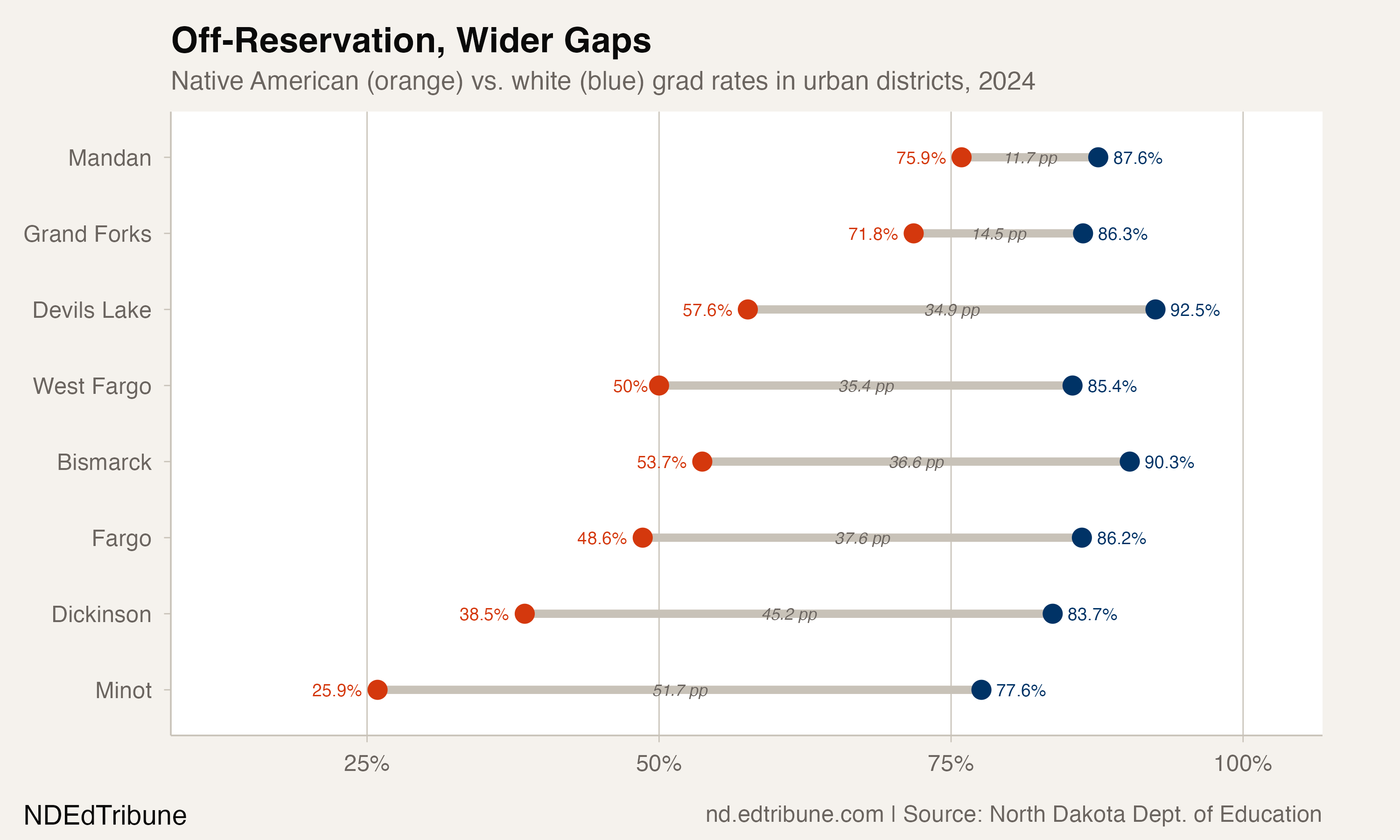
The widest graduation gaps for Native American students are not on reservations. They are in the state's largest cities.
In Minot↗ET, just 15 of 58 Native American students in the 2024 cohort graduated within four years, a rate of 25.9%. The white graduation rate in Minot was 77.6%, producing a 51.7 percentage point gap. That gap is more than double the statewide figure and the widest of any major district in the state.
Fargo↗ET graduated 48.6% of its 37 Native American seniors, a 37.6 point gap with white students. Bismarck↗ET graduated 53.7% of 108, a 36.6 point gap. West Fargo (50.0% of 40) and Devils Lake (57.6% of 33) showed gaps of 35.4 and 34.9 points respectively. These are not trivially small cohorts: Bismarck alone had more Native American seniors than many reservation districts.
By contrast, Belcourt↗ET on the Turtle Mountain Reservation graduated 69.1% of its Native American students, above the statewide Native American average. St. John, also near Turtle Mountain, graduated 100% of its Native American cohort of 20 students.
Native American students in predominantly white urban districts are graduating at lower rates than those in reservation schools that have far fewer resources. Bureau of Indian Education schools, which operate alongside state public schools on several reservations, report separately and are not included in these figures; the comparison covers only state-funded public schools. But the data is clear: the graduation gap is not simply a reservation problem. It may be, in large part, an integration problem.
Chronic absenteeism
The most direct driver of falling graduation rates is attendance. According to the North Dakota Department of Public Instruction, the chronic absenteeism rate for Native American students statewide was 39% in the 2023-24 school year, down slightly from a pandemic peak of 44% in 2021-22 but still far above the 20% state average. In Minot Public Schools, 43% of Native American students were chronically absent.
The pandemic hit reservation communities hard. Tribal governments, facing higher health risks, kept schools closed longer than the state required. Shane Martin, superintendent of the Turtle Mountain Community School, connected the attendance crisis to a longer history:
"As of 1926, 83% of all Native American kids were in boarding schools... There's still that trust factor that has gone away." -- Minot Daily News, Dec. 2024
The pandemic did not create distrust of government-run schools among Native families. It reactivated it. Extended closures reinforced the pattern of disengagement, and many students have not returned to consistent attendance.
Nationally, the pattern is similar. An Associated Press analysis found that half of 34 states surveyed showed chronic absenteeism rates for Indigenous students at least nine percentage points above their state average. Alaska, Nebraska, and South Dakota had the majority of their Native students classified as chronically absent. North Dakota's 19-point gap between Native American and statewide absenteeism rates fits squarely into this national pattern.
What works: St. John and Turtle Mountain
Not every district is failing its Native American students. St. John High School, serving about 125 students near the Turtle Mountain Reservation (95% Indigenous), has maintained a graduation rate between 95% and 100% for the past decade. In 2024, every one of its 20 Native American seniors graduated.
"Building relationships -- anybody can do that." -- Chip Anderson, principal of St. John High School, via Buffalo's Fire
St. John's approach is practical, not programmatic. The school uses flexible attendance policies that account for home stressors and a credit recovery program that lets students make up lost ground in days rather than semesters. Staff collaborate around individual students. These are not expensive interventions. They are choices about how tightly to enforce rules when students face circumstances the rules were not written for.
Nearby Turtle Mountain Community School, a larger district, has invested in a districtwide family engagement director, multi-tiered attendance support, and student stipends for attendance milestones. Its 87% attendance rate in 2023-24, while still below the state average, was a marked improvement from its pandemic low.
Reservation enrollment is shrinking
The graduation crisis unfolds against a backdrop of declining enrollment at reservation schools. Belcourt, the largest reservation district in the state, has lost 285 students since its 2013 peak of 1,702, a 16.7% decline. Fort Yates on the Standing Rock Reservation fell from 205 students in 2017 to 84 in 2026, a 59% drop. Warwick on the Spirit Lake Reservation declined from 269 in 2013 to 175 in 2026.
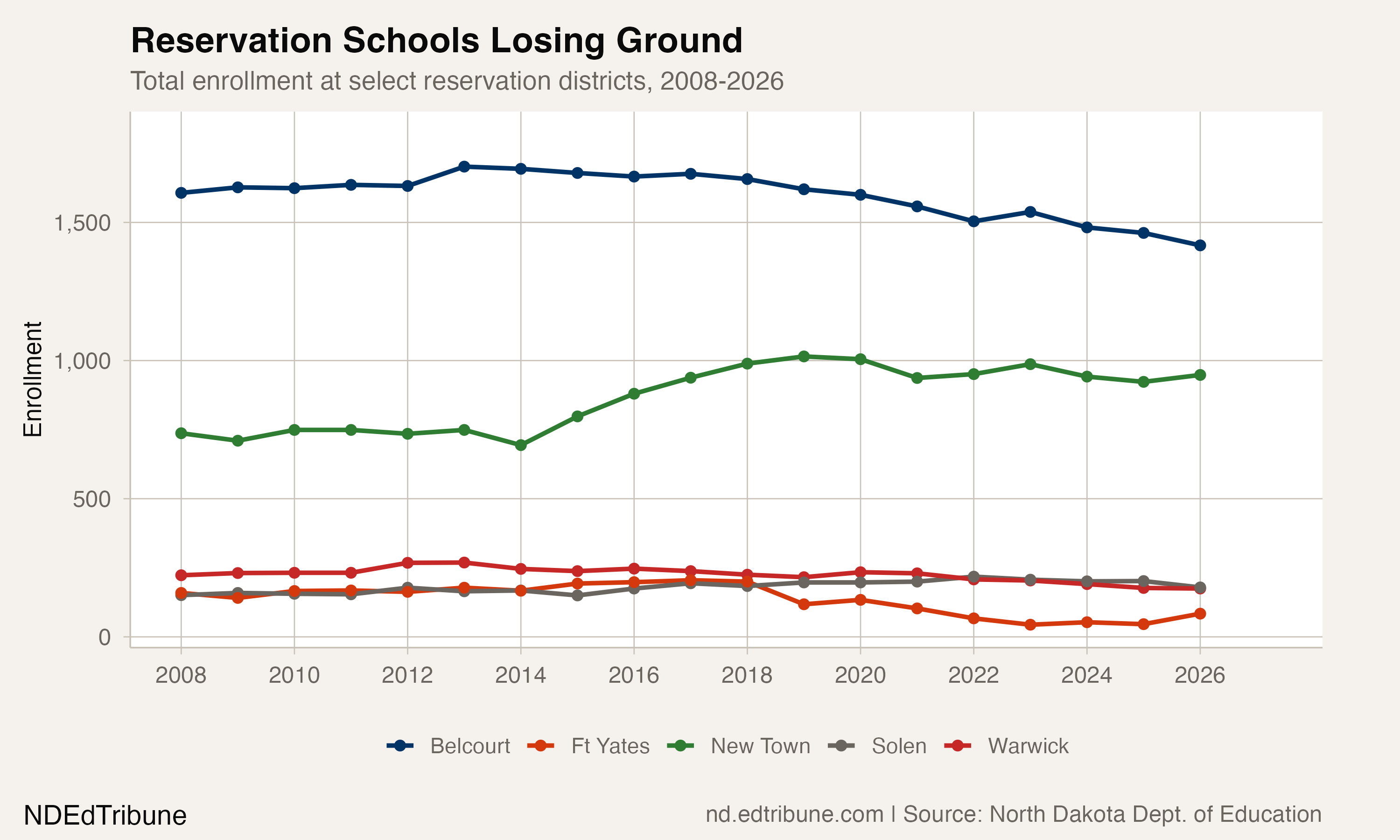
These declines shrink the funding base for the very programs needed to keep students in school. Fort Yates has lost so many students that it may lack the scale to offer the courses and support services that larger schools provide. New Town on the Fort Berthold Reservation, which grew during the Bakken oil boom to 1,015 students in 2019, has since fallen back to 948.
The math points to a migration pattern: Native American families moving to urban areas where their children face wider graduation gaps. The urban districts absorbing these students have not, by any measure in the data, figured out how to serve them.
One good year does not close a 24-point gap
The North Dakota DPI reported in December 2025 that 2024-25 graduation data showed a seven-point increase in Native American graduation rates, the largest single-year improvement in recent history. If it holds, it would be a partial recovery from the post-2020 collapse.
But one year does not close a 24-point gap or reverse four consecutive years of widening. The state's overall graduation rate also ticked up two points, meaning the gap could persist even as both lines rise. Minot graduated three out of four white students and one out of four Native American students. Until the urban districts where the gap is widest can explain how they plan to change that ratio, the statewide average will remain a number that describes no one's actual experience.
Detailed code that reproduces the analysis and figures in this article is available exclusively to EdTribune subscribers.
Discussion
Sign in to join the discussion.
Loading comments...