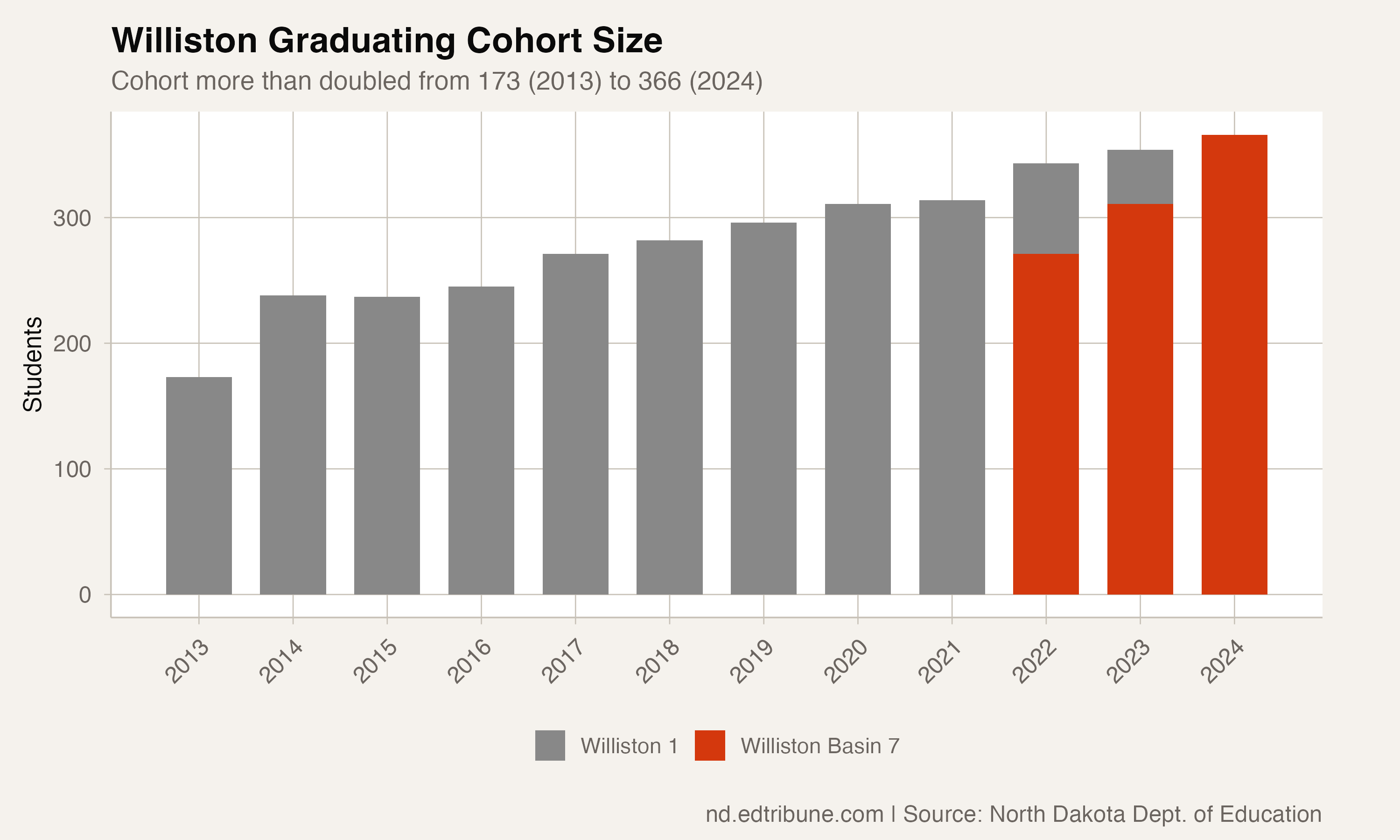
The Bakken oil boom transformed Williston, North Dakota, from a small prairie town into one of the state's fastest-growing communities. New schools were built. The graduating cohort more than doubled from 173 students in 2013 to 366 in 2024. Money poured in. Families arrived from across the country.
The graduation rate went the other direction. Williston Basin 7↗ET, the district formed from the reorganization of the old Williston 1, graduated just 68.6% of its cohort in 2024, the lowest rate among any large district in North Dakota.
Two districts, one trajectory
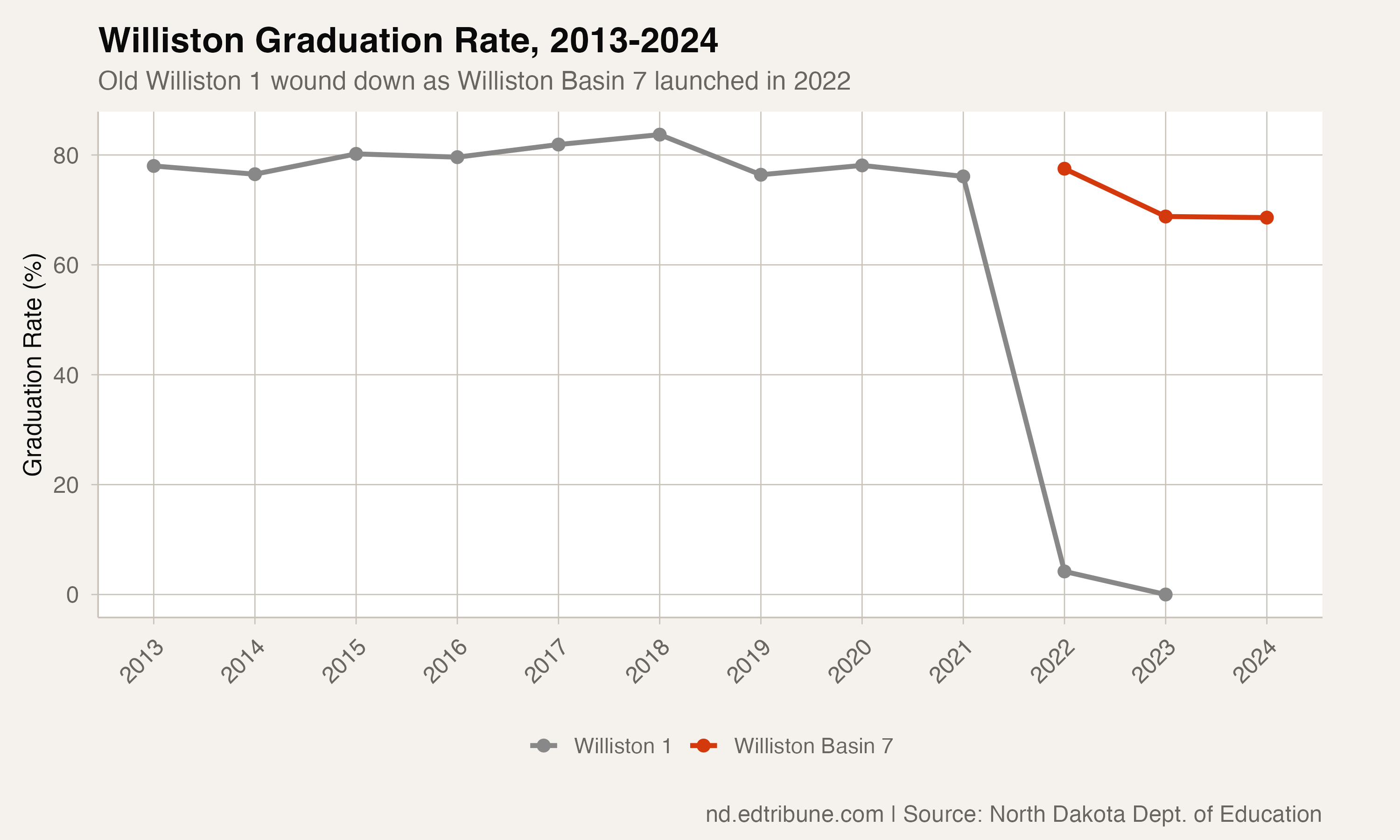
The Williston story requires understanding a structural change. The old Williston 1 district operated through 2023, but beginning in 2022 it was reorganized into Williston Basin 7, which absorbed the vast majority of students. The old district's cohort shrank to 72 in 2022 and 43 in 2023 as students transferred, producing artificially low rates (4.2% and 0%) that reflect the wind-down, not actual performance.
Williston Basin 7, the successor district, posted 77.5% in its first year (2022), then dropped to 68.8% in 2023 and 68.6% in 2024. The old Williston 1 ranged from 76% to 84% over its final years, never reaching the state average but hovering in the high 70s to low 80s. The new district has not matched even the old district's middling performance.
The oil boom's fingerprints
Williston's graduation challenge is inseparable from the Bakken boom. The oil industry brought rapid population growth, high wages for non-degree jobs, and extraordinary transience. Families arrived for one drilling season and left for the next. Student turnover rates in western North Dakota ranked among the highest in the state.
The boom's social effects showed up in the data as well. The number of students who are currently homeless in Williston surged from 19 to 170 as housing failed to keep pace with population growth. In 2024, students who are currently homeless in Williston Basin graduated at just 45.8%, with 24 students in the cohort. Economically disadvantaged students graduated at 50.7%, and Hispanic students, many of whom arrived with the oil workforce, at 52.6%.
The pull of high-paying oil field jobs -- available without a diploma -- may have reduced the perceived value of finishing high school for some students. When a roughneck job pays $80,000 a year and is hiring at 17, the calculus around staying in school changes.
Dickinson echoes the pattern
Dickinson↗ET, 100 miles south of Williston at the southern edge of the Bakken, shows a similar trajectory. The district's graduation rate has dropped from 92.9% in 2019 to 78% in 2024, a 14.9-point decline. Dickinson is not directly in the oil patch but shares the transient-population dynamics of western North Dakota.
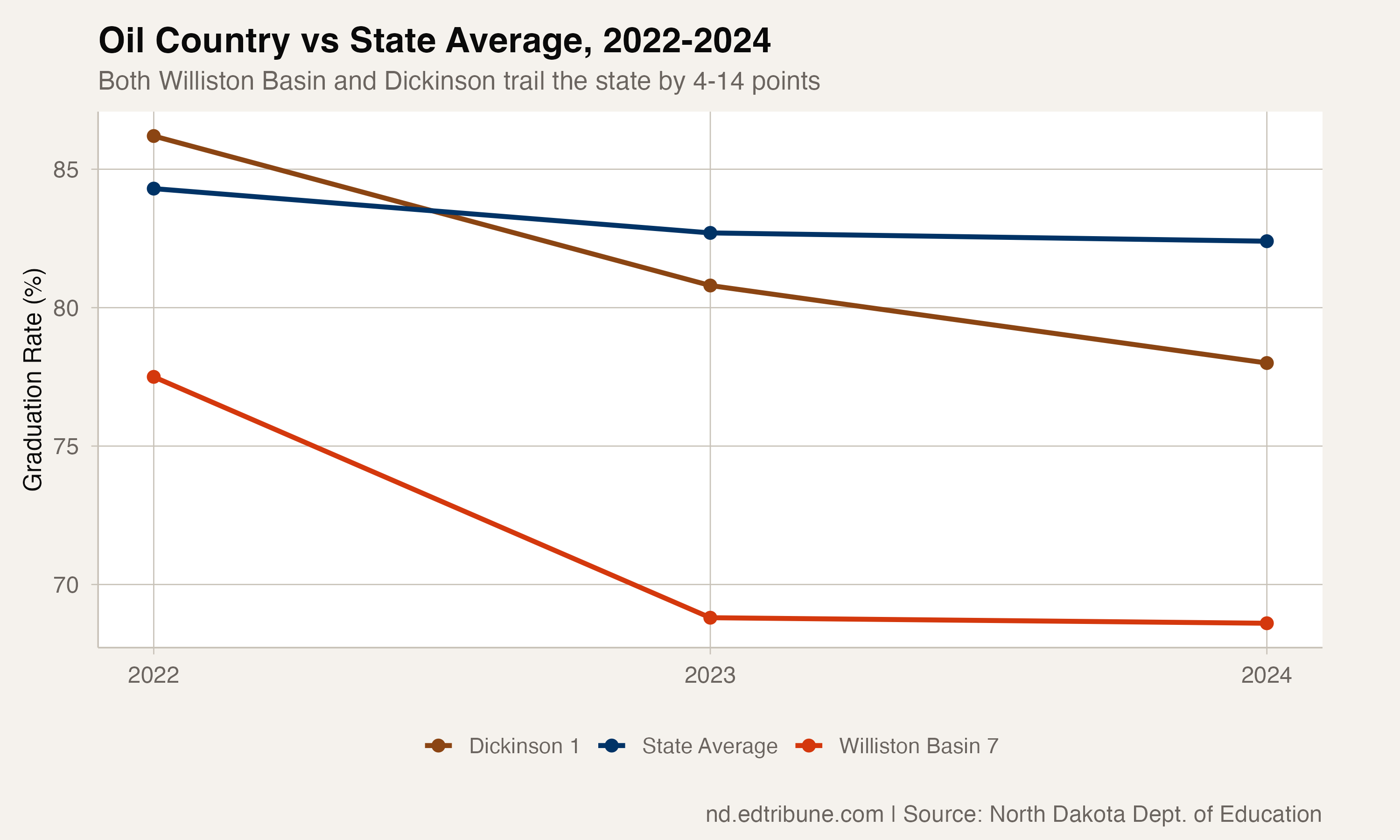
Together, Williston Basin at 68.6% and Dickinson at 78% represent the western North Dakota graduation challenge. Both sit well below the state average of 82.4%, and both are at their all-time lows.
White students below 75%
Even Williston Basin's white students, who make up the majority of the cohort at 225, graduated at only 73.3%. In most North Dakota districts, the white graduation rate runs 85-90%. Williston Basin's 73.3% is among the lowest white rates in the state, which means the problem here is not primarily about demographic composition or equity gaps, though those exist too. The oil country environment depresses graduation across all groups.
The district's overall 68.6% rate means roughly 115 students out of 366 did not graduate on time. Williston built new schools to accommodate the boom. It has not yet built the systems to get all those new students across the stage.
Data from the North Dakota Department of Public Instruction. Graduation rates represent four-year cohort rates. Williston 1 data available 2013-2023; Williston Basin 7 data available 2022-2024. All years use the end-year convention (2024 = class of 2024).
Detailed code that reproduces the analysis and figures in this article is available exclusively to EdTribune subscribers.
Discussion
Sign in to join the discussion.
Loading comments...