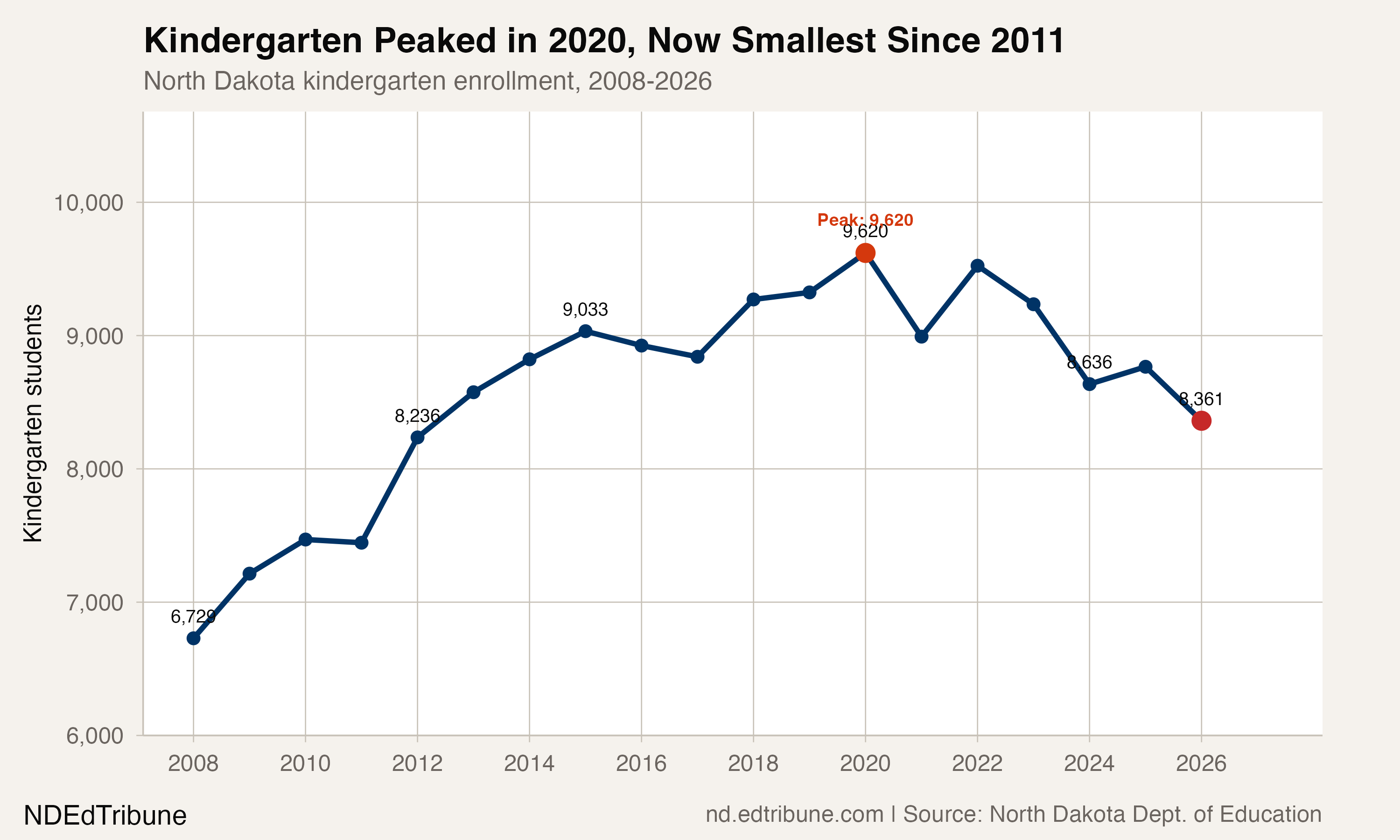
North Dakota enrolled 8,361 kindergartners in 2025-26. That is fewer students than it graduated. For the first time since 2011, the state's entering class is smaller than its exiting one, a reversal not seen since before the Bakken boom reshaped the state's schools.
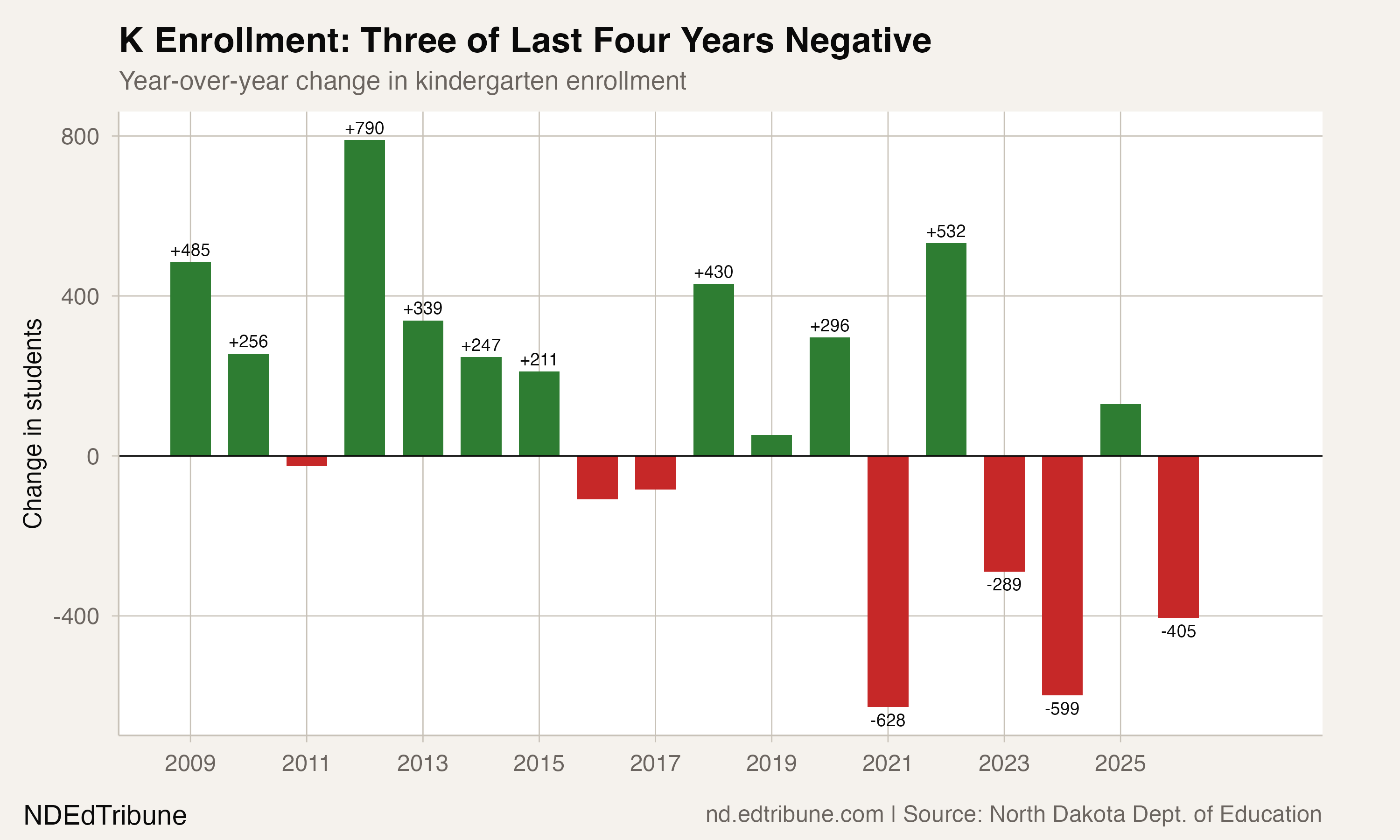
The 2026 kindergarten class is 13.1% smaller than the 2020 peak of 9,620, a loss of 1,259 students. It is the smallest K cohort since 2012, smaller than every kindergarten class enrolled during the oil boom years. The state added 22,546 students between 2008 and 2025, a 24.0% expansion driven by energy-sector migration. Kindergarten led that growth. Now it is leading the contraction.
The pipeline flips
For most of the past two decades, North Dakota's kindergarten classes were much larger than its graduating classes. The gap peaked in 2020, when kindergarten exceeded Grade 12 by 2,147 students, a 28.7% surplus pointing to years of total enrollment growth ahead.
In 2026, kindergarten (8,361) fell below Grade 12 (8,400) by 39 students. The last time this happened was 2011, before the Bakken boom reshaped the state's demographics. The reversal did not arrive suddenly. The K-to-G12 surplus shrank from 2,147 in 2020 to 1,827 in 2022, then to 608 in 2024, then to 427 in 2025, before crossing zero.
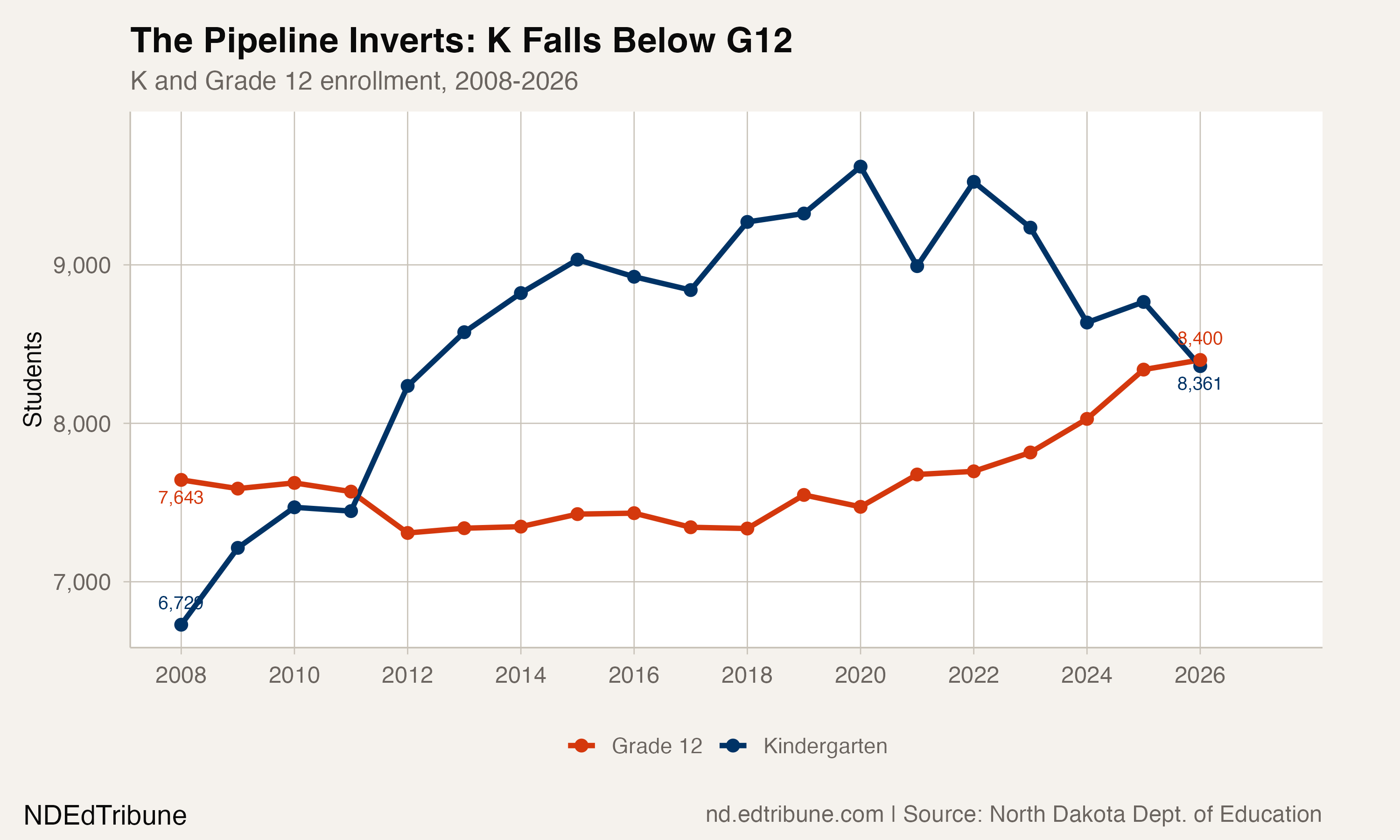
The arithmetic is simple. When each entering class is smaller than the departing one, the system shrinks unless enough families move in to make up the difference. North Dakota's total enrollment already fell by 233 students in 2026, the first drop since the pandemic year of 2021. Historically, kindergarten size predicts total enrollment six years later with near-perfect accuracy (r = 0.975).
Where the decline is concentrated
All five of North Dakota's largest districts enrolled fewer kindergartners in 2026 than in 2020. Fargo lost 195 K students, a 20.4% drop. Bismarck lost 172 (16.3%). Minot lost 116 (16.8%). Grand Forks lost 102 (16.3%). Even West Fargo, the state's fastest-growing district, lost 42 kindergartners (4.0%).
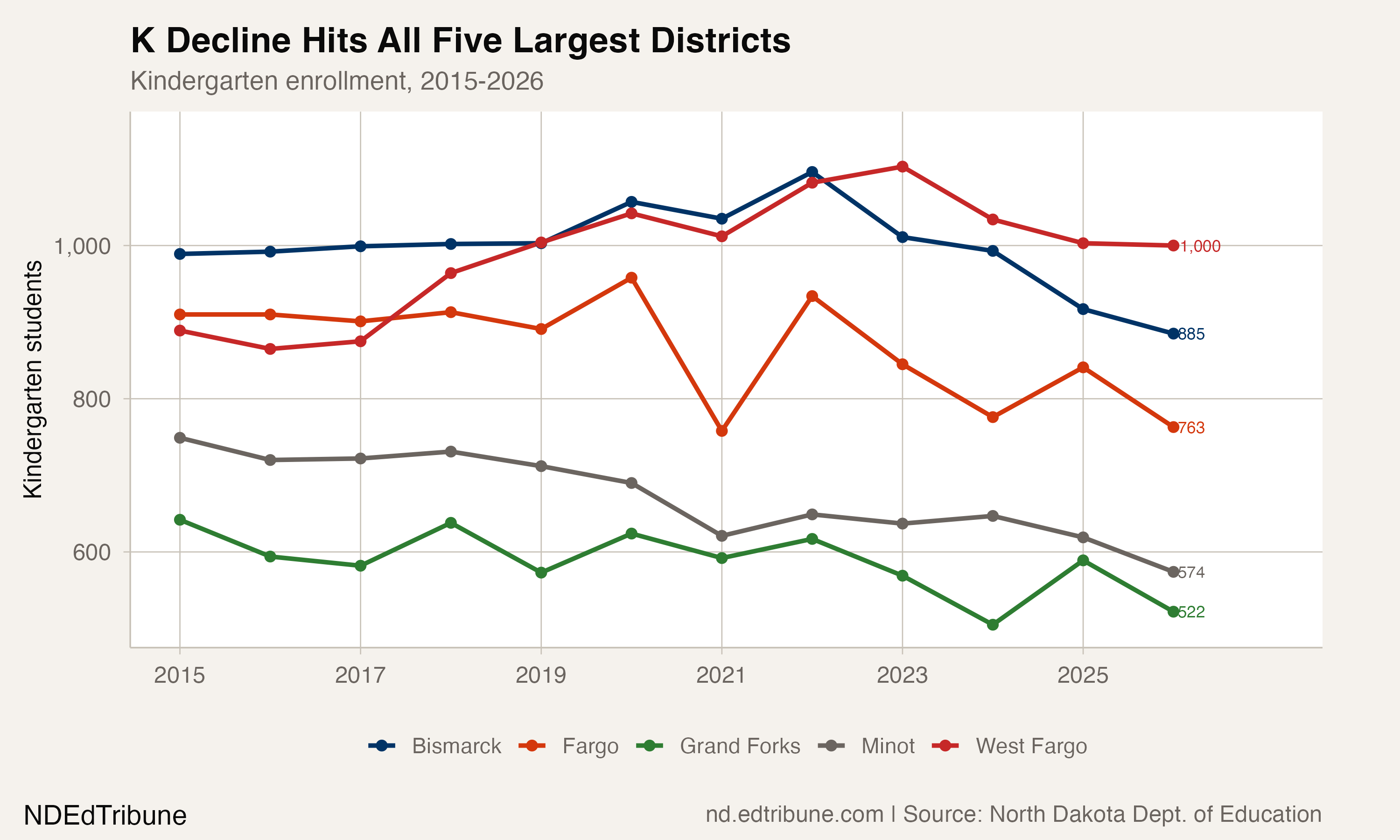
Combined, these five districts account for 627 of the statewide loss of 1,259 K students since 2020, roughly half. The remaining losses are spread across mid-sized and small districts. Twenty-two districts recorded their lowest kindergarten enrollment on record in 2026. Jamestown's K class fell 35.9%, from 170 to 109. Dickinson, the gateway to the Bakken, dropped 23.4%, from 398 to 305.
The exception is West Fargo. Its K enrollment of 1,000 is down from a 2023 peak of 1,103 but remains well above its pre-2020 baseline. The district is on track to overtake Bismarck as the state's largest, though a consultant warned that "one of the most notable changes that can affect enrollment is decreasing birth rate and smaller kindergarten classes."
Births, not departures
Fewer children are being born. North Dakota's 2026 kindergartners were born around 2020-2021, when pandemic-era births dropped nationally. U.S. births fell 7.7% in December 2020 and 9.4% in January 2021. North Dakota followed that pattern. The anticipated "COVID baby boom" never materialized.
The U.S. fertility rate hit 1.6 children per woman in 2024, the lowest in American history. North Dakota has an extra problem: its enrollment boom was built partly on in-migration that has since slowed. The Bakken brought young families to western North Dakota from 2008 through the mid-2010s. Their children fueled the K surge to 9,620 in 2020. As oil production matured and fewer workers arrived, the pipeline of kindergarten-age children narrowed from both ends.
Some families may also be delaying kindergarten entry or choosing private options. North Dakota's 2025 legislature signed the state's first charter school law and debated education savings accounts, though neither policy would have affected 2025-26 enrollment. The charter law takes effect in 2026-27 at the earliest, and the ESA bill was vetoed by Governor Armstrong.
The wave moves through the building
The K decline does not stay in kindergarten. It moves up the grade ladder year by year. The 2025-26 kindergarten class becomes the 2026-27 first-grade class, then a small second-grade class, and so on.
The evidence is already visible. K-3 enrollment peaked in 2020 at 36,828 and has fallen to 35,180, a loss of 1,648 students (4.5%). Meanwhile, grades 4-8 are still growing, up 2,263 since 2020, because those students entered during the boom-era K classes of 2012-2018. High school enrollment (grades 9-12) has grown 9.1% since 2020, fed by the even earlier pipeline.
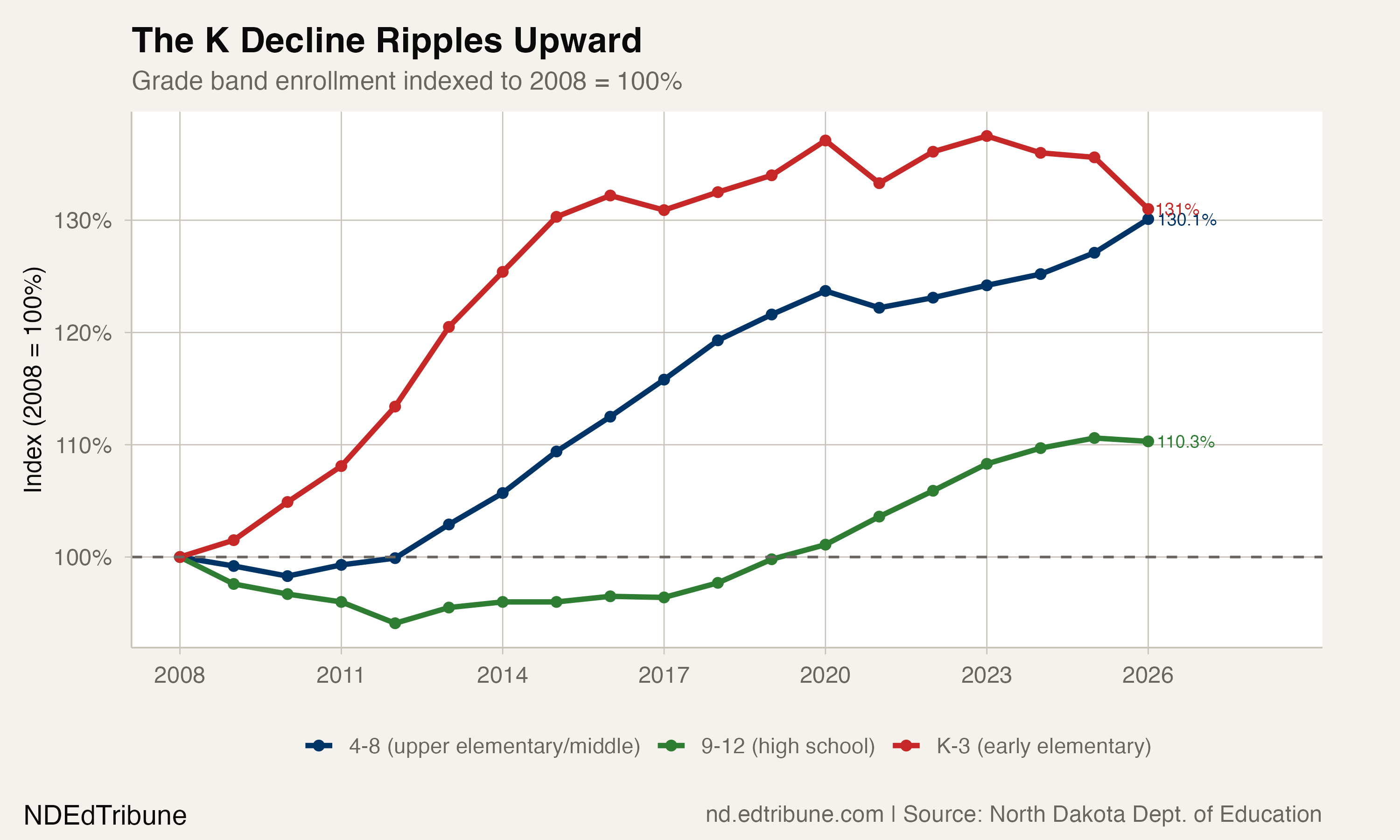
The grade profile in 2026 tells the story directly. Kindergarten (8,361) is the smallest grade. Fourth grade (9,577) is the largest, a gap of 1,216 students. The system is top-heavy: it has more juniors, sophomores, and freshmen than it has kindergartners, first-graders, or second-graders. As the smaller cohorts advance, middle schools and then high schools will feel the squeeze.
A 9,000-student gap
North Dakota's total enrollment in 2026 (116,365) remains 23.7% above its 2008 level of 94,052. But the growth engine has stalled. Between 2012 and 2019, the state added an average of 2,043 students per year. If that pace had continued, enrollment in 2026 would be approximately 125,656. The actual figure is 9,291 students below that projection.
The trajectory of the past three years tells the deceleration story. The state added 1,527 students in 2023, 382 in 2024, 831 in 2025, and then lost 233 in 2026. Kindergarten's share of total enrollment has fallen from 8.7% in 2014, near the peak of the boom, to 7.2% in 2026, back to where it was in 2008 before the growth era began.
The wave moves through the building -- slowly
The 2020 K class of 9,620 is now in sixth grade with 9,231 students. As it advances through middle and high school, the system will feel relatively stable, because the boom-era cohorts are large. The squeeze arrives when the 2024-2026 K classes, averaging 8,588 students, reach the grades now occupied by the 9,200-9,500 cohorts.
At $11,349 per pupil, the 1,259-student K decline from peak represents roughly $14.3 million in per-pupil revenue that will never enter the system as this cohort ages. That is not an immediate budget crisis. It is a slow-moving one -- felt first in rural districts where 129 of 165 already enroll fewer than 300 students, then in mid-sized cities like Jamestown and Dickinson where kindergarten has dropped more than 20%, and eventually in Fargo and Bismarck, where it has already started.
One note: the enrollment data carries no race or ethnicity breakdowns, so there is no way to tell whether the K decline is hitting all communities equally. The decline's causes -- fewer births and slower in-migration -- look the same in the enrollment numbers regardless of who stays and who leaves.
Detailed code that reproduces the analysis and figures in this article is available exclusively to EdTribune subscribers.
Discussion
Sign in to join the discussion.
Loading comments...