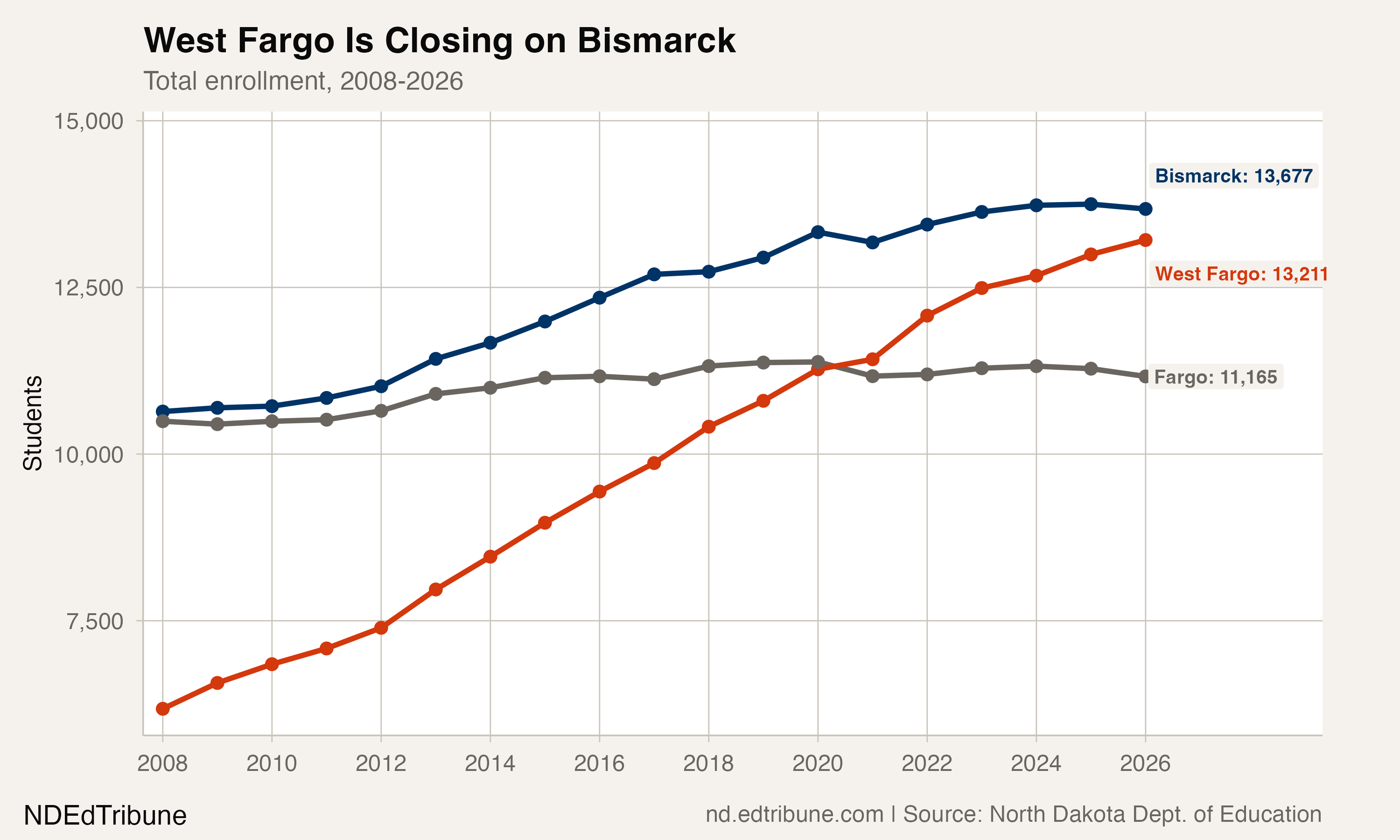
In 2008, West Fargo↗ET Schools enrolled 6,179 students, fewer than two-thirds the size of either Bismarck↗ET or Fargo↗ET. Eighteen years later, it has 13,211 students, a 113.8% increase, and sits 466 students behind Bismarck for the title of North Dakota's largest school district.
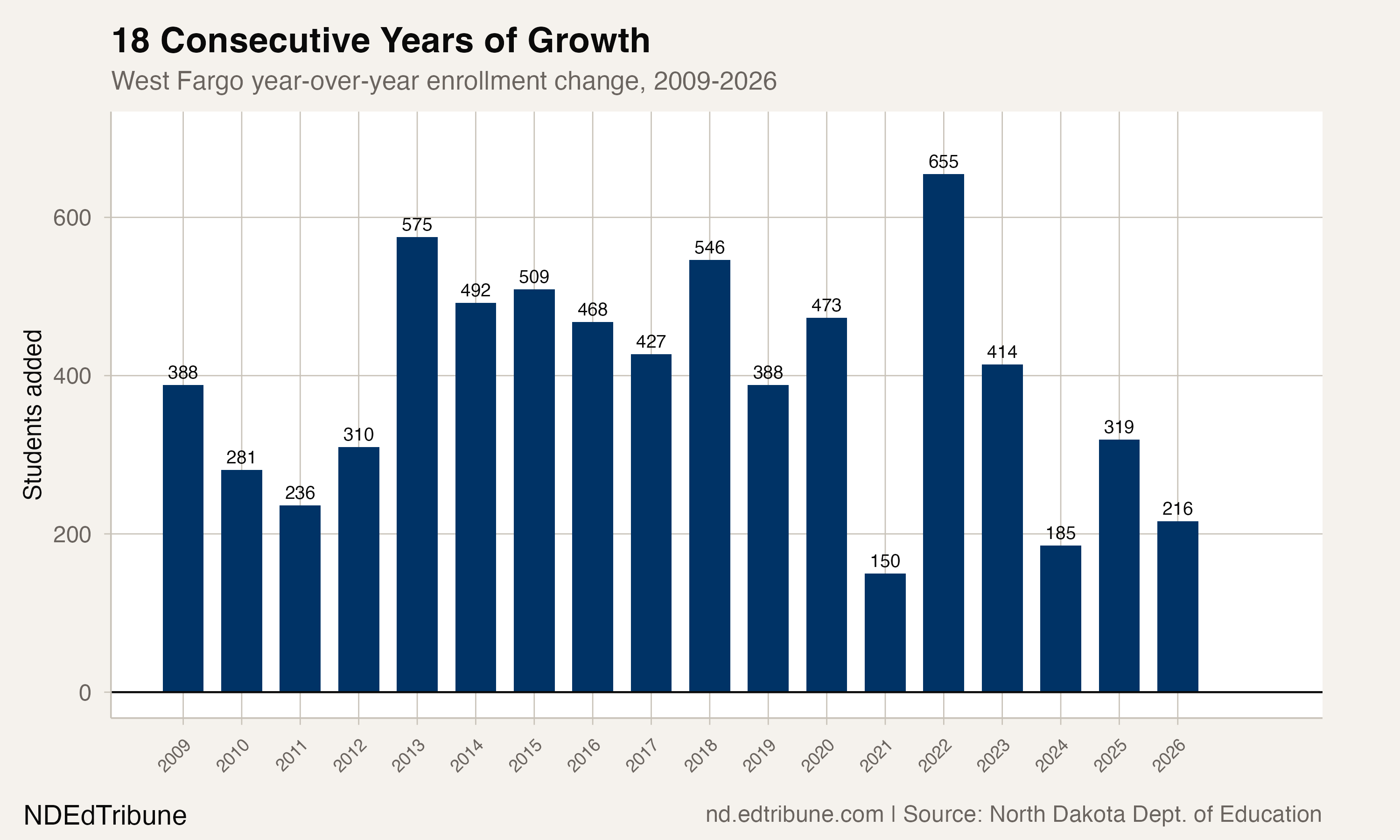
No other district in the state comes close. West Fargo has added students every single year since 2009, through the Bakken boom, through COVID, through the statewide enrollment dip of 2026. It is the only one of North Dakota's 165 districts to post 18 consecutive years of growth.
From suburb to contender
The growth came in waves. From 2009 through 2012, West Fargo added an average of 304 students a year, steady but unremarkable. Then the Bakken oil boom reshaped western North Dakota's economy, and the Fargo metro became its population engine. From 2013 through 2016, annual growth nearly doubled to 511, peaking at 575 in 2013.
The late 2010s held that pace at 458 per year. Even the pandemic barely dented the trajectory: 2021 was West Fargo's weakest year at 150 new students, but 2022 roared back with 655, the largest single-year gain in the district's history.
West Fargo passed Fargo in 2021. That year, Fargo lost 213 students while West Fargo gained 150. The gap has only widened: West Fargo now leads Fargo by more than 2,000 students.
466 students from the top
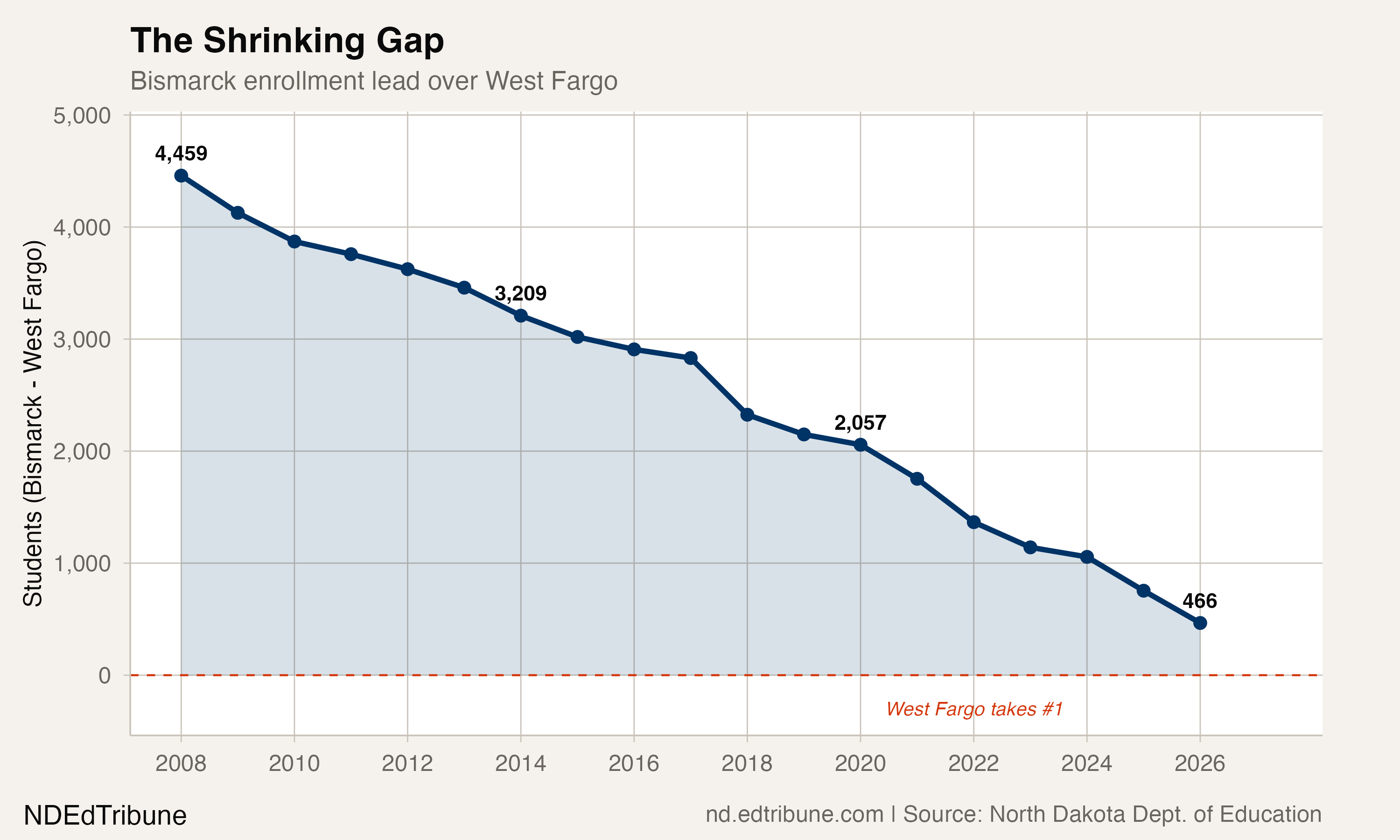
The more consequential race is with Bismarck. In 2008, Bismarck held a 4,459-student lead. That margin has eroded every single year, falling to 2,057 by 2020 and to 466 in 2026.
Bismarck peaked at 13,749 in 2025 and lost 72 in 2026. West Fargo gained 216. If both trajectories hold, West Fargo becomes North Dakota's largest school district within two years.
That crossover would be more than symbolic. Per-pupil state funding follows students, and the district with the largest enrollment pulls outsized weight in legislative funding debates. West Fargo's business manager, Levi Bachmeier, told InForum that scale now shapes every budget decision:
"We're now so big that more than 200 students is only a 2% growth."
What's driving it
The simplest explanation is land. West Fargo sits on the western edge of the Fargo metro, where new housing developments have eaten into former agricultural land for two decades. The city's population grew 13.3% between 2019 and 2024, reaching an estimated 41,027 residents.
That pipeline is not slowing down. Development projections from MetroCOG's West 94 Area Transportation Plan estimate the city could add up to 12,000 housing units on 2.5 square miles of undeveloped land near Interstate 94, potentially growing the city's population by 50% by 2050. The completion of the Fargo-Moorhead Diversion project, expected in 2027, would remove the floodplain designation that has kept much of that land off the market.
Refugee resettlement in the broader Fargo metro has also fed enrollment growth, though the enrollment data lacks race or ethnicity breakdowns to quantify it directly. InForum reporting notes that Fargo received 80% of the state's refugee placements from 2000 to 2021, though that share dropped to 53% by 2024 as resettlement expanded to smaller communities.
The question the streak cannot answer
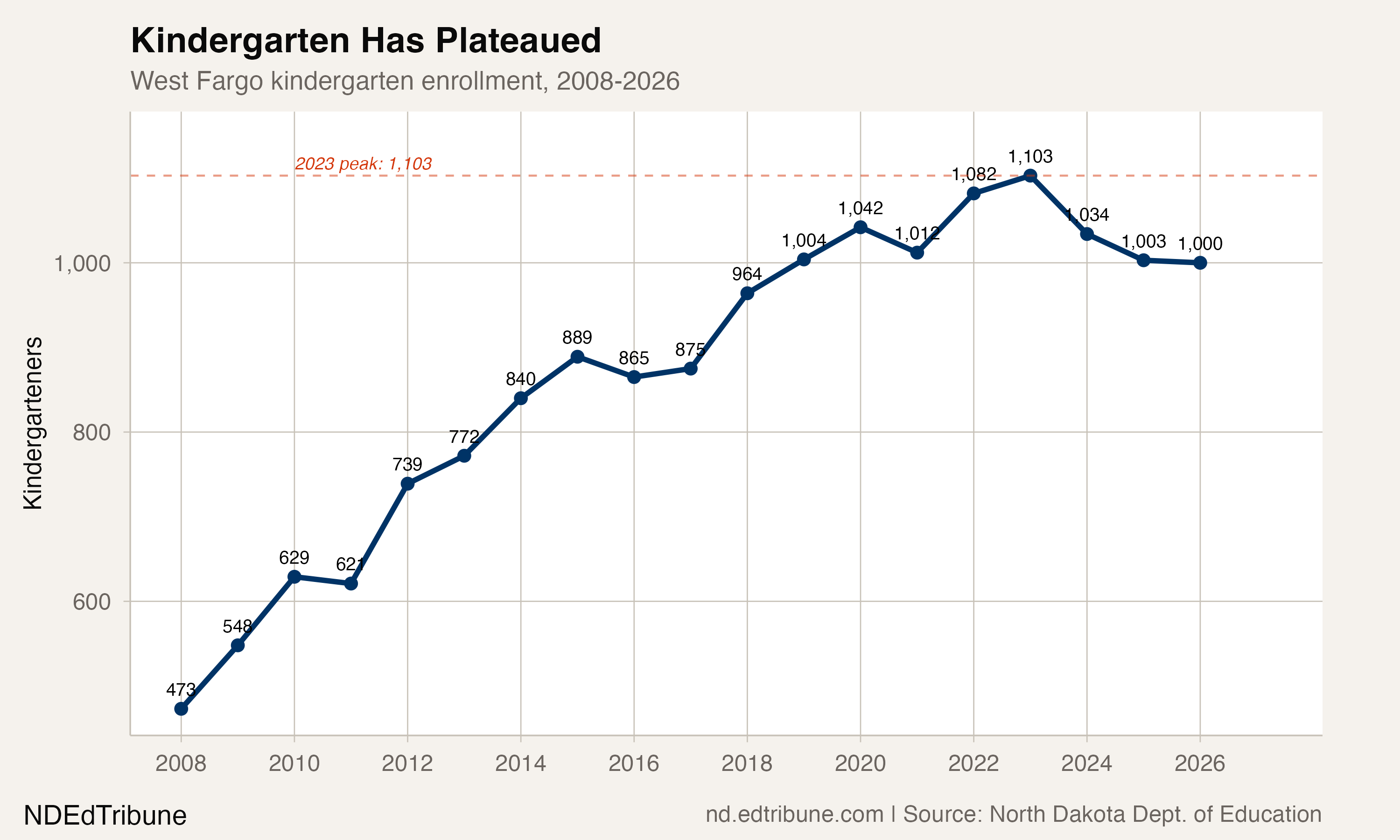
West Fargo's growth has been broad-based. Every grade level at least doubled since 2008: grade 12 grew from 360 to 970 (+169.4%), kindergarten from 473 to 1,000 (+111.4%). But kindergarten, the leading indicator, peaked at 1,103 in 2023 and has dropped in each of the last three years.
An enrollment study commissioned by the district flagged declining birth rates and smaller kindergarten classes as the primary risk. The consultant called the district's current growth a "bubble of students moving through our schools," with elementary growth slowing while middle and high school numbers swell.
The district is building for the present, not the peak. Voters approved a $99.6 million bond referendum in February 2025 to expand Horace High School, Heritage Middle School, and remodel South Elementary School. A second question, which would have funded a new elementary school, failed by 0.1 percentage points.
Concentration of gravity
West Fargo's rise has reshaped the state's enrollment map. In 2008, 6.6% of North Dakota's K-12 students attended West Fargo schools. In 2025-26, it was 11.4%, one in every nine students statewide.
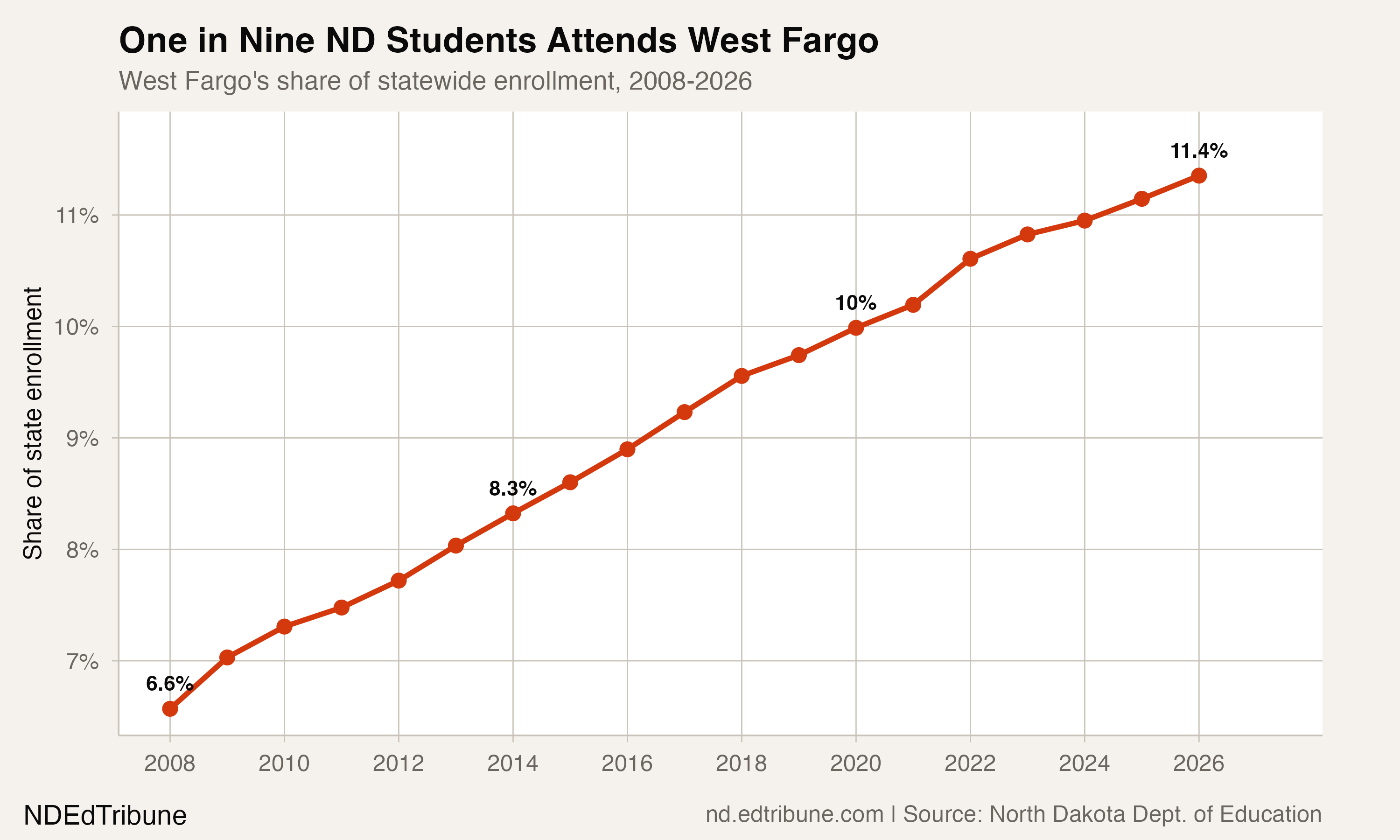
That concentration is happening while the state contracts. North Dakota's total enrollment fell by 233 students in 2026, only the second decline since 2009. Ninety-five of 165 districts lost students. West Fargo grew anyway.
The 18-year streak will end eventually. Kindergarten enrollment points that direction. But the more immediate reality is a district that, in February 2025, asked voters to approve $99.6 million in bonds for a high school expansion and got it -- then lost a second question, for a new elementary, by 0.1 percentage points. West Fargo is building for a student body that may already be peaking at the front door. The high school expansion will serve the boom-era cohorts for another five years. The elementary school that voters rejected by 14 votes may never need to be built.
Detailed code that reproduces the analysis and figures in this article is available exclusively to EdTribune subscribers.
Discussion
Sign in to join the discussion.
Loading comments...