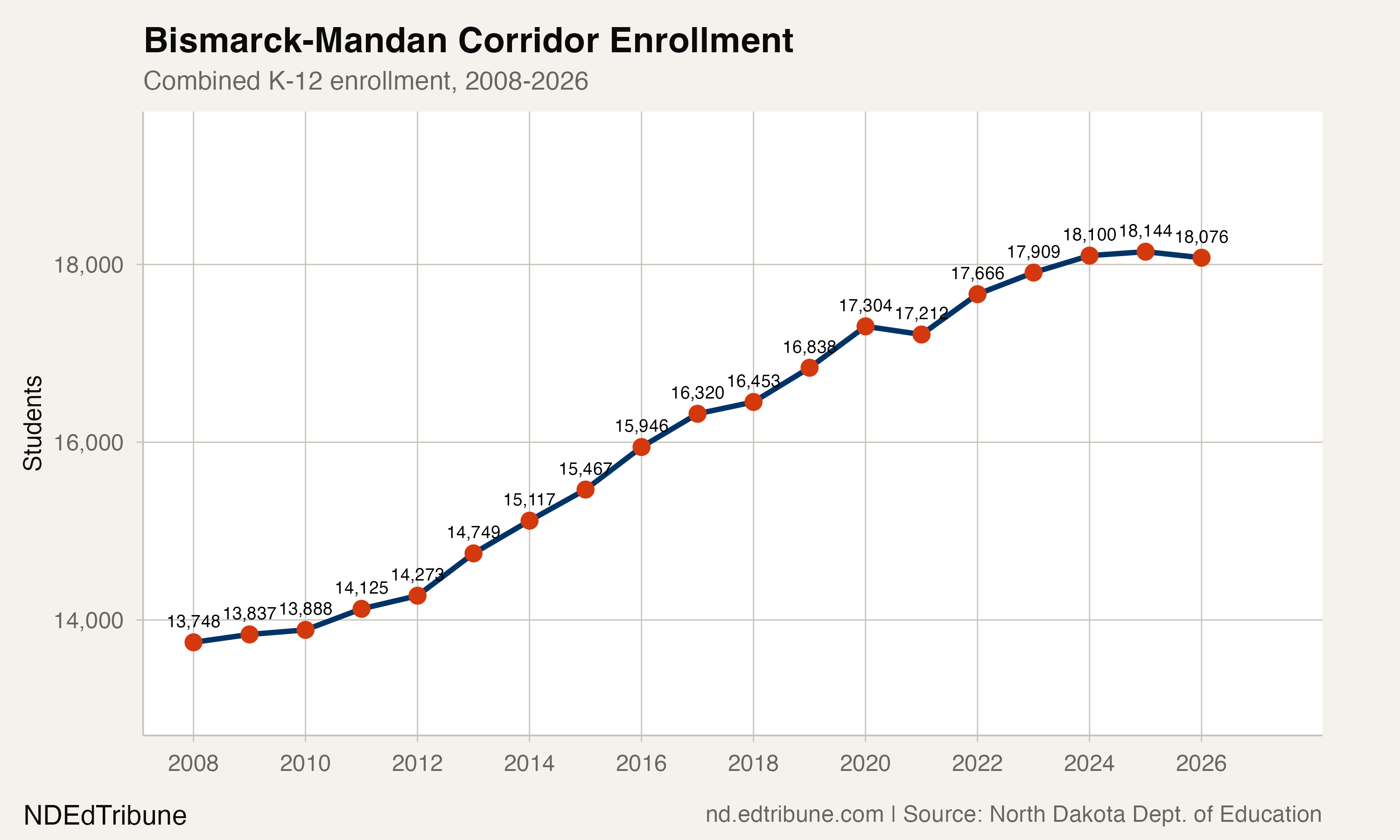
For 18 years, the Bismarck-Mandan corridor grew. The two districts on opposite banks of the Missouri added students nearly every year, first on the strength of the Bakken oil boom, then as state government and healthcare kept expanding in the capital region. Combined enrollment went from 13,748 in 2008 to a peak of 18,144 in 2025, up 32.0%.
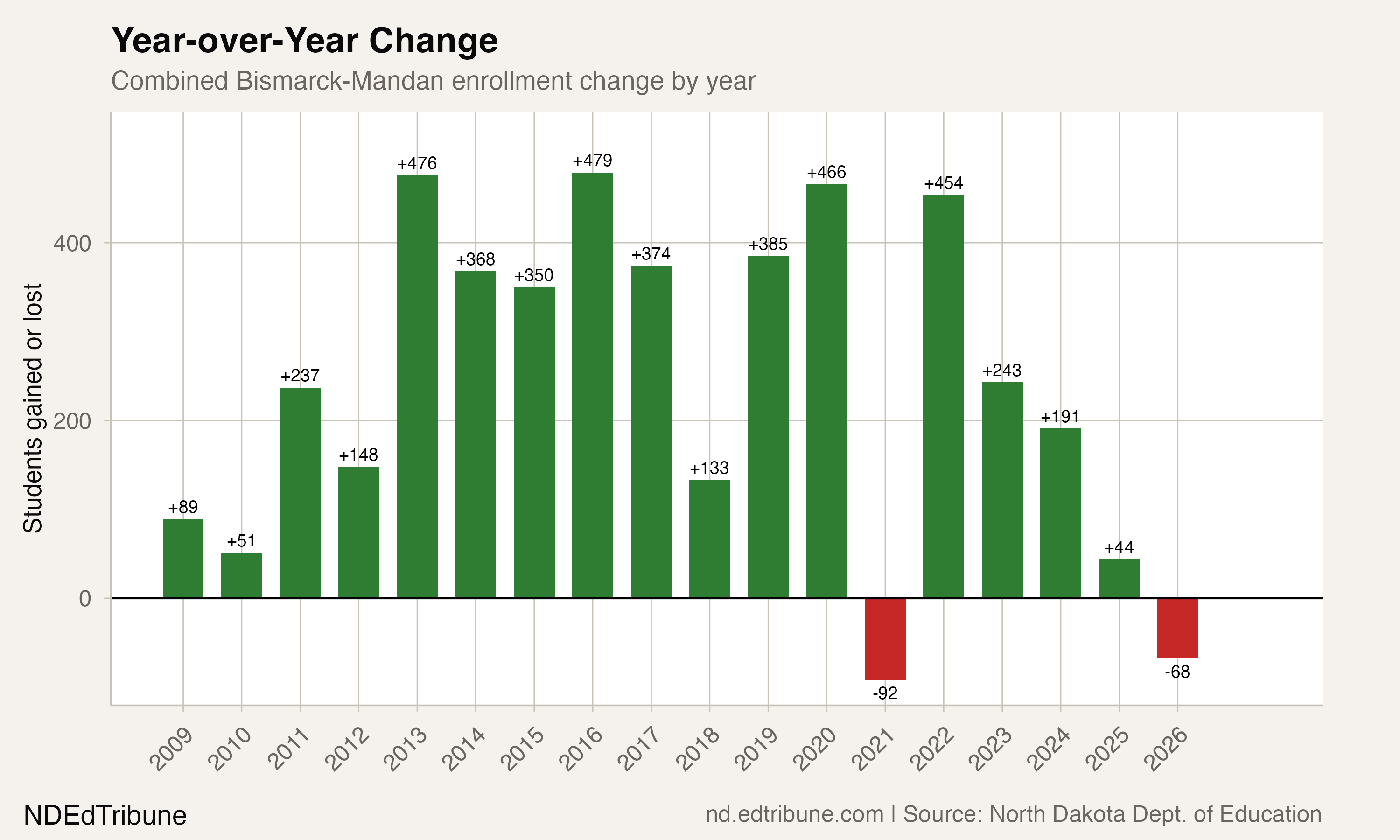
That streak broke this year. The corridor lost 68 students in 2026, its first non-COVID decline in the dataset. But the single-year dip is less important than the slowdown leading up to it: the corridor added just 44 students in 2025 and 191 in 2024, down from annual gains of 350 to 480 during the boom. From 2013 to 2020, the corridor averaged 365 new students per year. Since then, 129.
The two sides of the river
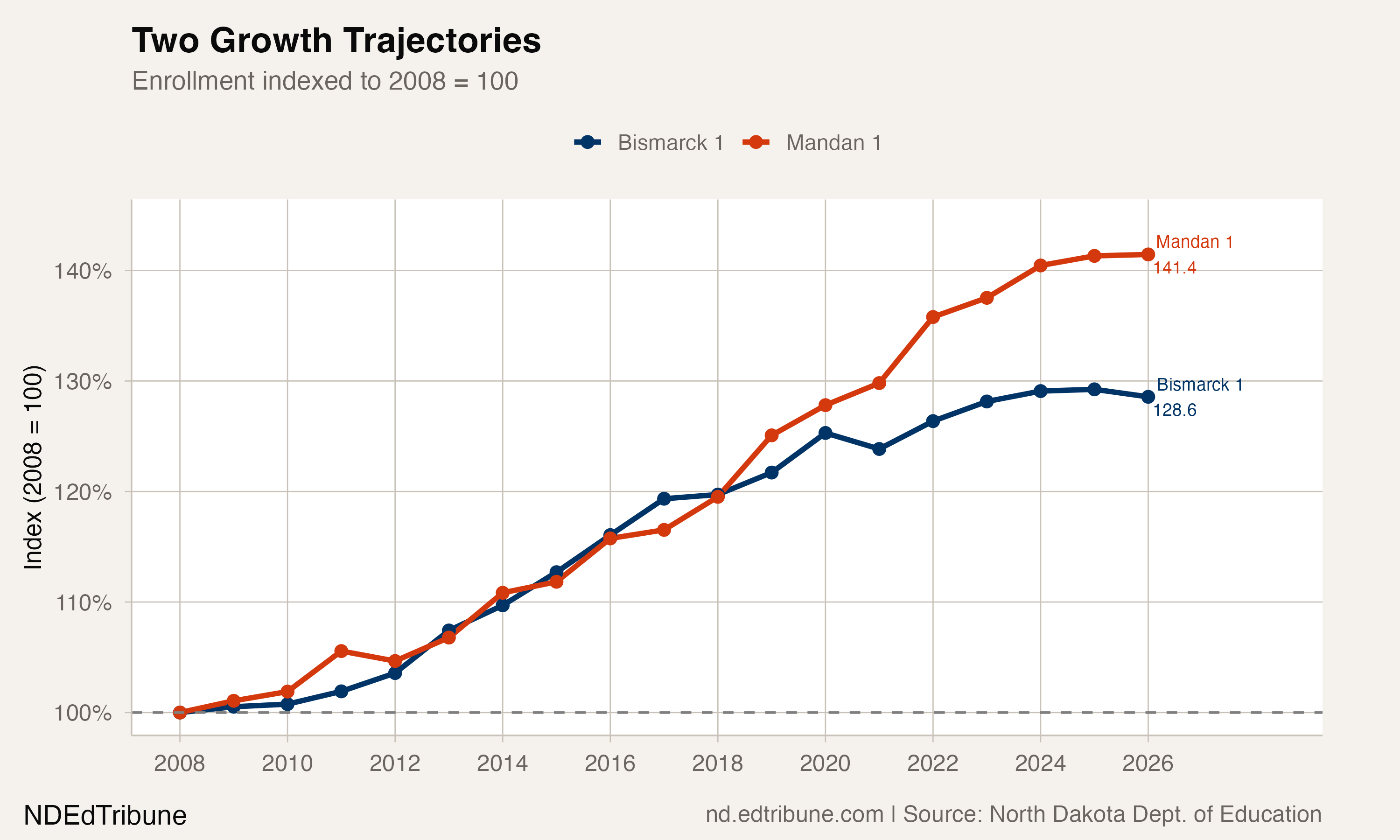
The combined number hides a split. Bismarck↗ET peaked at 13,749 students in 2025 and fell to 13,677 in 2026, losing 72. It has grown just 2.6% since 2020. Mandan↗ET, across the river, hit an all-time high of 4,399 in 2026, up 10.7% over the same stretch. Mandan's share of the corridor has crept from 22.6% in 2008 to 24.3%.
Since COVID, the gap in momentum has widened. Mandan added 424 students from 2020 to 2026; Bismarck added 348. In proportional terms, Mandan grew at four times Bismarck's rate. A new $94.5 million Mandan High School opened in fall 2024, built for roughly 1,400 students. Mandan was planning for continued growth. Bismarck was already leveling off.
What the kindergarten numbers are saying
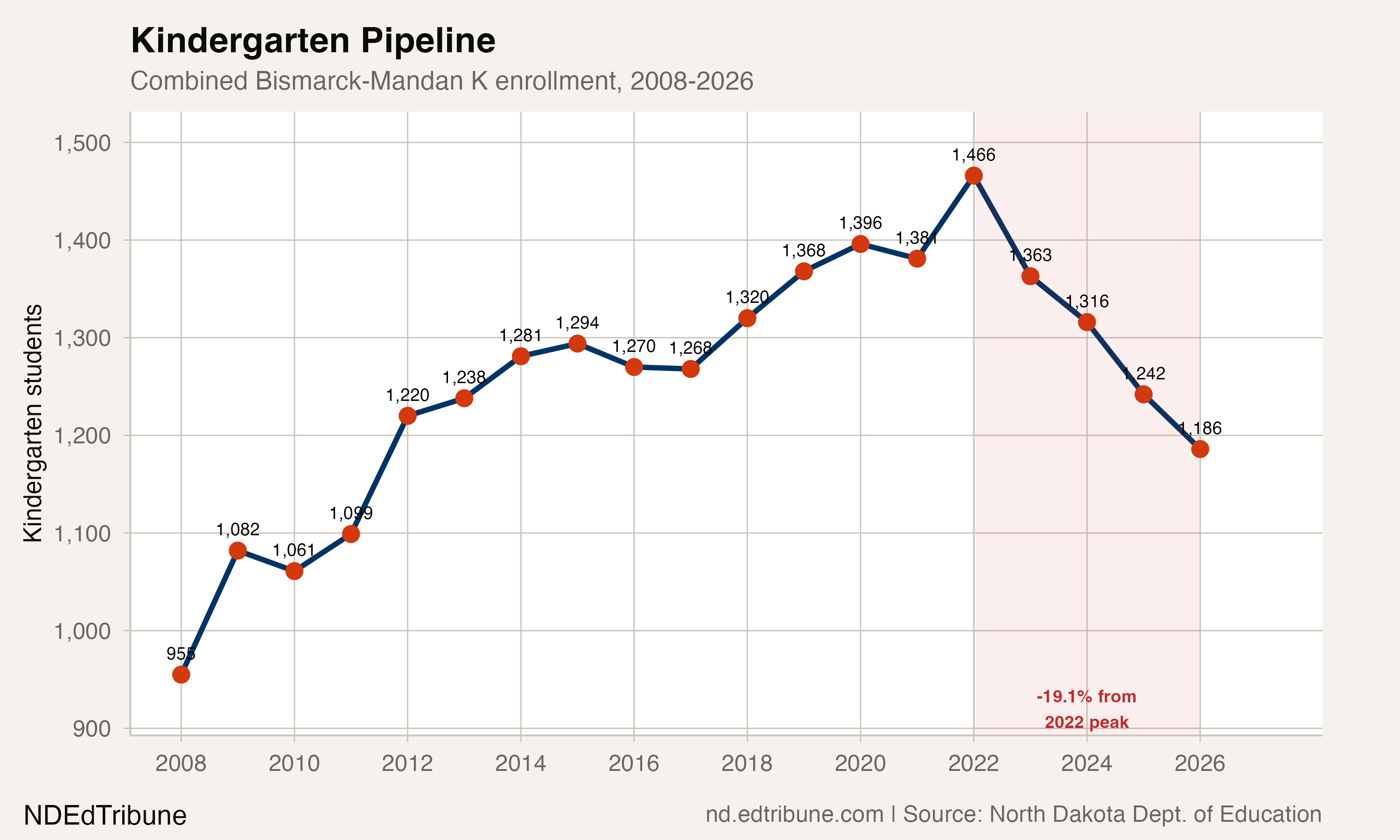
The corridor's deceleration is most visible in kindergarten. Combined K enrollment peaked at 1,466 in 2022 and has fallen every year since, reaching 1,186 in 2026. That is a 19.1% drop in four years. Bismarck's kindergarten class has been hit hardest: 1,096 kindergartners in 2022, 885 in 2026, a decline of 211 students, or 19.3%.
Mandan's kindergarten enrollment has also softened. After peaking at 370 in 2022, it fell to 301 in 2026, an 18.6% decline.
The most likely explanation is demographic. North Dakota's birth rate has fallen 35% since 2016, from roughly 17 births per 1,000 residents to about 11. David Flynn, an economics professor at the University of North Dakota, told the Grand Forks Herald the decline reflects economic uncertainty, rising costs, and changing norms around family size.
"This really does seem to be a broader, more systemic type of issue for the state of North Dakota." -- Grand Forks Herald, Oct. 2025
Children born in 2016, when the birth rate began its decline, entered kindergarten in 2021 or 2022. The K enrollment peak in 2022 aligns with this timeline. If the birth rate remains near its current level, K classes in the corridor are unlikely to recover for years.
Meanwhile, the corridor's upper grades are still growing. Combined 12th-grade enrollment reached 1,356 in 2026, up 19.6% from 1,134 in 2008. Bismarck's high school enrollment (grades 9-12) grew from 3,476 to 4,280 over the period, even as K-8 flattened. The boom-era kindergarten cohorts are aging through the secondary grades, propping up aggregate totals even as the incoming pipeline weakens.
Three eras of growth
From 2008 to 2013, the oil boom drew families into central North Dakota. The corridor added roughly 200 students per year. From 2013 to 2020, growth picked up to 365 per year as both districts built new schools and subdivisions spread on both sides of the river. Since 2020, the average has dropped to 129, and the year-by-year numbers tell the story: +454 in 2022, +243 in 2023, +191 in 2024, +44 in 2025, -68 in 2026.
The corridor still accounts for 15.5% of North Dakota's total enrollment. But its share of statewide growth has become erratic. In 2024, the corridor captured half of the state's net enrollment gain. In 2025, it captured just 5.3%. In 2026, both the corridor and the state lost students.
West Fargo and the question of who is largest
While Bismarck's growth has slowed, West Fargo↗ET has continued to accelerate. In 2008, Bismarck enrolled 4,459 more students than West Fargo. By 2026, that gap had narrowed to 466, with Bismarck at 13,677 and West Fargo at 13,211. West Fargo has grown 113.8% since 2008, more than quadrupling its rate of growth relative to Bismarck's 28.6%.
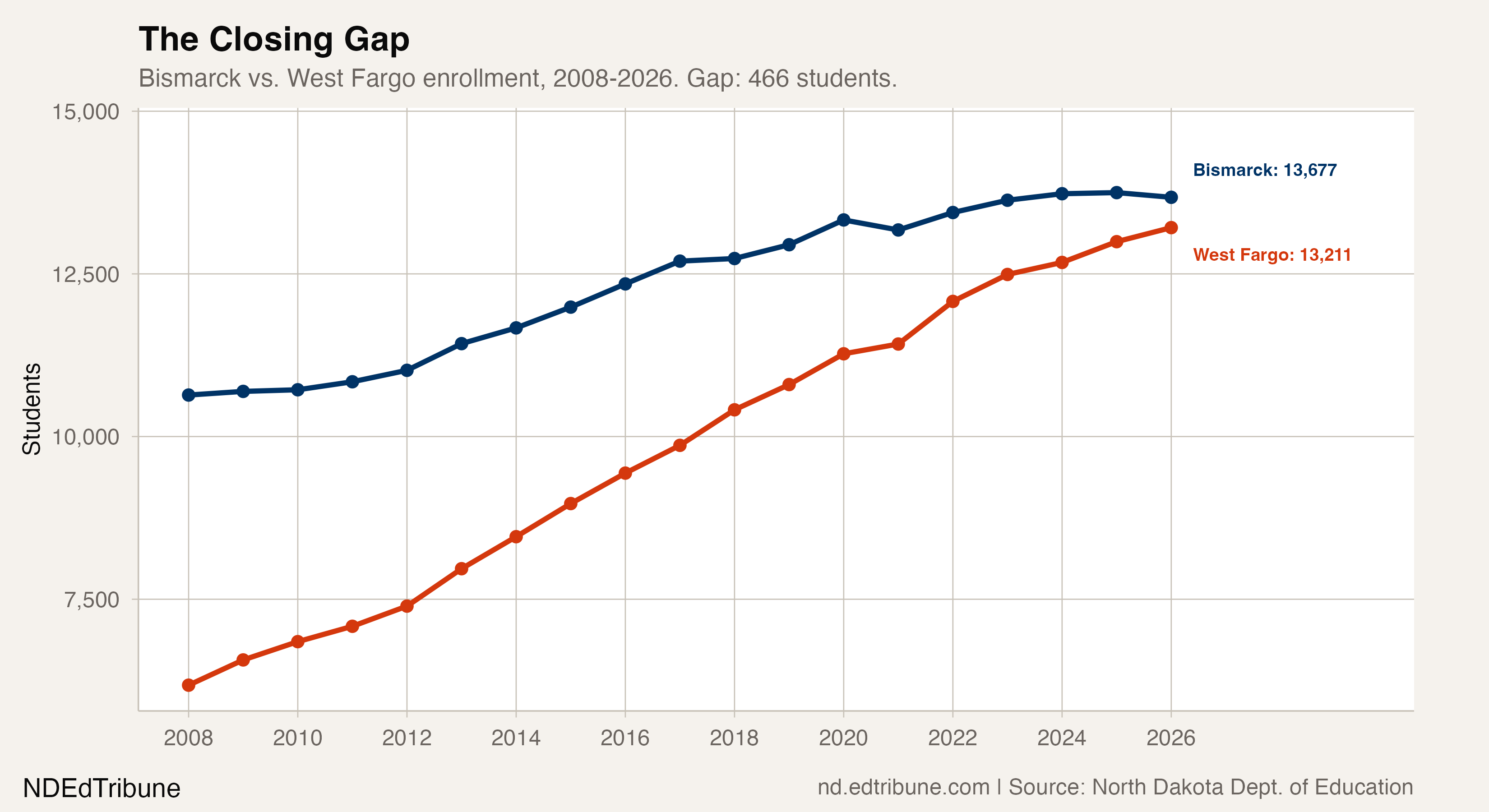
Robert Schwarz, CEO of enrollment consultant RSP & Associates, told InForum that the two districts are "neck and neck." West Fargo's growth has been powered by rapid housing development in the Horace area south of the city, and the completion of the Fargo-Moorhead Diversion project could unlock space for roughly 8,000 additional housing units over the next decade.
"You guys are neck and neck." -- Robert Schwarz, RSP & Associates, InForum
Over the last three years, West Fargo has added an average of 240 students per year while Bismarck has averaged 15. If those rates hold, West Fargo would surpass Bismarck as North Dakota's largest district within two years. Bismarck has held that title for the entire 19-year span of the enrollment dataset.
Graduation rates: steady but not growing
Bismarck's four-year graduation rate peaked at 91.5% in 2019 and has since declined to 84.5% in 2024, even as the graduating cohort grew from 924 to 1,057 students. Mandan's graduation rate has been more volatile, ranging from 78.8% to 87.9% over the last 12 years, with the most recent year (2024) at 85.3%.
The graduation data cannot explain why rates have dipped. Without demographic breakdowns in the enrollment data, it is impossible to distinguish whether the decline reflects a changing student body composition, larger cohorts straining capacity, or other factors entirely.
Two buildings, two bets
Mandan opened a $94.5 million high school in fall 2024, built for 1,400 students -- capacity for growth the kindergarten pipeline may no longer deliver. Across the river, Bismarck's enrollment fell for the first time outside a pandemic year, and the district's graduation rate has slid 7 points since 2019 even as it remains the state's largest.
The corridor still educates 15.5% of North Dakota's students. But its combined kindergarten class -- 1,186, down from 1,466 four years ago -- will be moving through those new and old buildings for the next 12 years. Mandan's shiny hallways were designed for an era that may have already peaked in 2022. Bismarck's aging ones were built for an era that certainly did.
Detailed code that reproduces the analysis and figures in this article is available exclusively to EdTribune subscribers.
Discussion
Sign in to join the discussion.
Loading comments...