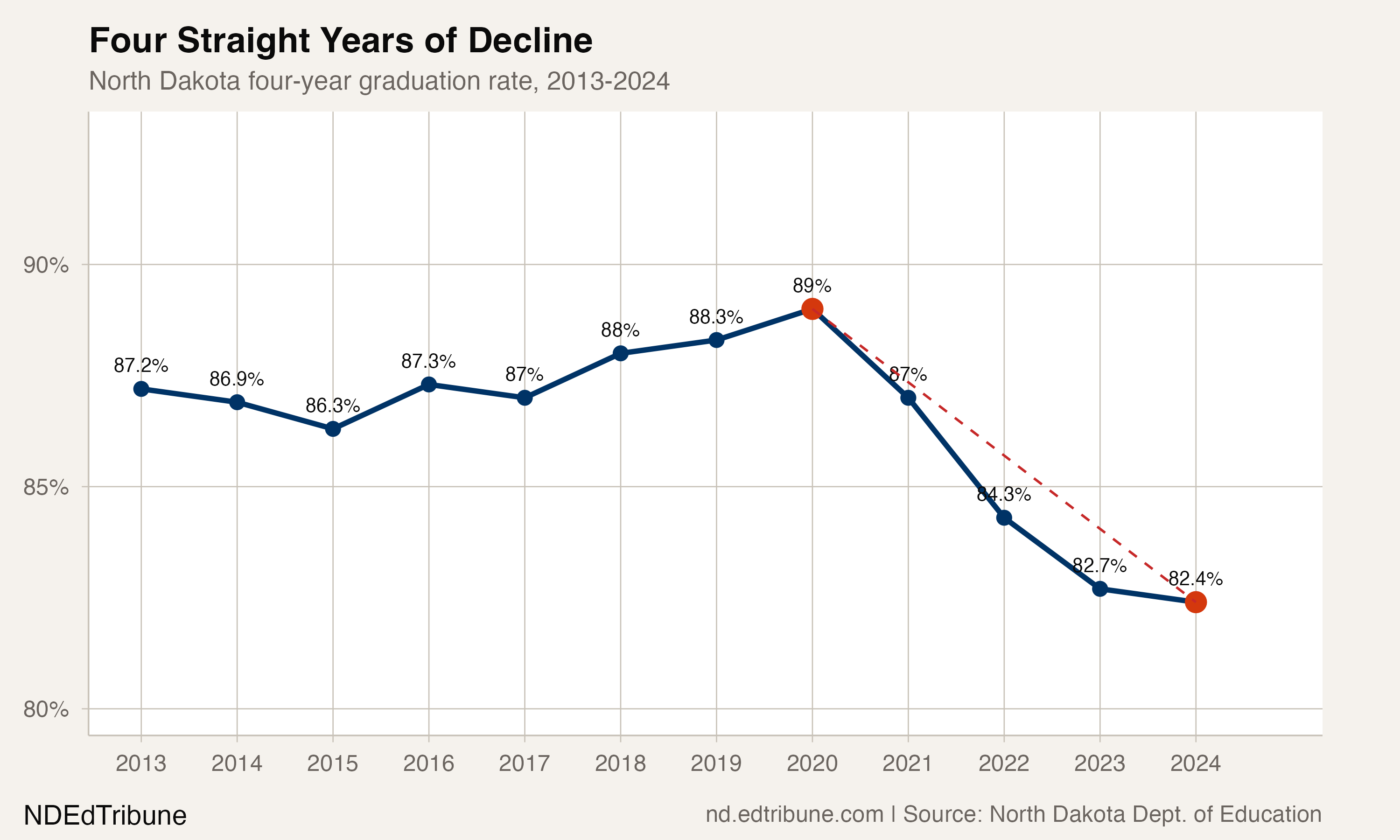
North Dakota graduated 89.0% of its high school seniors in 2020. Four years later, that number is 82.4%. The state has not posted a single year of improvement since.
A caveat: the 2020 rate was likely boosted by pandemic-era grading flexibility. But even against the pre-pandemic average of 87-88%, the 2024 rate is 5 points lower. This is not a return to normal.
That 6.6-point drop translates to 1,527 students in the 2024 cohort who did not earn a diploma within four years -- nearly double the 826 non-graduates in 2020. (Some may still graduate in a fifth or sixth year; this is the four-year rate.) The slide came in stages: 2.0 points in 2021, 2.7 in 2022, 1.6 in 2023, and 0.3 in 2024. The pace has slowed, but the direction hasn't changed.
A Bigger Cohort, Not Enough Graduates
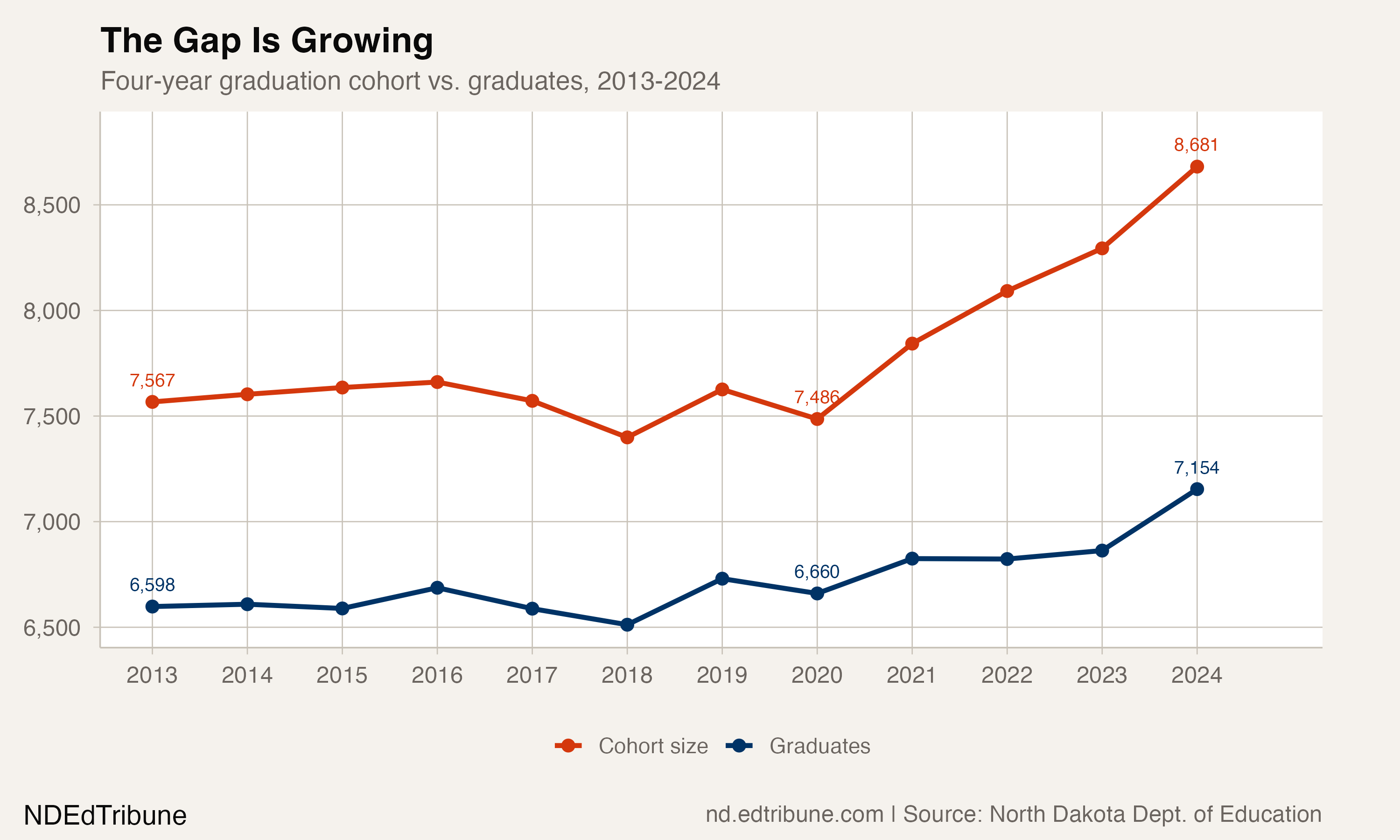
The arithmetic is straightforward. North Dakota's four-year graduation cohort grew from 7,486 students in 2020 to 8,681 in 2024 -- a 16.0% increase. These are the children of the Bakken oil boom: families who moved to western North Dakota in the early 2010s brought young kids who are now finishing high school. Research from Resources for the Future found that elementary enrollment in core oil-producing districts surged 20% above historic highs by 2015, with kindergarten expanding 32% above 1990s levels. Those kindergartners are now seniors.
The number of graduates also grew, from 6,660 to 7,154, up 494 students. But the cohort grew by 1,195. North Dakota is producing more graduates than ever in raw terms while falling behind on the share it gets across the finish line.
The cohort has also diversified sharply. Students of color made up 15.1% of the graduating class in 2013. By 2024, that share hit 26.0%. Black students in the cohort nearly tripled, from 198 to 579. Hispanic students grew from 150 to 542. North Dakota's foreign-born population grew by 123% between 2010 and 2022, the largest proportional increase of any U.S. state, pulled by labor demand in oil, manufacturing, and healthcare. Many of those arrivals were of childbearing age. Their children are now reaching the graduation pipeline.
Nobody Is Spared
Every demographic subgroup has declined since 2020. Not most. All of them.
Black students took the steepest hit: 82.2% to 70.8%, down 11.4 points. English learners fell 14.0 points, from 83.3% to 69.3%, though the EL cohort is small (270 students in 2024), making that rate jumpy. Native American students, already the lowest-performing group, dropped from 72.7% to 63.4%. Economically disadvantaged students fell from 76.9% to 67.6%. Even white students, at 92.2% in 2020, have slid to 87.5%.
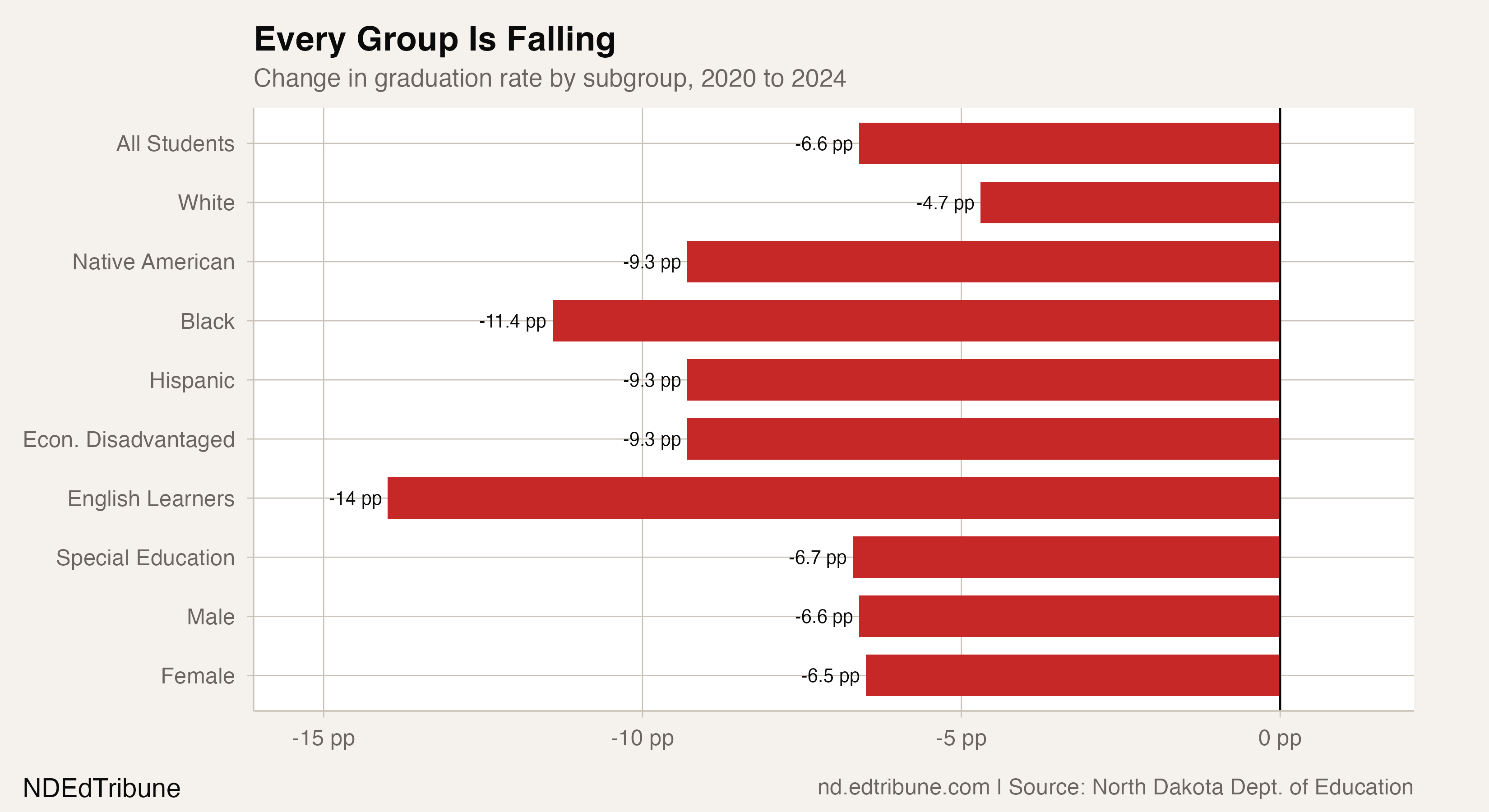
The gender gap follows the same pattern. Male graduation rates fell from 87.6% to 81.0%; female rates from 90.4% to 83.9%. The gap widened from 2.8 points in 2020 to 5.2 in 2022, then narrowed back to 2.9 by 2024. Both are falling roughly in lockstep.
The Equity Gap That Closed Is Opening Again
Between 2013 and 2020, North Dakota made meaningful progress in narrowing the graduation gap between white and Native American students. The gap shrank from 26.0 percentage points to 19.5, a compression of 6.5 points over seven years. Native American rates climbed from 64.3% to 72.7% while white rates also rose, but more slowly.
That progress is gone. By 2024, the gap had widened back to 24.1 percentage points. Native American students lost 9.3 points from their 2020 peak while white students lost 4.7. Nearly half a decade's worth of gains erased in four years.
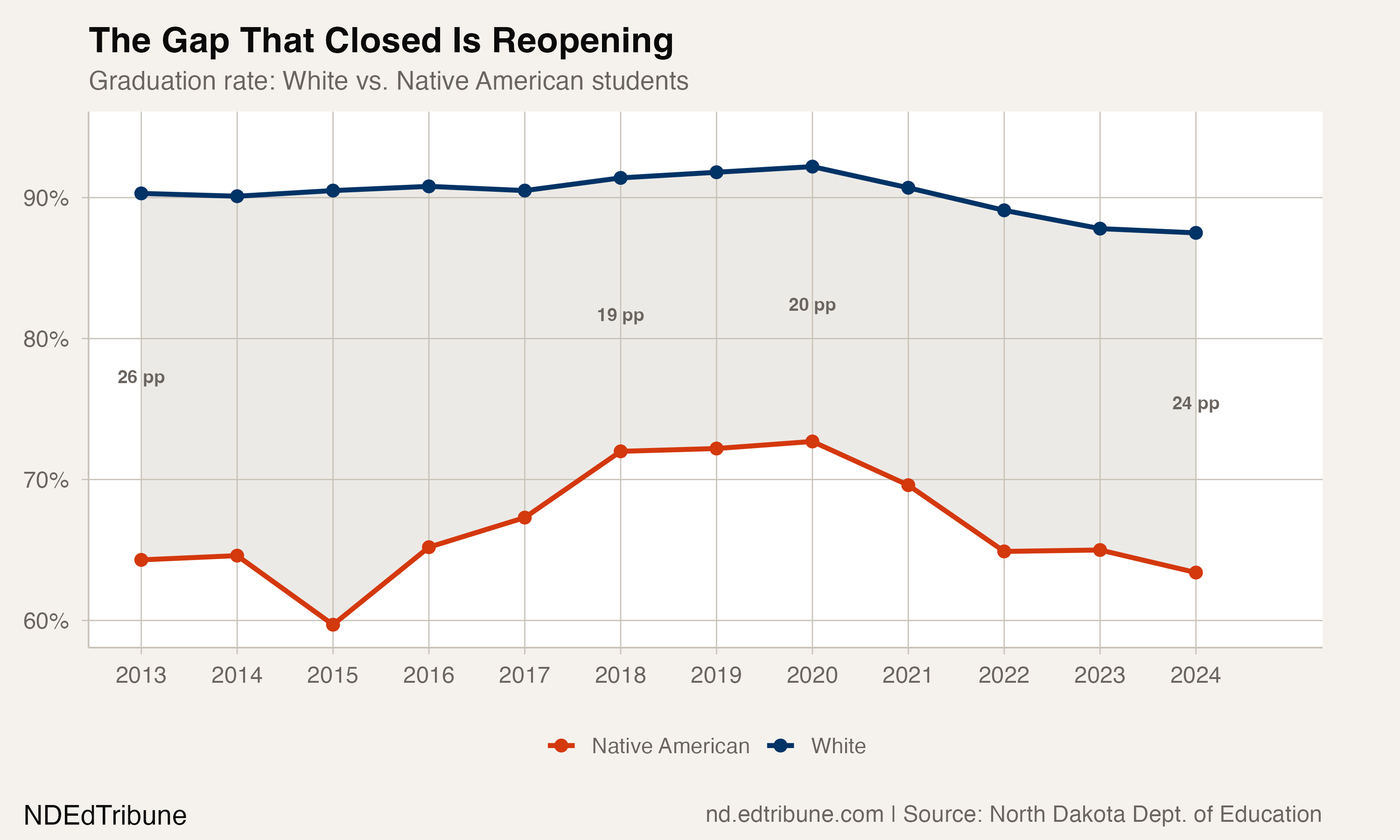
Native American students make up 10.8% of the 2024 graduation cohort, the largest minority group. The 63.4% graduation rate means roughly one in three Native American students in the cohort did not graduate within four years. At Belcourt↗ET, which serves the Turtle Mountain Band of Chippewa, the graduation rate fell from 75.2% to 68.0%.
What Is Behind the Numbers
Three forces are pushing in the same direction.
First, the cohort surge. A system built to graduate roughly 7,500 students a year is now processing over 8,600. If staffing, counselors, and intervention capacity did not grow to match, the rate would fall even if nothing else changed.
Second, chronic absenteeism, which doubled statewide after the pandemic. North Dakota's rate rose from 11% in 2019-20 to 22% in 2021-22, according to Valley News Live reporting on state data. Joe Kolosky, director of approval and opportunity at the North Dakota Department of Public Instruction, attributed the trend partly to the pandemic:
"COVID-19 did have a dramatic impact on attendance rates in the state and the country." Source: Valley News Live, July 2023
West Fargo's chronic absenteeism rate tripled from 5% to 16% between 2019-20 and 2022-23. Fargo's went from 17% to 25%. Students who miss more than 10% of school days accumulate credit deficits that make on-time graduation harder to achieve.
Third, compositional change. A growing share of the cohort comes from groups that have historically graduated at lower rates: Native American, Black, Hispanic, economically disadvantaged, and English learner students. That is not a statement about those students -- it reflects accumulated barriers, from housing instability to language access to chronically underfunded tribal schools. When the share of students facing those barriers grows, the aggregate rate drops even if each group's rate holds steady. In North Dakota, each group's rate is also falling, which compounds the effect.
The Minot Problem
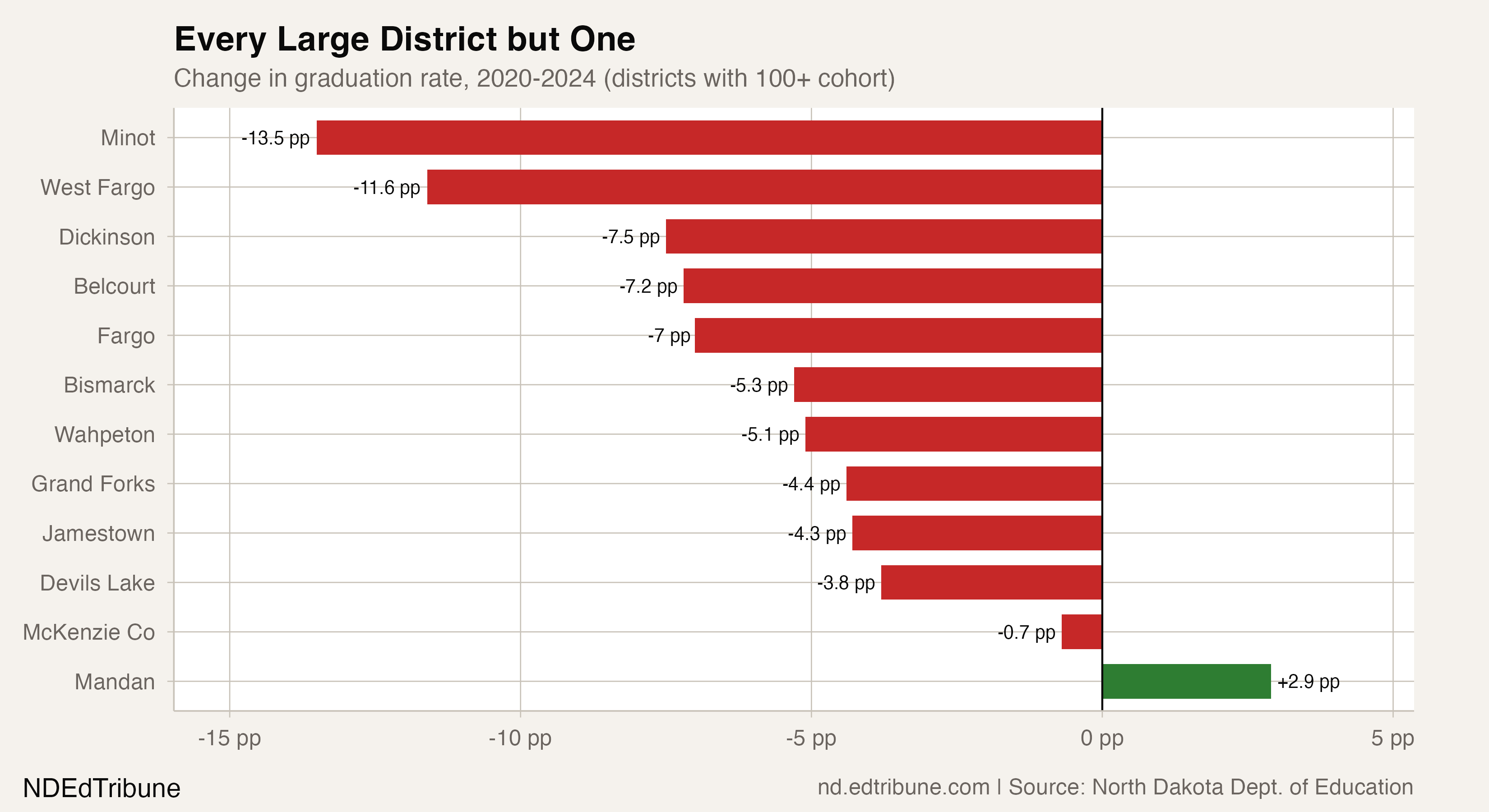
Minot↗ET stands out. Its graduation rate dropped from 83.4% in 2020 to 69.9% in 2024, a 13.5 percentage point decline that is more than double the state average. The 559-student cohort is the fifth largest in the state.
The explanation is partly structural. Minot's Souris River Campus Alternative High School, which serves students who have struggled in traditional settings, graduated just 7.5% of its 120-student cohort in 2024. A separate virtual academy graduated one of its 12 students. Both programs are counted in Minot's district-level rate. Magic City Campus, the traditional high school, graduated at 89.2% -- roughly where it has always been.
The same pattern shows up across the largest districts. West Fargo↗ET fell from 91.5% to 79.9%, an 11.6-point drop, while rapidly adding students and alternative programs. Fargo↗ET dropped from 87.0% to 80.0%. Bismarck↗ET went from 89.8% to 84.5%. Of the 12 districts with cohorts of 100 or more, only Mandan↗ET improved, up 2.9 points.
The Alternative School Complication
Alternative and virtual high schools exist for a reason: they keep students who would otherwise leave the system entirely. But their low graduation rates drag down district-level numbers.
"Students...have lost hope for a positive future." Principal Joe Kalvoda, on students in alternative programs, Buffalo's Fire
Statewide, alternative and virtual programs enrolled roughly 1,238 students in the 2024 graduation cohort -- about 14.3% of the total -- and graduated 59.7% of them. Strip those programs out and the "traditional" graduation rate was 86.2% in 2024, down from 92.3% in 2020. Still falling, by 6.1 points over four years. Alternative school growth explains some of the headline decline, but not most of it.
What to Watch
The decline has not bottomed out. The 2024 rate of 82.4% is the lowest on record in the 12-year dataset. Grade 9 enrollment, which peaked at 9,232 in 2023, means large cohorts will keep arriving at the finish line for several more years.
North Dakota added 1,195 students to its graduation pipeline in four years. It needs proportionally more counselors, credit recovery programs, and alternative pathways to keep up. The $4.8 million Stronger Connections grant targeting chronic absenteeism is a start. But 82.4% means 1,527 students a year entering adulthood without a diploma. For a state with fewer than 780,000 residents, that is a workforce pipeline problem that compounds annually.
Detailed code that reproduces the analysis and figures in this article is available exclusively to EdTribune subscribers.
Discussion
Sign in to join the discussion.
Loading comments...