Correction (May 29, 2026): An earlier version described Minot as the state's fourth-largest district and ranked it 20th among large-cohort districts by graduation rate. Minot is the fifth-largest district, and it ranks 19th of the 22 districts with cohorts of 50 or more. The text has been updated.
McKenzie County↗ET (Watford City) grew 344.8% over the past two decades, from 533 students in 2008 to 2,371 in 2025-26, the steepest enrollment surge of any district in the Bakken oil patch. The boom that turned quiet western North Dakota farm towns into some of the fastest-growing communities in the Great Plains landed harder here than almost anywhere. And in 2024, McKenzie County graduated 85.8% of its senior cohort, well above the statewide average of 82.4%.
That is the number worth studying. McKenzie absorbed the most growth, built a $54 million skills center, hired aggressively, and held its graduation rate above the state line while other oil districts slipped well below it.
Williston Basin↗ET grew 164.6% over the same window, to 5,584 students in 2025-26, and graduated 68.6% of its 2024 cohort. Minot↗ET, home to the state's fifth-largest district and Minot Air Force Base, graduated 69.9%. Dickinson↗ET, the energy hub of southwestern North Dakota, graduated 78.0%. Same boom, same labor market, four very different outcomes. The question this article works through is what McKenzie did with the growth that the others did not.
A statewide slide concentrated in oil country
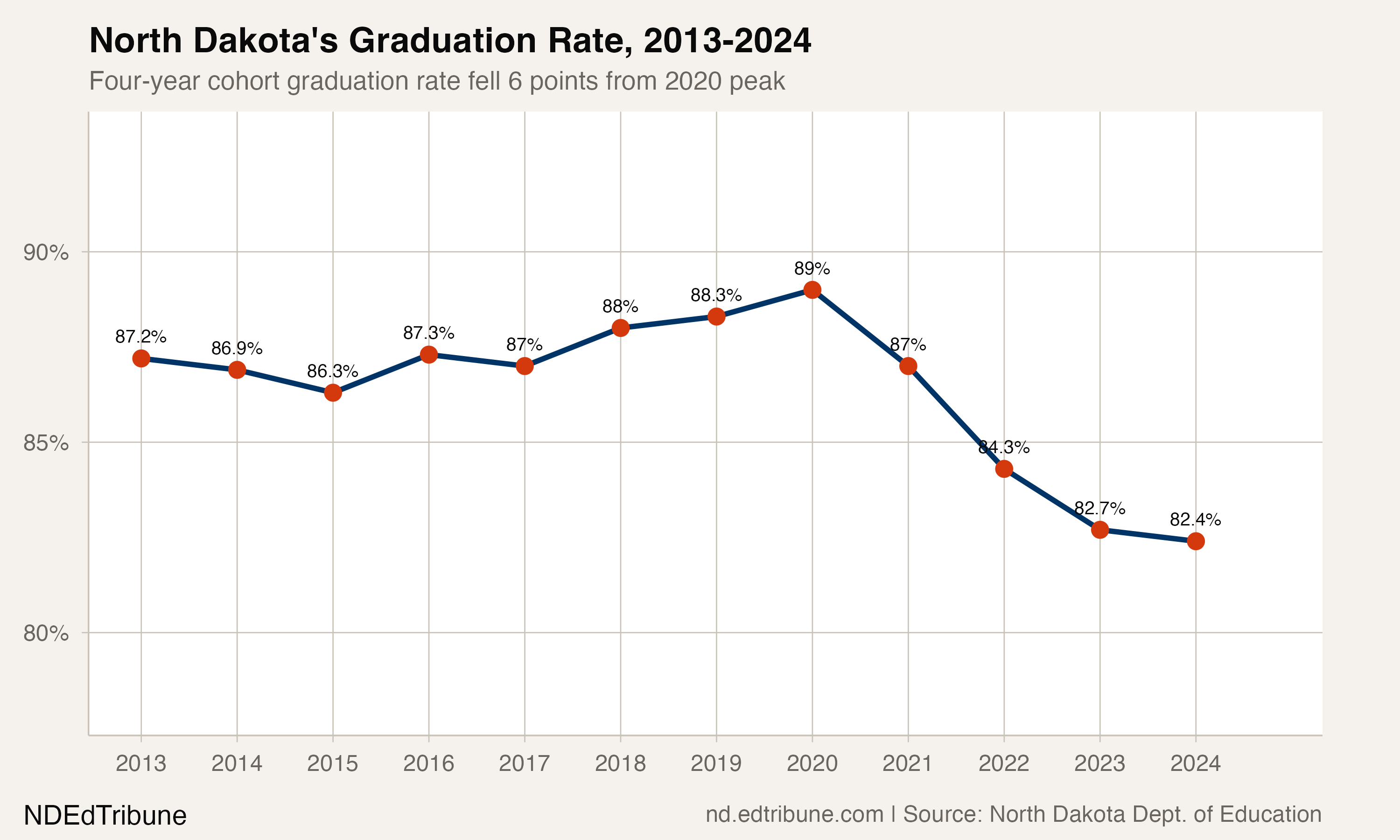
North Dakota's four-year graduation rate peaked at 89.0% in 2020. It has fallen every year since, landing at 82.4% in 2024. The decline is broad: 26 of 35 large districts (those with cohorts of at least 30) saw rates drop between 2019 and 2024. Only nine improved.
But the size of the drop varies wildly. Bismarck fell 7.0 percentage points, from 91.5% to 84.5%. Fargo fell 4.0 points, from 84.0% to 80.0%. Those declines track the statewide trend: 896 non-graduates in 2019 compared to 1,527 in 2024, an extra 631 students per year leaving school without a diploma.
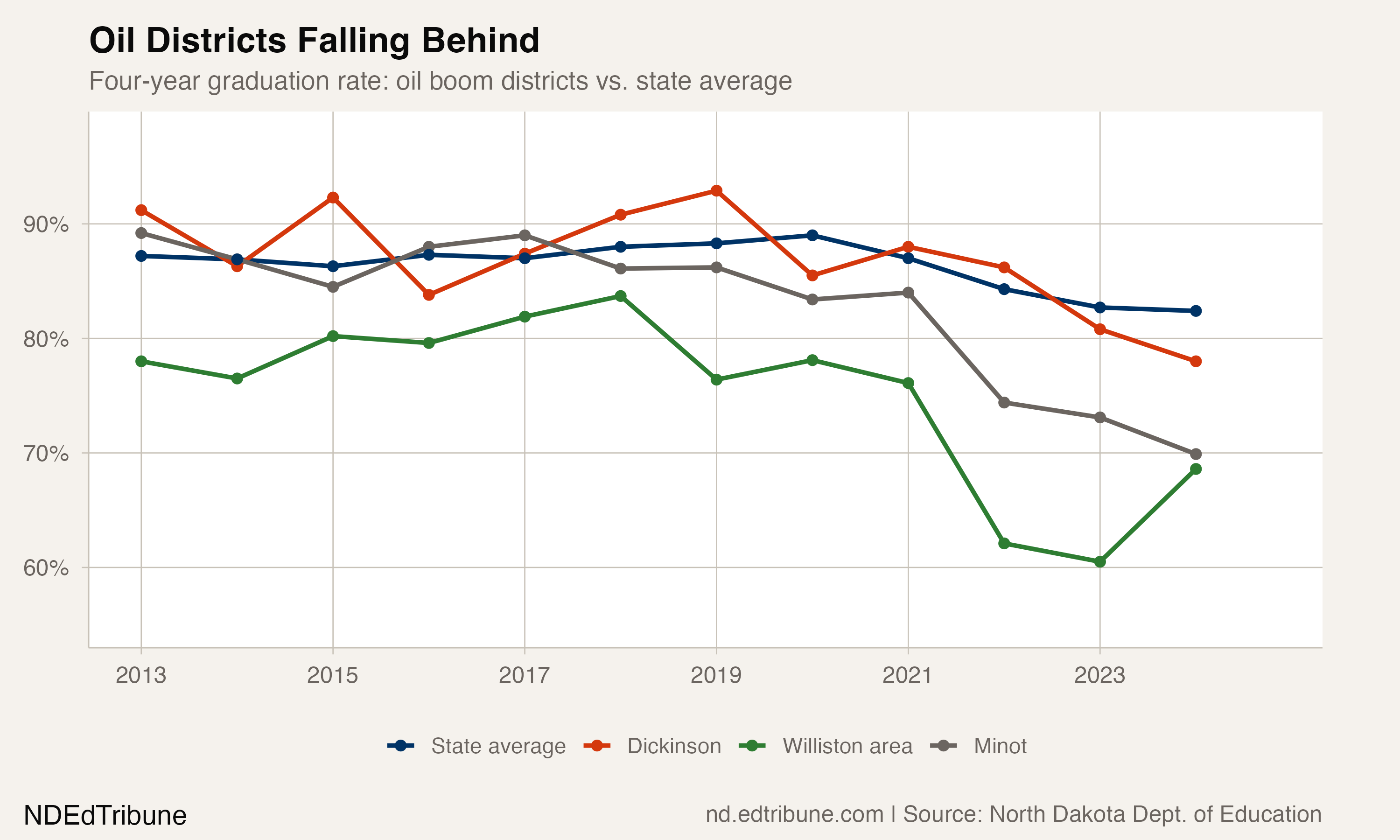
The oil districts fell much harder. Minot dropped 16.3 points in five years, from 86.2% to 69.9%. Dickinson dropped 14.9 points, from 92.9% to 78.0%. Williston has not cracked 80% in any year with available data. The former Williston 1 and Williams County 8 districts merged into Williston Basin 7 in 2021; looking at the combined entity, the trajectory has been downward: 76.4% in 2019, 78.1% in 2020, and 68.6% in the most recent cohort. (The 2022 and 2023 combined figures are distorted by the merger transition, when a small remnant cohort in the old Williston 1 reported near-zero completion while the new district was ramping up.)
More students, fewer diplomas
The paradox: enrollment grew while completion fell. The statewide cohort expanded 13.8% between the classes of 2019 and 2024, from 7,626 to 8,681 students. Much of that growth landed in districts absorbing oil workers' families.
Williston's enrollment rose from 2,110 in 2008 to 5,584 in 2026. McKenzie County↗ET (Watford City) grew 344.8% over the same period, from 533 to 2,371. Dickinson added 1,562 students, a 62.0% increase.
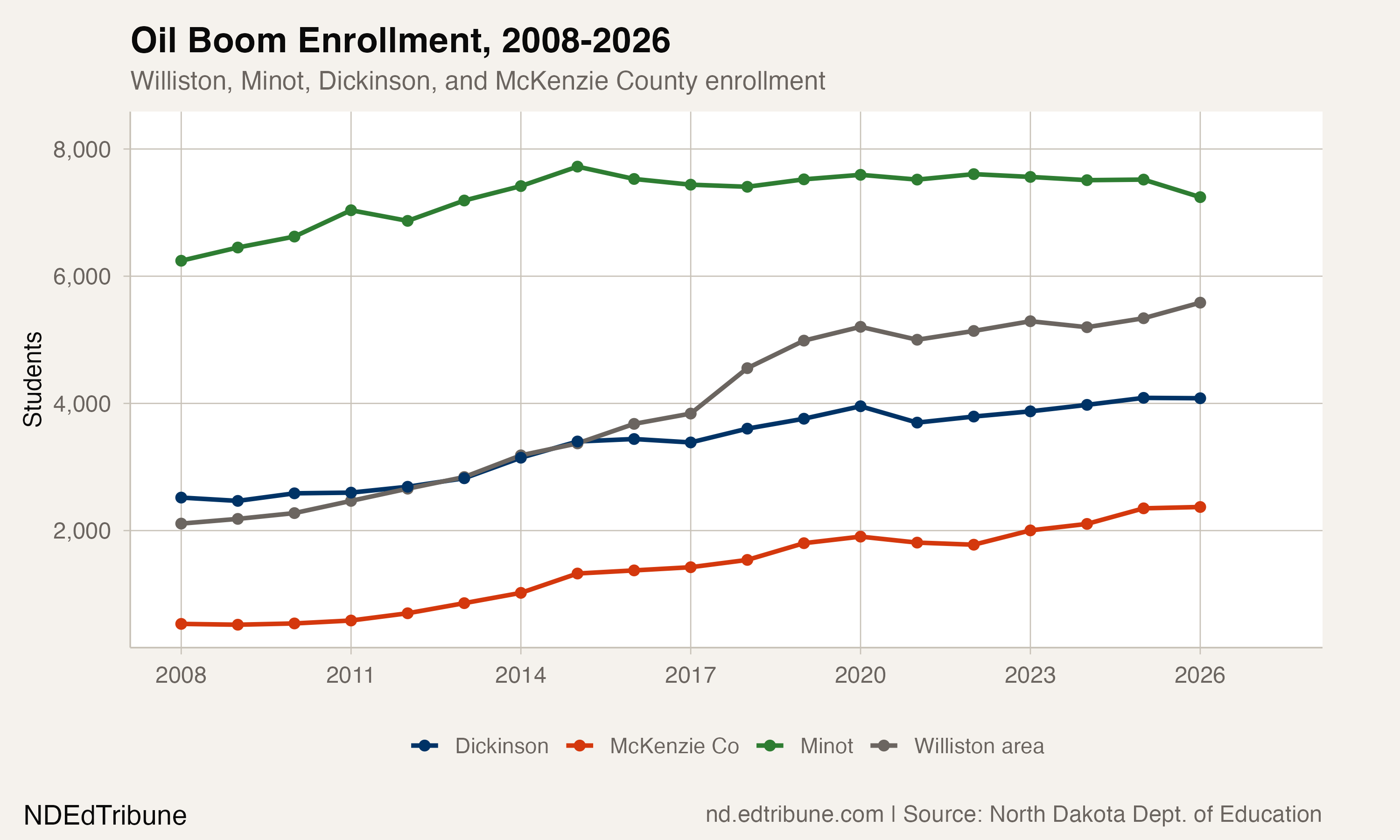
Here the McKenzie comparison sharpens. McKenzie County saw the largest enrollment growth of the group, yet its 2024 graduation rate stood at 85.8%, well above the state average. What separates McKenzie from Williston or Minot is not the scale of growth but something about how the growth was absorbed.
Minot's cohort size tells part of the story. Its graduating class grew from 479 in 2019 to 559 in 2024, a 16.7% increase. But that growth did not produce proportional completions. The district graduated 413 students in both 2019 and 2020. By 2024, despite 80 more students in the pipeline, only 391 graduated. The additional students did not become additional graduates.
Who is not graduating
The subgroup data in Williston Basin's 2024 cohort shows steep internal gaps. White students, who make up 225 of the 366-student cohort, graduated at 73.3%, already well below the state average for white students (87.5%). Hispanic students graduated at 52.6% (30 of 57). Native American students graduated at 56.8% (21 of 37). Students experiencing homelessness graduated at 45.8% (11 of 24). Students who are economically disadvantaged graduated at 50.7% (37 of 73).
In Minot, the gaps are sharper. Native American students graduated at 25.9% in 2024, 15 out of 58. That rate has collapsed from 85.7% in 2017 (18 of 21) as the cohort nearly tripled in size. Students who are economically disadvantaged in Minot graduated at 53.4%.
One bright spot within Minot's data: military-connected students, many of them from Minot Air Force Base families, graduated at 89.1% (49 of 55), the highest subgroup rate in the district and above the state average.
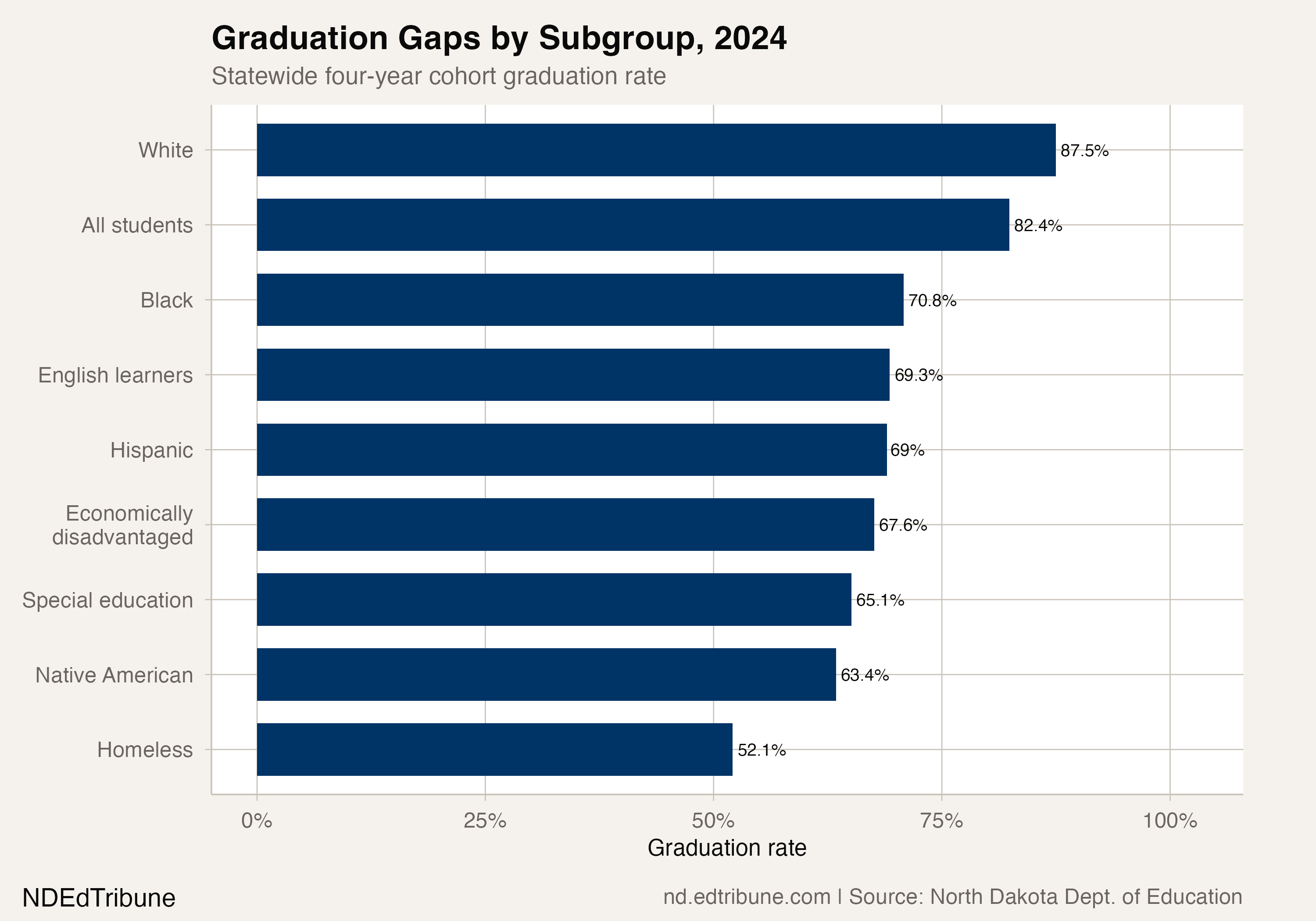
Statewide, the pattern holds. White students graduated at 87.5%. Native American students graduated at 63.4%, the lowest of any racial group. Students who are economically disadvantaged graduated at 67.6%, down from 76.5% in 2019.
Transient families and the boom-bust cycle
The Bakken oil fields created a labor market where an entry-level rig worker could pull six figures. That wage pull has historically been the top concern for schools: students leaving for oilfield work before finishing high school. A 2016 Resources for the Future study found that administrators in oil-producing districts "did not see a spike in high school dropout rates during the shale boom," attributing it to modern drilling companies' preference for workers with at least a diploma or GED.
But the study flagged a different problem as the bigger concern: student mobility. Schools reported families arriving and leaving mid-year, following the seasonal rhythm of drilling. Teachers described students "leaving in the fall only to return in the spring when drilling resumed." That churn does not show up in October enrollment counts but disrupts instruction, erodes relationships, and makes four-year completion harder to sustain.
A 2025 study published in Applied Economics, titled "Bakken out of education?", found that while the boom did not reduce high school graduation rates in its early phase, it significantly decreased four-year college enrollment in core oil counties, suggesting the economic pull of the oilfields affects educational trajectories even among students who do earn a diploma.
The current data suggests the graduation hit may have arrived on a delay. The students in the 2024 graduation pipeline were born around 2006, during the early boom. They spent their entire school careers in districts dealing with rapid demographic change, overcrowded buildings, and high teacher turnover.
Minot's compounding pressures
Minot's decline stands out because the city is not a one-industry town. It hosts Minot Air Force Base, a regional university, and a medical center. Yet its graduation rate has fallen more steeply than any other large district: 89.2% in 2013 to 69.9% in 2024, a 19.3-point collapse.
The Native American cohort in Minot's graduating class has grown from 11 students in 2013 to 58 in 2024. The city draws Native American families from the Turtle Mountain and Fort Berthold reservations, and some enroll at Souris River Campus, an alternative high school within the district. A Buffalo's Fire investigation found that Souris River Campus had a 59% American Indian dropout rate in 2023-24. With only 55 students enrolled, individual outcomes swing the statistics heavily, but the pattern is consistent with a district absorbing a growing population of high-mobility students without a proportional graduation response.
"Classrooms here are smaller, so they should have more one-on-one with teachers." Brian Aufforth, principal of Souris River Campus, quoted in Buffalo's Fire, Nov. 2024
The statewide data has a blind spot here. North Dakota's graduation data does not include a mobility or transiency indicator, so there is no way to separate students who started ninth grade in the same district from those who transferred in mid-career. In oil districts where mid-year churn is a defining feature, the four-year cohort rate may be measuring something different from what it measures in stable communities.
Where the oil districts land in the ranking
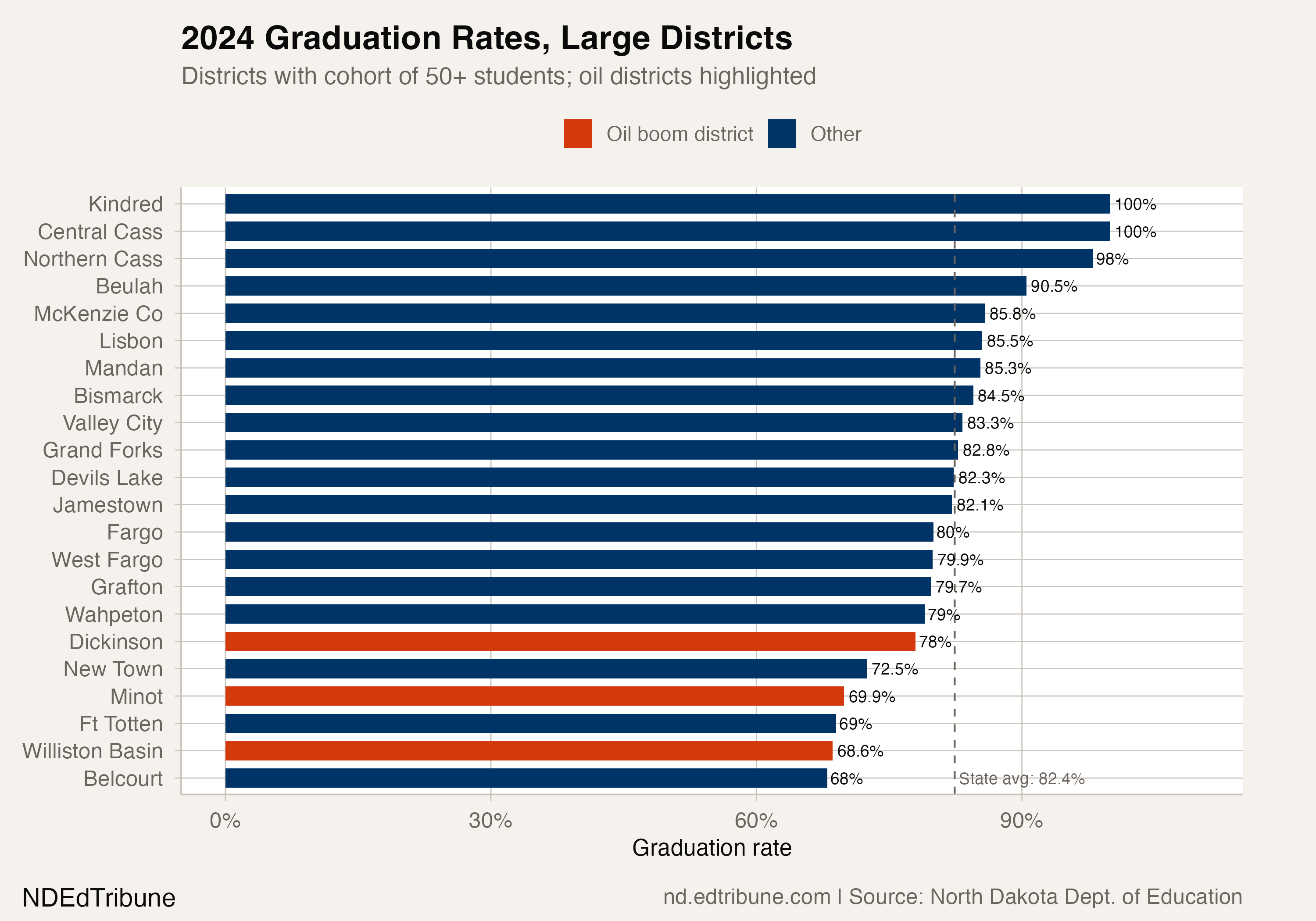
McKenzie County, 90 miles west of Minot, grew 344.8% and still graduates 85.8% of its seniors. It built a $54 million skills center and hired aggressively. That places it comfortably in the upper half of the state's graduation table despite carrying the heaviest growth of any oil district.
The other three sit lower. Among North Dakota's 22 districts with cohorts of 50 or more, Dickinson ranks 17th at 78.0%, Minot ranks 19th at 69.9%, and Williston Basin ranks 21st at 68.6%. Williston, 60 miles north of Watford City, grew 164.6% and graduates 68.6%. Minot, with an air force base and a regional university, graduates 69.9%. The data says growth alone does not determine outcomes. Something separates the districts that absorbed the boom and the districts that were absorbed by it, and McKenzie is the clearest example of the first kind.
In Minot, 15 of 58 Native American seniors earned a diploma in 2024. At Souris River Campus, the alternative school meant to be a safety net, the American Indian dropout rate was 59%. Principal Brian Aufforth says smaller classes should mean more one-on-one time. The numbers say it has not worked that way.
Detailed code that reproduces the analysis and figures in this article is available exclusively to EdTribune subscribers.
Discussion
Sign in to join the discussion.
Loading comments...