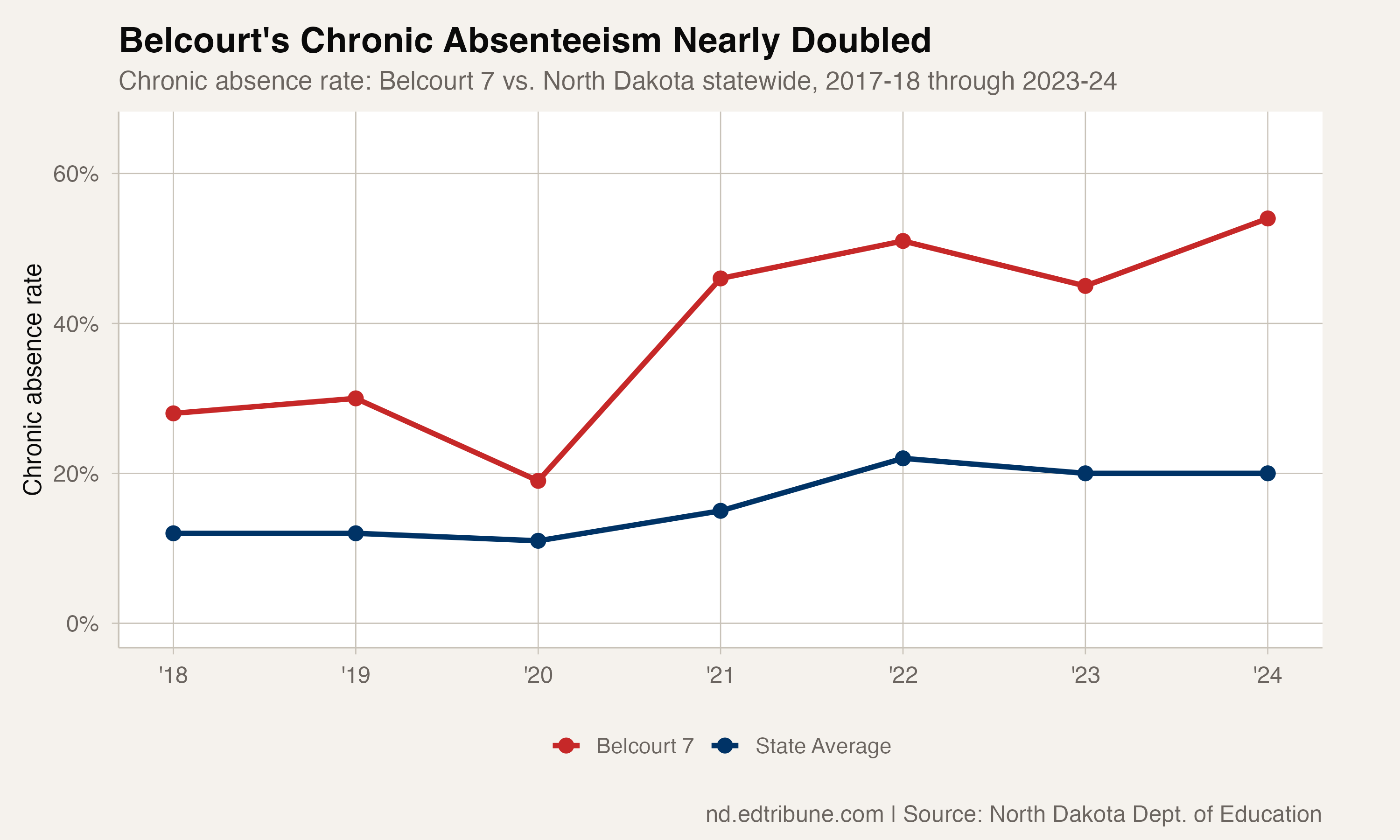
Correction (July 23, 2026): An earlier version misstated the year-by-year path of Belcourt's chronic absence rate. The actual series is 28% in 2018, 30% in 2019, 19% in 2020, 46% in 2021, 51% in 2022, 45% in 2023, and 54% in 2024. The prior version's figures for 2020, 2021, and 2022 were wrong.
Belcourt 7 serves students on the Turtle Mountain Band of Chippewa reservation in north-central North Dakota, one of the most densely populated reservations in the country. In 2017-18, the district reported a 28% chronic absenteeism rate. By 2023-24, that number had nearly doubled to 54%.
More than half of all students in the district now miss more than 10% of school days.
A reversal within a reversal
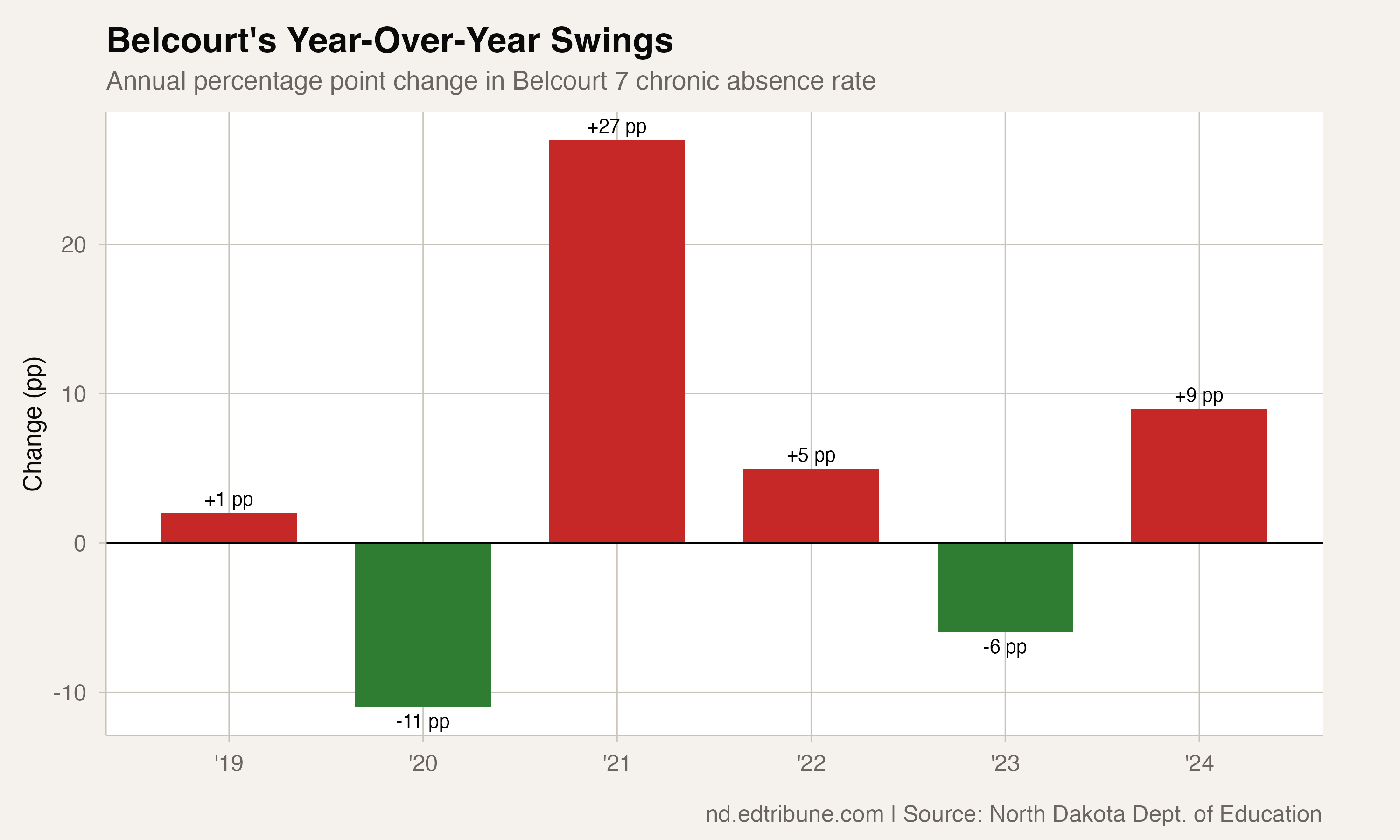
The trajectory is not a simple upward line. Belcourt's rate held near its starting point through 2019, at 28% and then 30%, before dropping to 19% in 2020. It surged to 46% in 2021 and peaked at 51% in 2022 during the worst of the pandemic. The rate then improved to 45% in 2023, a move that looked like the beginning of recovery.
Then 2024 happened. The rate jumped 9 percentage points in a single year, from 45% to 54%, erasing the prior year's progress. It was the largest single-year increase the district has recorded since the initial COVID surge.
The state average, by comparison, has been flat at 20% for two consecutive years. Belcourt is moving in the opposite direction.
Inside the schools
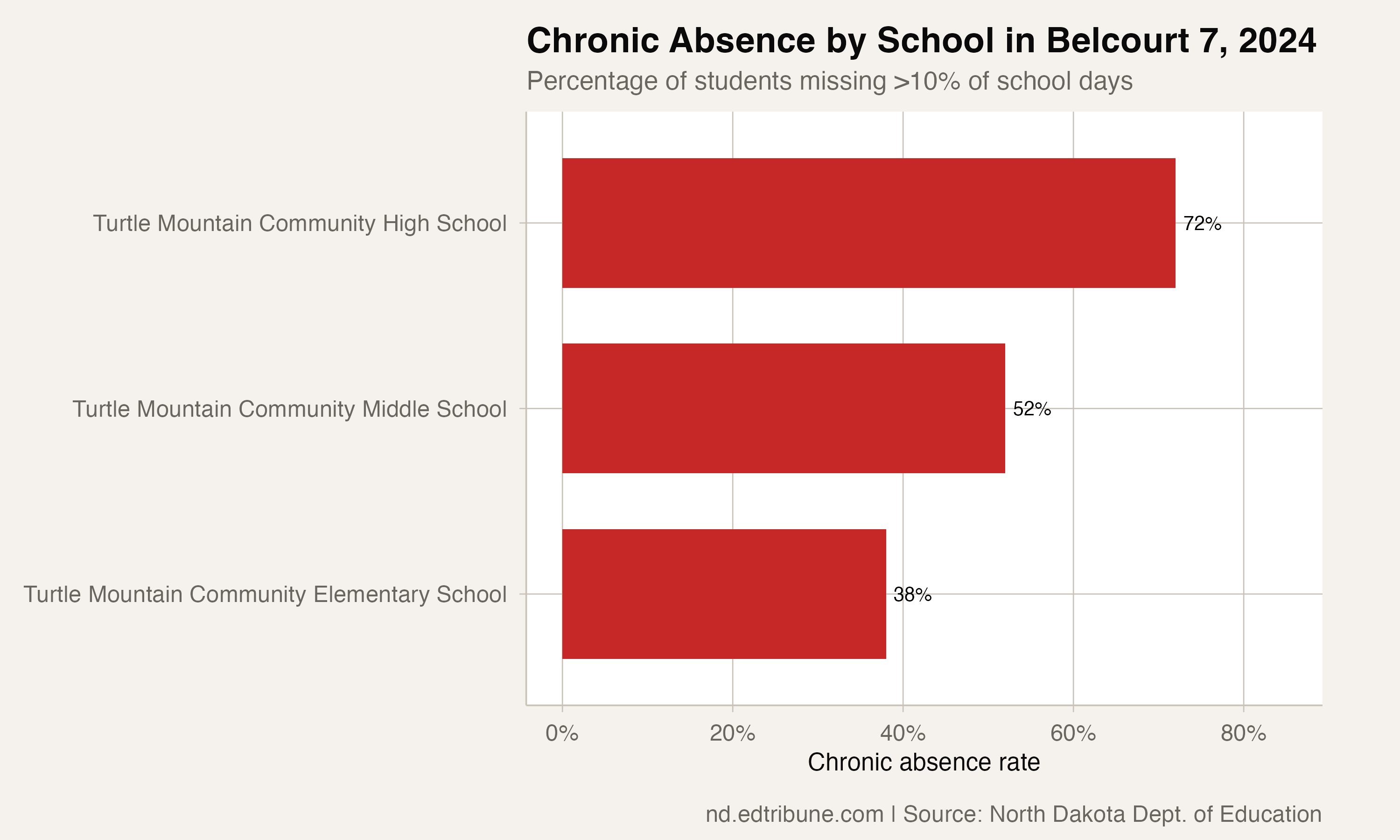
Within Belcourt 7, the crisis is not evenly distributed. Turtle Mountain Community High School has the highest rate, with chronic absenteeism reaching levels where the majority of students are missing significant instructional time. The elementary schools, while lower, still report rates well above the state average.
The school-level data reveals a pattern common in high-absence districts: the rates worsen as students age. By the time students reach high school, the cumulative effect of years of disengagement, combined with the greater autonomy that older students have over their own attendance decisions, produces rates that would be considered emergency-level in most districts.
Reservation context
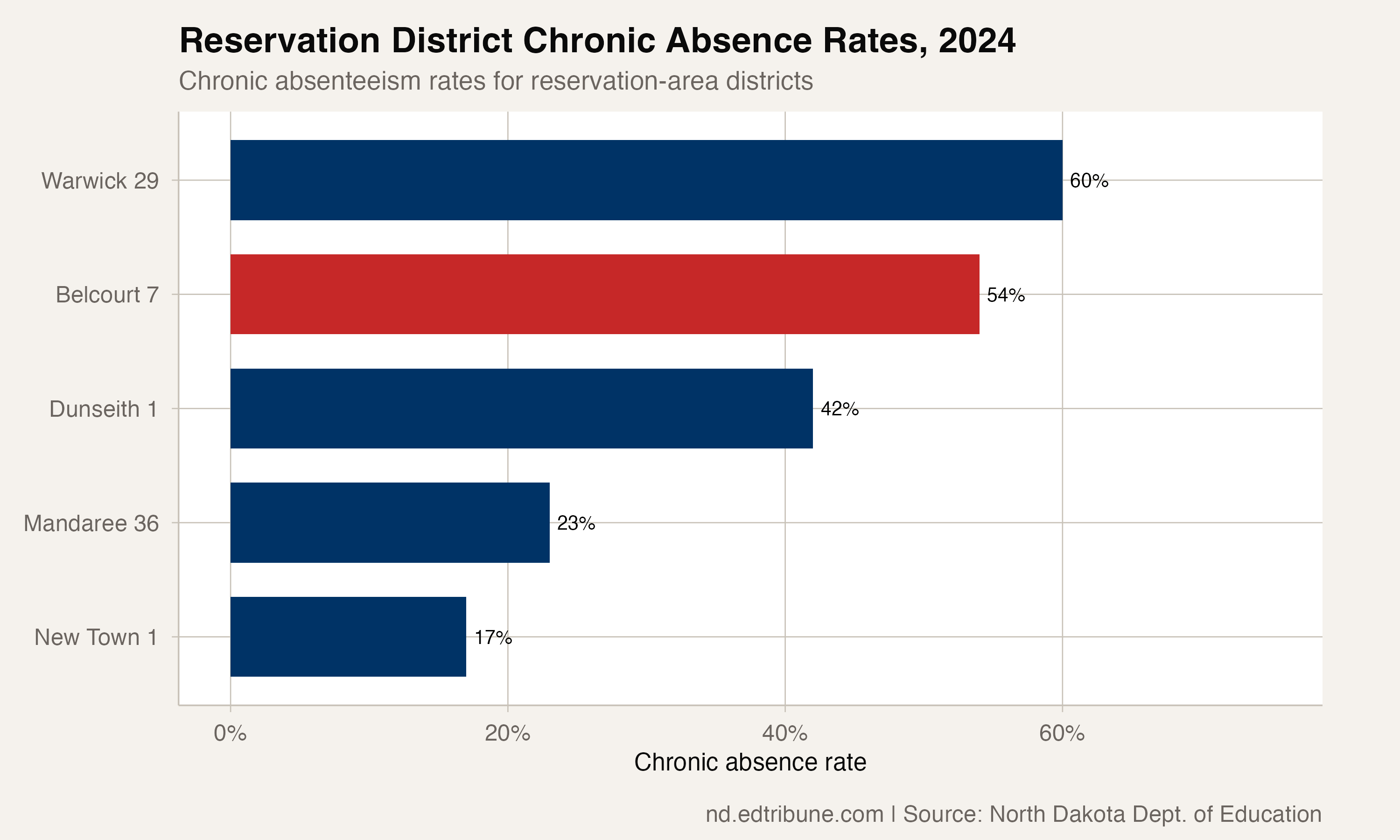
Belcourt is not alone. Across North Dakota's reservation-area districts, chronic absenteeism rates are dramatically elevated. Warwick 29, on the Spirit Lake Reservation, reports a 60% rate, the highest in the state. Fort Yates and other reservation-adjacent districts face similar challenges.
The shared factors are well documented. Tribal communities kept students out longer during COVID due to higher health vulnerability, a decision rooted in the disproportionate COVID mortality rates in Native American populations. Transportation on reservations, where distances are long and public transit is nonexistent, creates a daily barrier that weather-dependent North Dakota winters make worse. Poverty, health disparities, and intergenerational trauma all compound the challenge.
But Belcourt's 2024 surge demands a more specific explanation. A 9-point increase in a single year, after two years of improvement, suggests something changed. Whether it was a staffing disruption, a policy shift, a community crisis, or simply the exhaustion of whatever momentum had driven the 2022-2023 improvement, the data does not say.
The scale of the gap
The distance between Belcourt and the state average has grown from 16 percentage points in 2018 to 34 points in 2024. Put another way: the state has a one-in-five chronic absence problem; Belcourt has a one-in-two problem.
A 54% chronic absence rate is not a problem that attendance letters and phone calls can solve. It reflects structural conditions -- economic, geographic, and historical -- that require structural responses. For the students on Turtle Mountain, those responses have not arrived.
Detailed code that reproduces the analysis and figures in this article is available exclusively to EdTribune subscribers.
Discussion
Sign in to join the discussion.
Loading comments...