In 2012, nearly every ninth grader in North Dakota made it to senior year. Of the 7,462 students who started high school that fall, 7,427 were still enrolled as twelfth graders four years later -- a 99.5% survival rate. The class of 2015 was, by this measure, almost perfectly intact.
A decade later, the pipeline is broken. Of the 9,232 ninth graders in the class of 2026, only 8,400 reached twelfth grade. That is 832 students gone. The survival rate has fallen to 91.0%, and for the class of 2025 it hit 90.4%. Combine that with a graduation rate that has dropped 6.6 points in four years, and the effective completion rate -- the share of ninth graders who actually get a diploma -- has fallen from 85.9% to 75.1%. One in four ninth graders now fails to graduate on time.
The two leaks
There is no single point of failure. Students are disappearing at every transition.
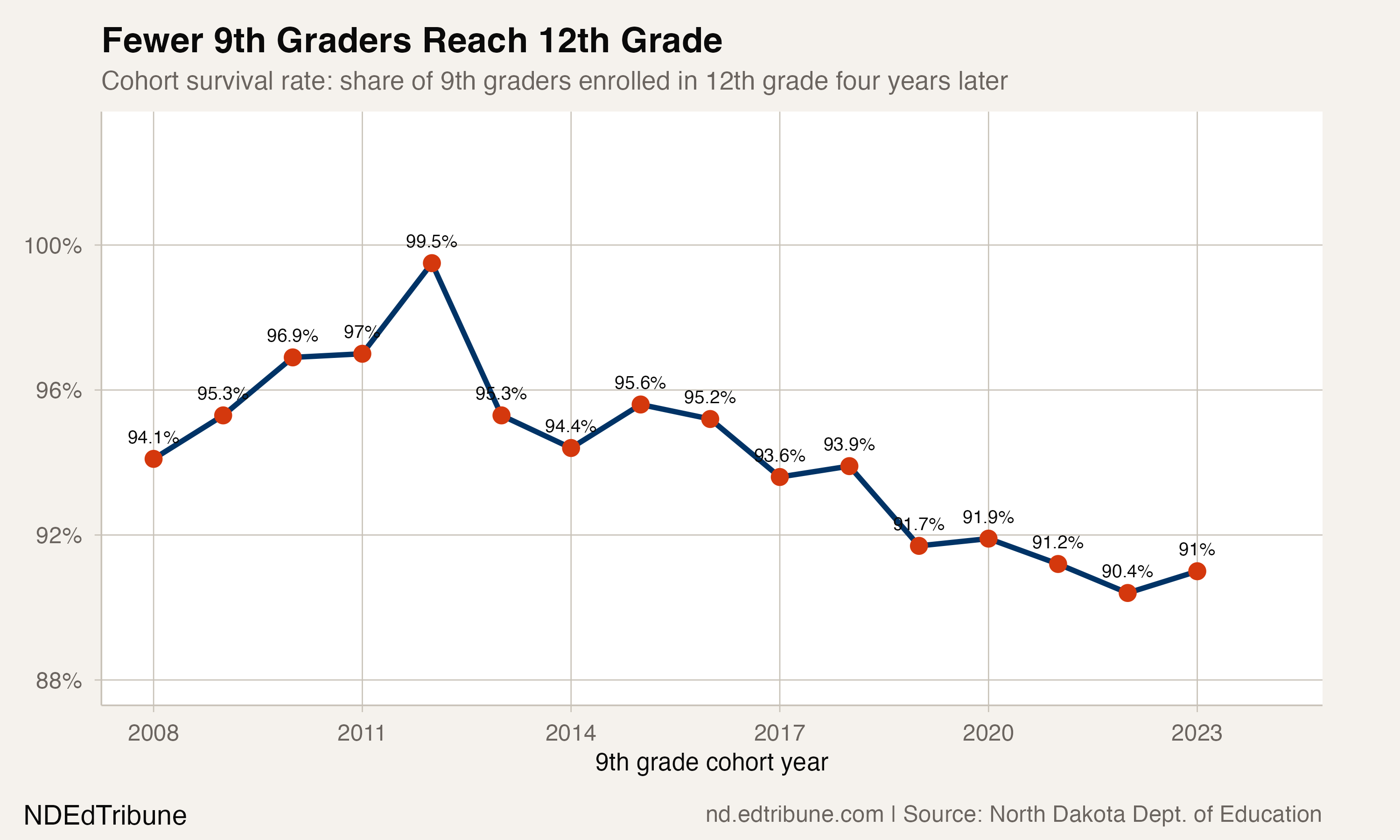
The 9th-to-12th survival rate tells the first half. From 2008 to 2012, it climbed steadily, peaking at 99.5%. Then it reversed. By the 2019-2022 cohorts, it had settled around 91% -- roughly 9% of each entering class gone before senior year. For the 2022 cohort, that was 889 students, more than the entire graduating class of most North Dakota high schools.
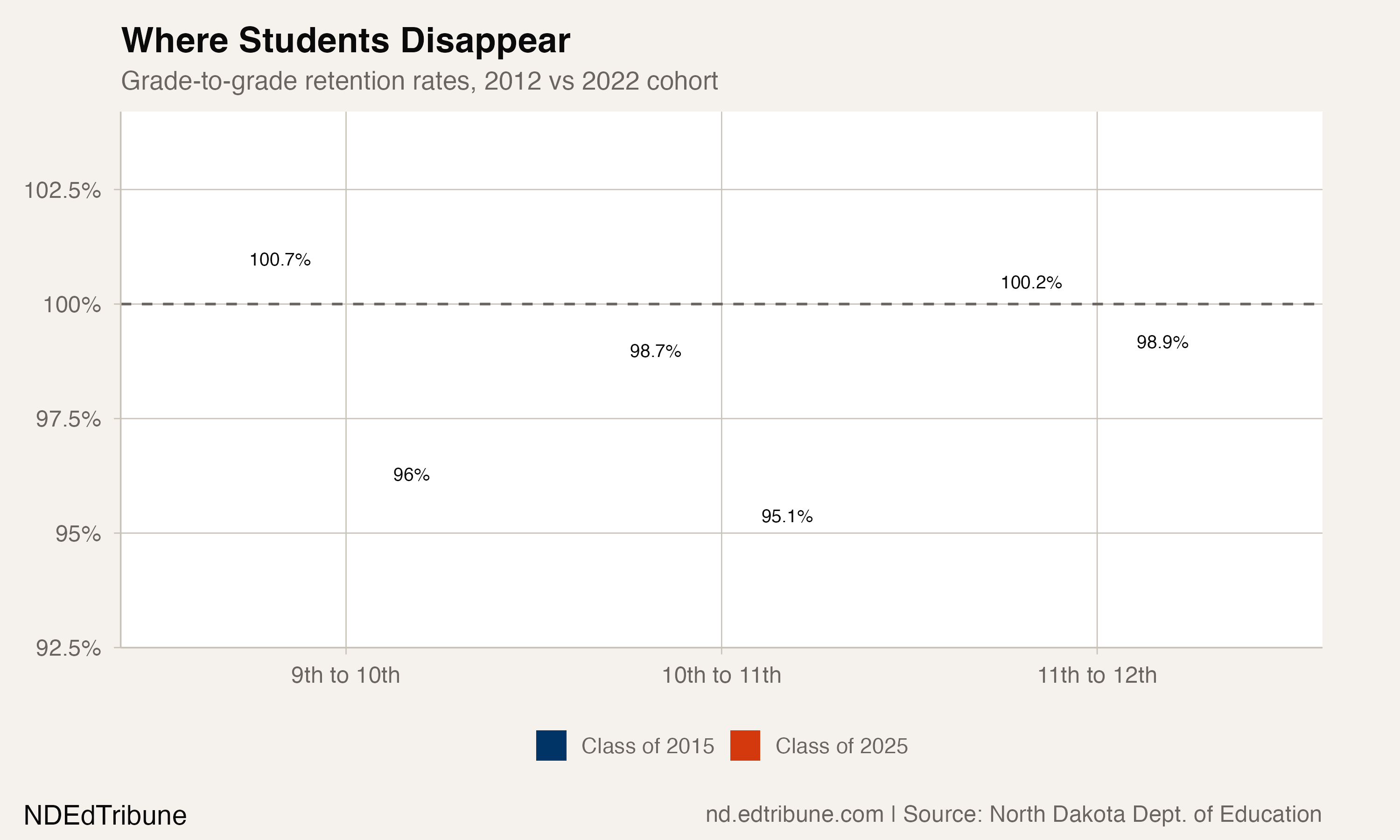
Grade-by-grade data shows where the loss concentrates. Comparing the 2012 cohort to the 2022 cohort, the 9th-to-10th retention rate dropped from 100.7% to 96.0%. (Rates above 100% reflect out-of-state transfers in, a consistent feature of North Dakota's 8th-to-9th transition, which has run between roughly 102% and 105% every year since 2008.) The 10th-to-11th transition, historically the weakest link, fell from 98.7% to 95.1%.
The second leak is at the finish line. Among students who reach twelfth grade, fewer earn a diploma. The four-year graduation rate peaked at 89.0% in 2020 and has since fallen to 82.4% in 2024 -- a 6.6-point decline that erased a decade of progress.
The graduation rate fell everywhere
No group was spared. White students fell from 92.2% to 87.5%. Economically disadvantaged students dropped from 76.9% to 67.6%. Hispanic students went from 78.3% to 69.0%. Black students from 82.2% to 70.8%.
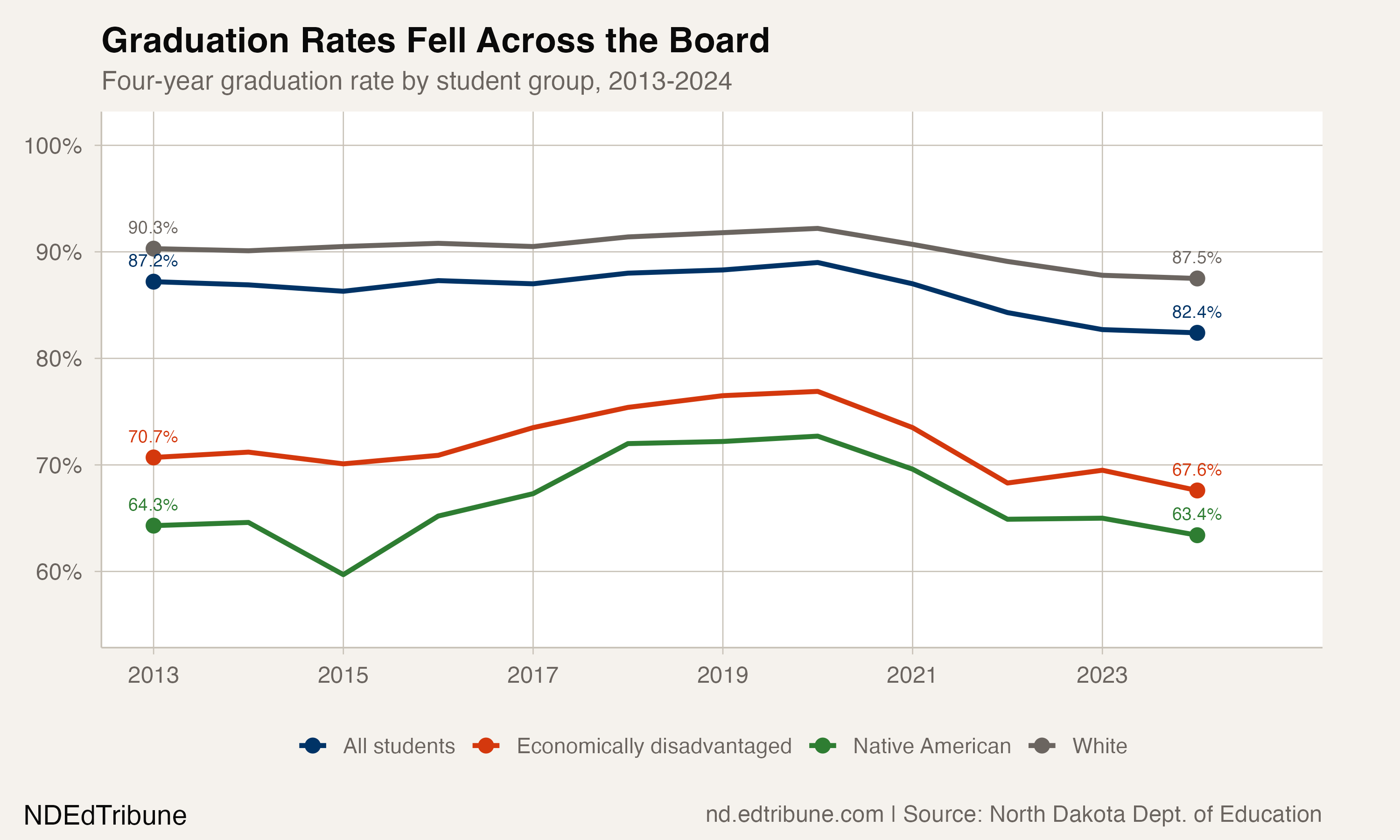
Native American students took the steepest hit: 72.7% in 2020 down to 63.4% in 2024, erasing nearly a decade of gains. The white-Native American gap had narrowed from 26 points to 19.5 between 2013 and 2020. By 2024 it was back to 24.1.
Among students who are currently homeless, the four-year graduation rate fell from 64.8% to 52.1%. Only about half of students who are currently homeless and reach senior year now earn a diploma on time.
Boom-era cohorts hitting high school
Part of this is structural. North Dakota's 9th grade enrollment surged from 7,462 in 2012 to 9,232 in 2023, a 23.7% increase driven by children born during the Bakken oil boom. Kindergarten classes swelled by as much as 32% above historical levels during the boom years, and those elementary cohorts have now aged into high school.
The boom brought families whose lives were often transient. As Resources for the Future researchers documented, oil-field children moved frequently:
"Certain students leave in the fall only to return in the spring when drilling resumed after the winter." Source: Resources for the Future, 2016
That mobility pattern disrupted elementary schools a decade ago. Whether those same students, now teenagers, are contributing to high school attrition is plausible but not provable from this data. What is clear is that the cohorts entering high school are substantially larger -- and likely more mobile -- than the classes that came before them.
Chronic absenteeism as accelerant
A second factor, with stronger direct evidence, is the post-pandemic spike in chronic absenteeism. North Dakota's rate doubled from 11% in 2019-20 to 22% in 2021-22, according to the Department of Public Instruction.
"The COVID-19 Pandemic did have a dramatic impact on our attendance rates." Joe Kolosky, ND Department of Public Instruction
In Fargo, 29% of students were chronically absent in 2021-22, up from 17% before the pandemic. West Fargo, the state's fastest-growing district, tripled from 5% to 16% over the same period. The timing lines up: the first cohort to enter high school during the pandemic graduated in 2024.
Chronic absenteeism is the strongest available predictor of both dropout and non-completion. The post-pandemic spike was severe enough to plausibly account for a large share of the graduation decline -- though this data cannot distinguish students who stopped attending from students who left the state.
The districts hit hardest
Every large North Dakota district except Mandan saw its graduation rate fall between 2020 and 2024.
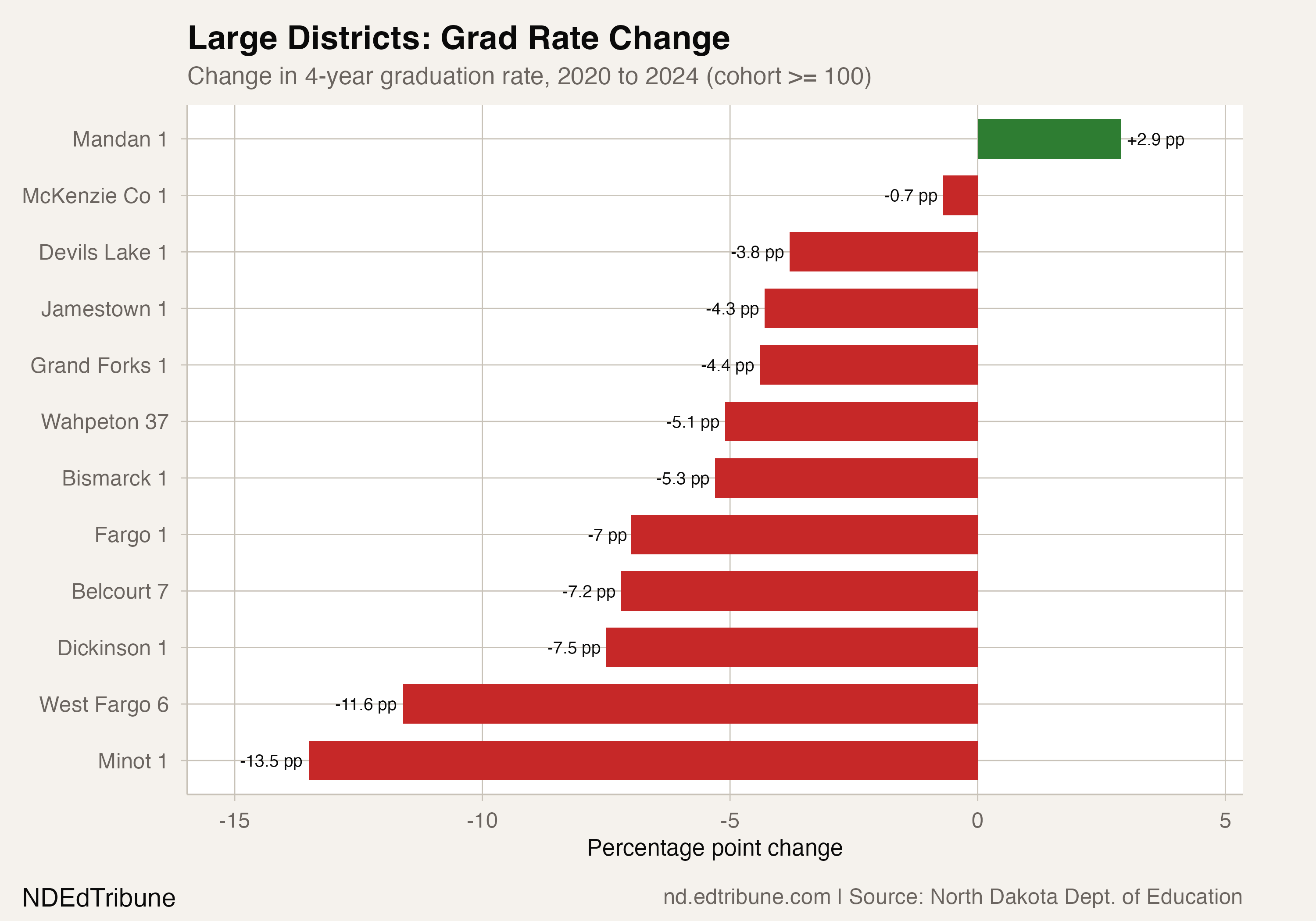
Minot↗ET fell the farthest: 13.5 points, from 83.4% to 69.9%, in a cohort of 559 students. That is roughly 75 more students per year who would have graduated in 2020 but did not in 2024. West Fargo↗ET dropped 11.6 points to 79.9%, a slide its own leadership has acknowledged.
"We have work to do because we want to exceed the state and grow annually." Vince Williams, Assistant Superintendent, West Fargo Public Schools
Fargo↗ET (the state's largest district by cohort size, with 949 seniors) fell 7.0 points to 80.0%. Bismarck↗ET, with the largest cohort at 1,057, declined 5.3 points to 84.5%. The sole exception, Mandan↗ET, gained 2.9 points, the only large district to improve.
The combined toll
Multiply the survival rate by the graduation rate and you get the effective completion rate: the share of ninth graders who make it all the way to a diploma. For the 2021 cohort (the most recent with both survival and graduation data), that rate was 75.1%, down from 85.9% for the 2012 cohort.
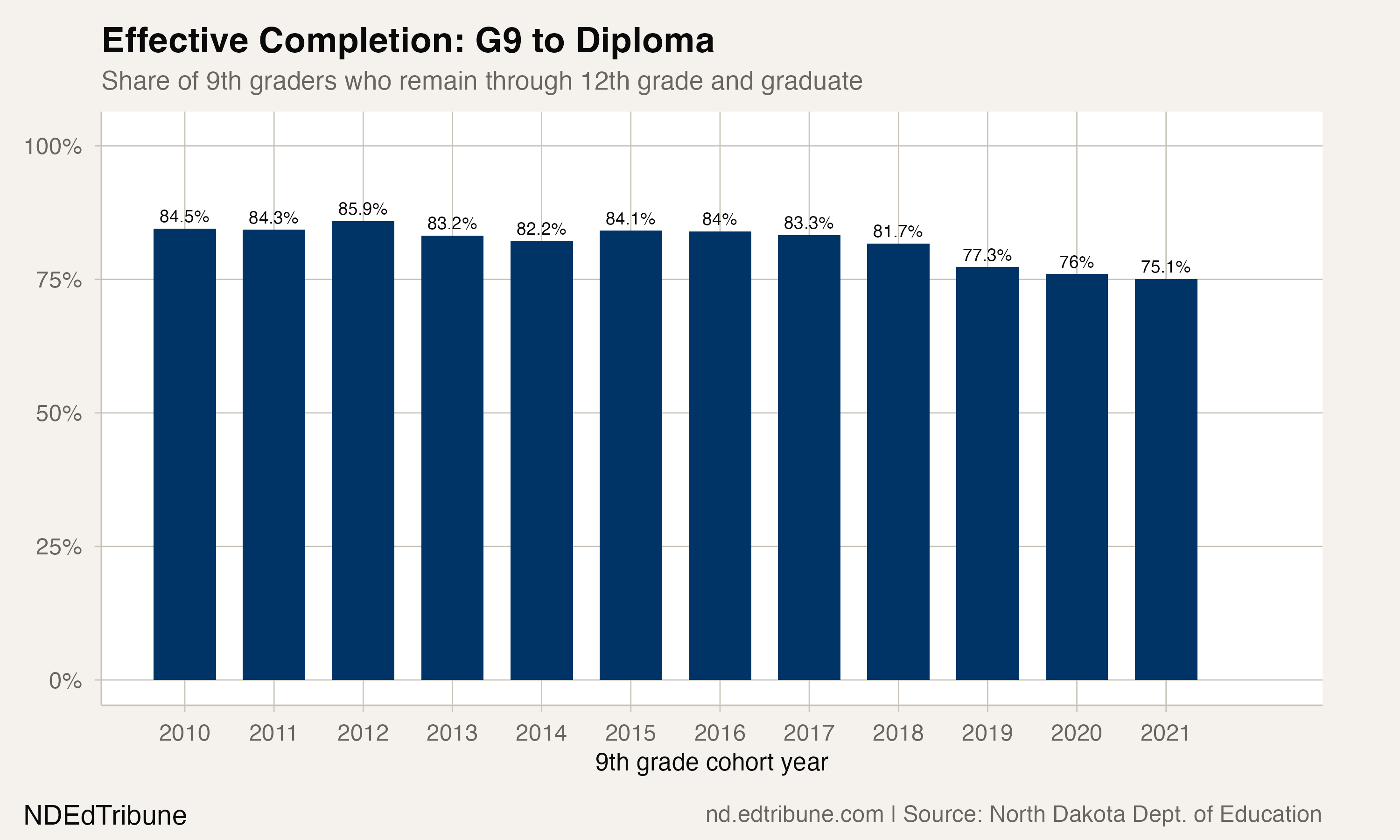
The decline was gradual through 2018, hovering around 82-84%. Then it picked up speed. The 2019 cohort dropped to 77.3%, the 2020 cohort to 76.0%, and the 2021 cohort to 75.1%. In raw numbers: the 2021 cohort entered ninth grade with 8,804 students. Of those, 776 were gone by twelfth grade, and roughly another 1,413 who made it to senior year did not graduate on time. That is about 2,189 students -- nearly 25% of the entering class -- who did not earn a four-year diploma.
There is a hopeful data point: the Department of Public Instruction reported that the 2024-25 graduation rate improved by 2 percentage points, with a 7-point gain among Native American students. Whether that holds will not be clear until the cohort survival data for those years is available.
But the system is already responding to the gap. West Fargo's assistant superintendent, Vince Williams, told InForum that the district has "work to do" to get its 79.9% rate back above the state average. Minot is running alternative high school programs at Souris River Campus that graduate 7.5% of their students. Statewide, roughly 2,189 ninth graders from the class of 2021 did not earn a diploma on time -- enough to fill every seat in a mid-sized North Dakota high school, with hundreds left standing.
Detailed code that reproduces the analysis and figures in this article is available exclusively to EdTribune subscribers.
Discussion
Sign in to join the discussion.
Loading comments...