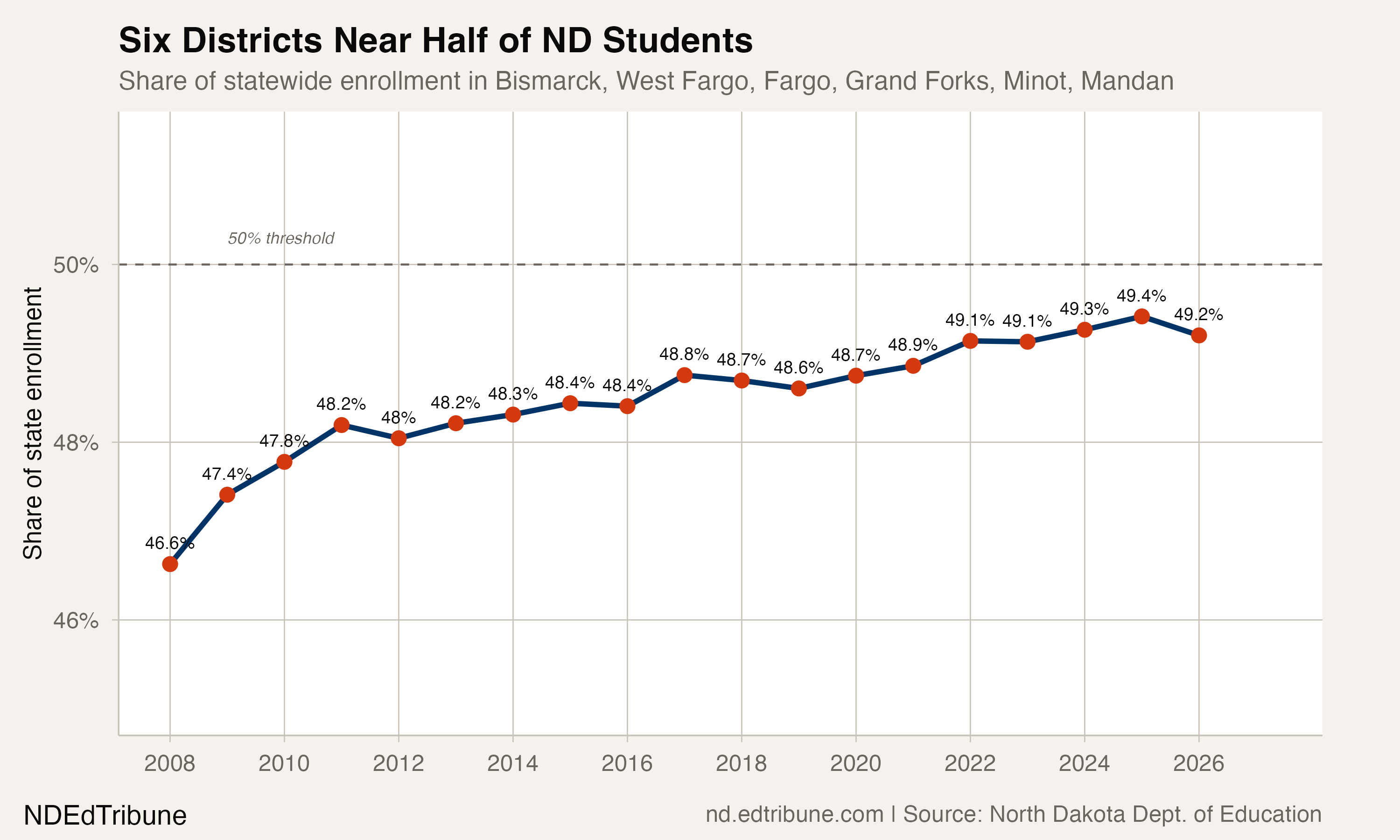
North Dakota has 165 school districts. Six of them, Bismarck↗ET, West Fargo↗ET, Fargo↗ET, Grand Forks↗ET, Minot↗ET, and Mandan↗ET, now enroll 57,254 students, or 49.2% of the state's 116,365 total. The remaining 159 districts share the other half.
In 2008, those same six served 46.6%. A 2.6 percentage-point shift may sound modest, but it translates to 13,399 additional urban students over 18 years, a steady pull toward the state's handful of population centers while 29 rural districts have closed or merged.
Two enrollment systems in one state
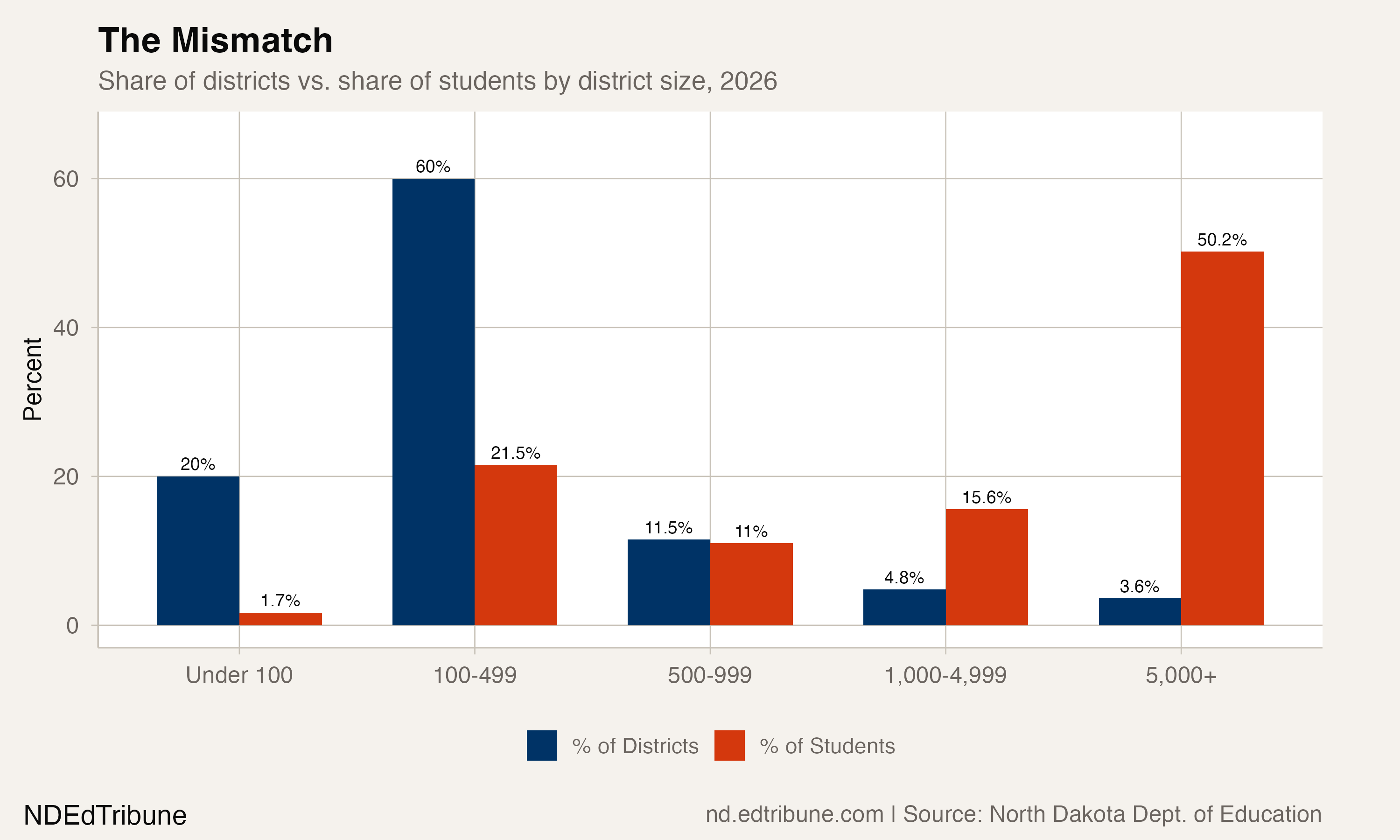
The concentration runs deeper than the top six. North Dakota's 10 largest districts now serve 61.2% of all students, up from 55.7% in 2008. One in 16 districts educates three in five students.
The flip side is just as stark. Eighty percent of North Dakota's districts enroll fewer than 500 students. Together, those 132 districts serve 23.1% of the state's children. Thirty-three have fewer than 100. Twelve have fewer than 50.
The median district enrolls 239 students. The average enrolls 705. When the typical district is one-third the size of the average, the distribution has become deeply skewed.
The convergence
The two lines on this chart have been closing for nearly two decades. In 2008, the 159 non-urban districts collectively enrolled 50,197 students; the urban six enrolled 43,855. That 6,342-student gap has narrowed to 1,857.
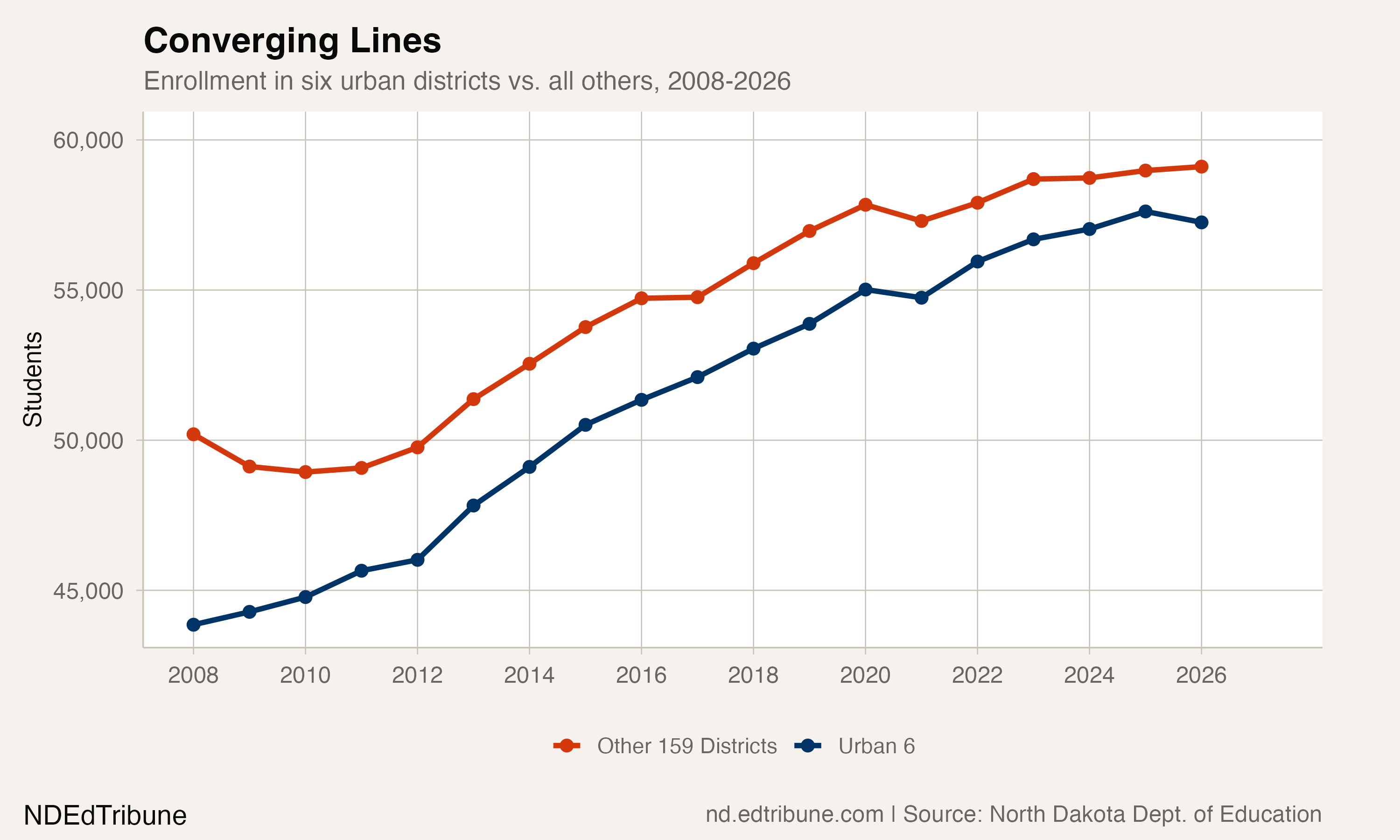
Both groups grew over this period. North Dakota added 22,313 students statewide between 2008 and 2026, a 23.7% increase fueled by the Bakken boom and metro-area job growth. But the urban six captured most of it: 13,399 of those students (60.1%) landed in six districts while 8,914 (39.9%) spread across what was, in 2008, 188 other districts.
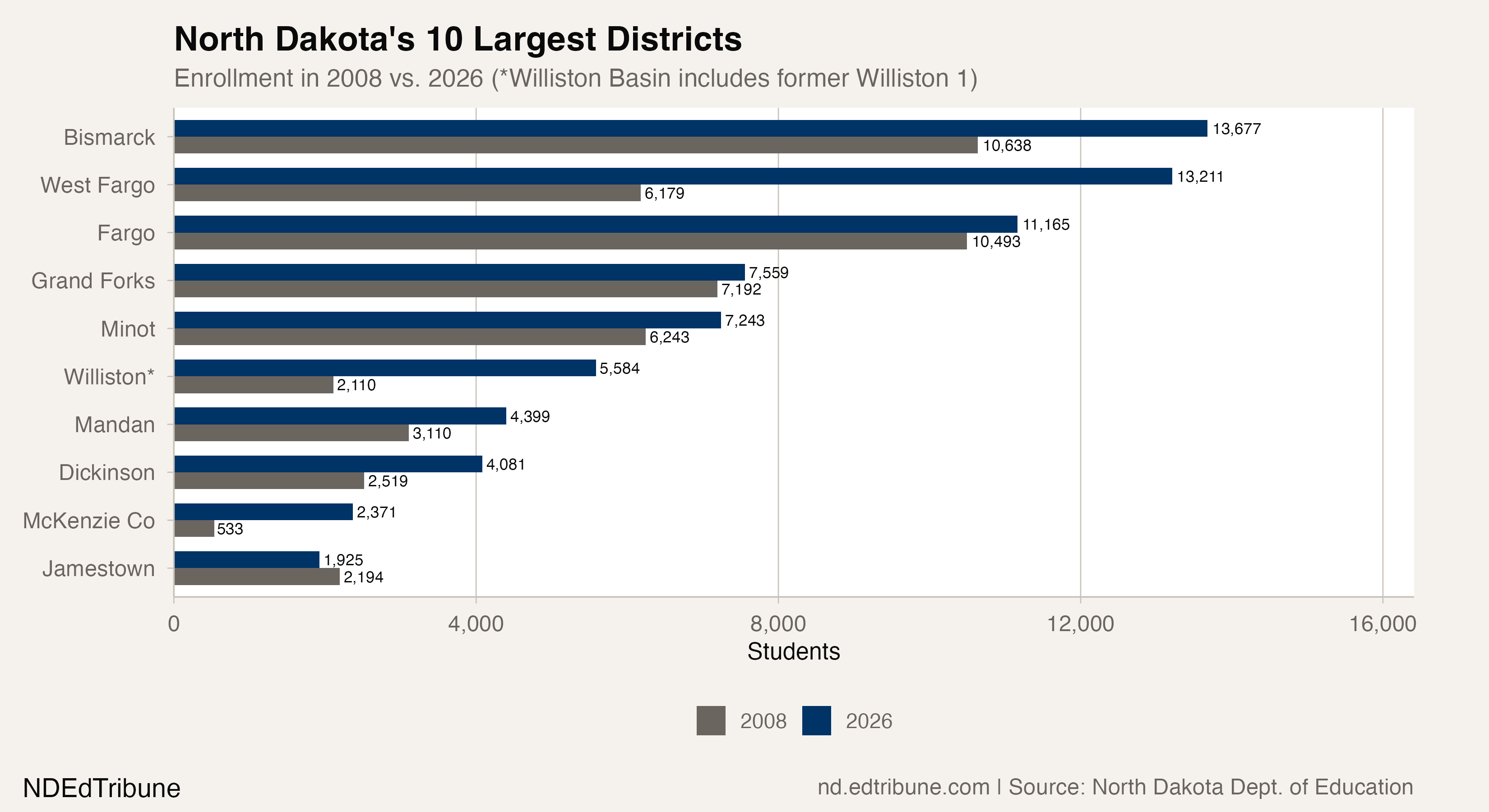
The growth was not evenly distributed even among the urban six. West Fargo added 7,032 students, a 113.8% increase that more than doubled its enrollment. Bismarck grew by 3,039 (28.6%). Mandan added 1,289 (41.4%) and Minot 1,000 (16.0%). Fargo and Grand Forks grew the least in absolute terms: 672 (6.4%) and 367 (5.1%), respectively.
West Fargo passes Fargo
The biggest shift within the urban six happened in 2021, when West Fargo passed Fargo to become the state's second-largest district. In 2008, West Fargo enrolled 6,179 students to Fargo's 10,493, a gap of 4,314. By 2026, West Fargo leads by 2,046 (13,211 to 11,165), and the gap widens every year.
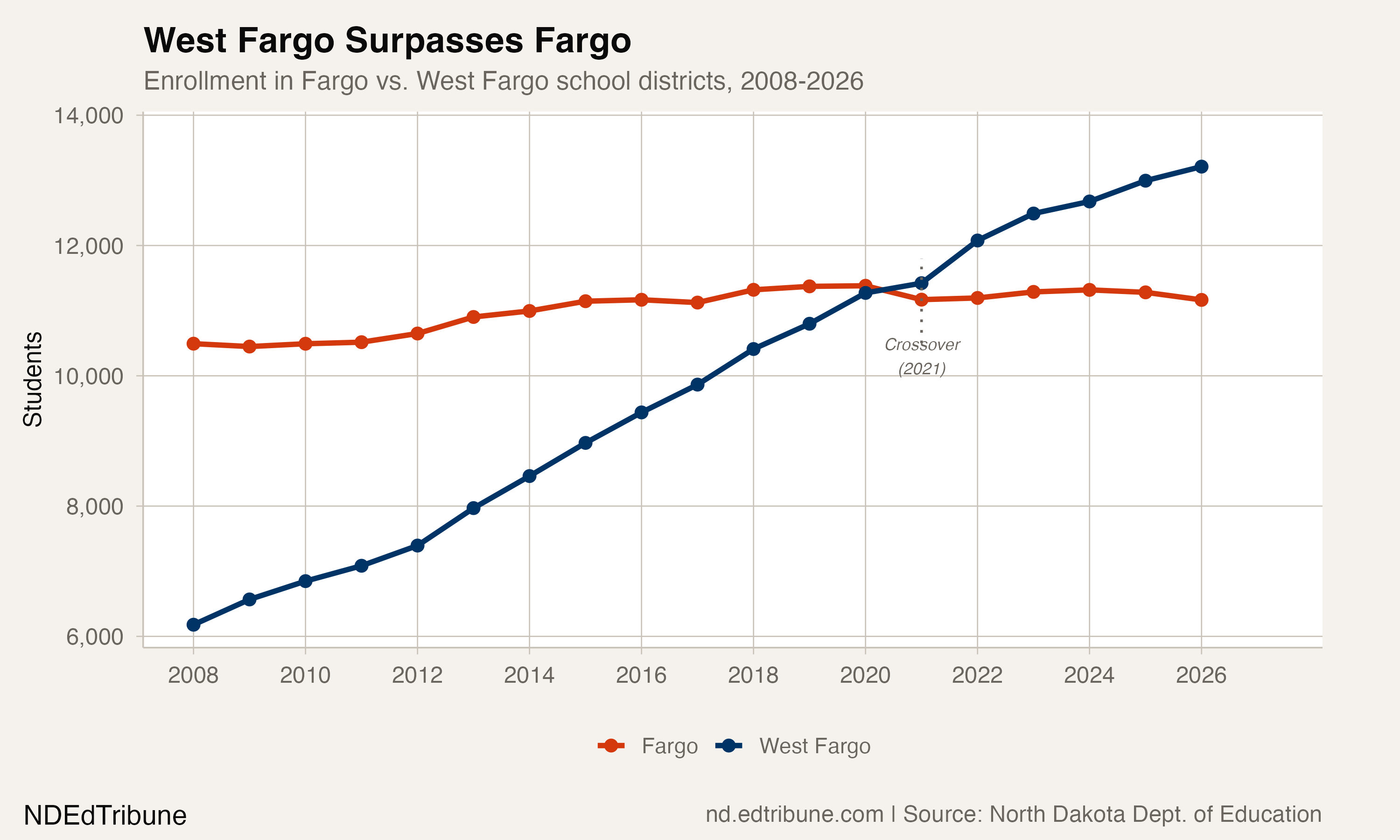
It is a textbook suburban growth pattern. West Fargo has consistently added 300 to 400 students a year over the past decade, driven by new housing on the metro's western edge. Enrollment projections from the district's consultant, RSP & Associates, put West Fargo at roughly 14,255 students by 2028-29. At that pace, it overtakes Bismarck (13,677 in 2026) as the state's largest district within two to three years.
Fargo, meanwhile, has barely budged in a decade. Its 2026 enrollment of 11,165 is only 672 above its 2008 level. The city's schools serve a mature, built-out urban core. West Fargo absorbs the families moving to the metro's new subdivisions.
The 2026 dip
The urban share actually peaked at 49.4% in 2025 and ticked down to 49.2% in 2026. Four of the six urban districts lost students. Minot fell by 276 students, Grand Forks by 120, Fargo by 116, and Bismarck by 72. Only West Fargo (+216) and Mandan (+4) grew. The urban six collectively lost 364 students while the remaining 159 districts gained a net 131.
Minot's decline stands out. The district peaked at 7,723 in 2015 and has fallen to 7,243, a loss of 480 students over 11 years (6.2%). A district demographer projects Minot will lose another 89 by 2029-30, with elementary holding steady while middle and high school numbers erode. The district's 2025-26 budget already shows a $401,265 deficit.
Bismarck, the state's largest district, peaked at 13,749 in 2025. Its 72-student dip in 2026 could be noise, or it could be the start of a plateau after growing in 16 of the past 18 years. The next two years will tell.
The rural math
North Dakota has lost 29 districts since 2008, from 194 to 165. That consolidation has not stopped the underlying shift. The average enrollment in a non-urban district has risen from 267 to 372, but only because the smallest districts merged or closed, removing themselves from the denominator. The districts that remain are not necessarily growing; many are simply the ones that have not yet closed.
Twenty-four districts hit their all-time enrollment low in 2026. Twenty-five hit their all-time high. The near-symmetry masks the scale difference: the 25 at record highs collectively enroll 35,876 students. The 24 at record lows enroll 8,193, more than four times fewer.
The funding arithmetic makes it worse. North Dakota pays roughly 80% of per-pupil education costs through its foundation aid formula, with local taxpayers covering the rest. When enrollment drops, the per-pupil funding drops with it, but the fixed costs for buildings, buses, and administration do not. For communities where the school is the last public institution, losing it means losing a civic anchor.
But the alternative, keeping schools open below the point of educational viability, has its own costs. Thirty-three districts serve fewer than 100 students, and 12 serve fewer than 50. At that scale, offering a full course sequence, specialized instruction, and extracurriculars becomes financially and logistically difficult no matter how willing local taxpayers are to cover the gap.
The population engine underneath
School enrollment follows population, and North Dakota's population has concentrated sharply. The state's 10 largest cities accounted for 83% of all population growth between 2010 and 2020, according to North Dakota Compass. Meanwhile, 30 of 53 counties lost population.
The gap is generational. Rural counties have an elderly share of 24%, versus 16% in urban counties. Fewer families with school-age children means fewer students, and the gap will only widen as younger workers keep migrating toward metro jobs.
The oil counties complicate the urban-rural binary. McKenzie County, home to the Bakken formation's core, grew school enrollment from 533 to 2,371 between 2008 and 2026, a 344.8% increase. Williston's combined enrollment (now Williston Basin 7 after a 2021 merger) rose from 2,110 to 5,584. These districts are neither traditionally urban nor traditionally rural. They are extraction economies where enrollment rises and falls with commodity prices.
The legislative math
When the North Dakota legislature debates per-pupil funding, the votes come from 47 districts, some representing Fargo classrooms of 25, others representing Slope County classrooms of four. The funding formula sends the same $11,072 base rate to both, supplemented by weighting factors for rural isolation that keep tiny districts solvent. That formula was designed when no six districts served anywhere near half the state's students.
In 2026, Minot's school board is already wrestling with a $401,265 budget deficit driven by enrollment losses. Marmarth is educating four students in three grade levels, 250 miles from the nearest city. West Fargo just passed a $99.6 million bond to expand a high school, drawing on the same state budget. The funding formula treats all three as variations on a theme, but the schools themselves have little in common.
Detailed code that reproduces the analysis and figures in this article is available exclusively to EdTribune subscribers.
Discussion
Sign in to join the discussion.
Loading comments...