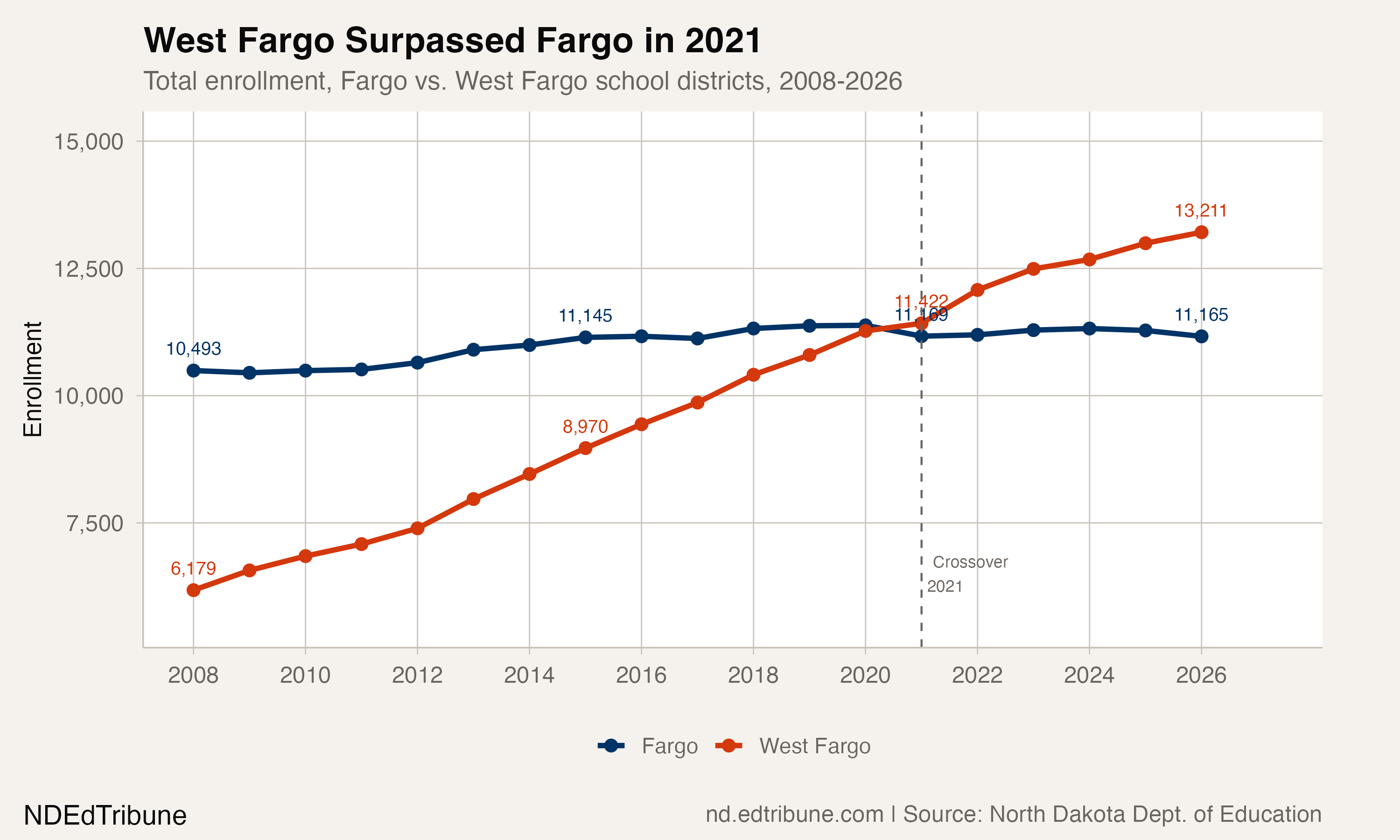
In 2008, West Fargo↗ET enrolled 6,179 students, fewer than half the size of its neighbor across the Sheyenne Diversion. Fargo↗ET had 10,493. The gap was 4,314 students, wide enough that nobody confused the two districts' trajectories.
By 2021, West Fargo had erased that entire lead. By 2026, it had reversed it. West Fargo now enrolls 13,211 students to Fargo's 11,165, a deficit of 2,046 for the metro's historic anchor district. In a state of 116,365 K-12 students, where these two districts together account for one in five, the flip matters beyond rankings. It reshapes funding, building plans, and which side of the metro sets the agenda.
A gap that only moves one way
The crossover was not a one-year blip. It was the end of a 13-year compression. Fargo led by 4,314 students in 2008. That lead shrank every single year, passing through 2,175 in 2015, 909 in 2018, and a paper-thin 110 in 2020. In 2021, West Fargo took the lead by 253 students. Five years later, the margin is 2,046 and accelerating.
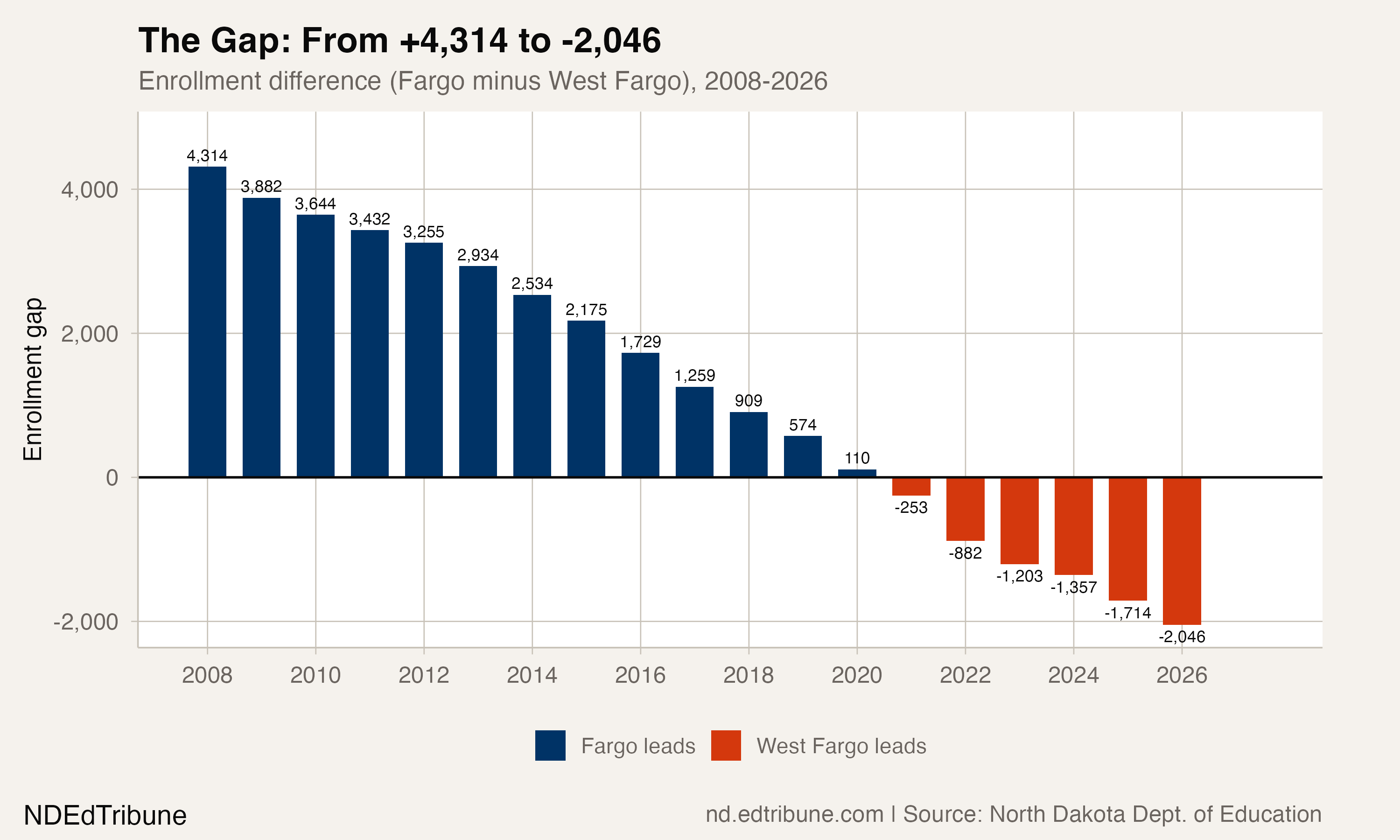
The numbers behind this inversion are lopsided. West Fargo grew 113.8% over the 18-year period, adding 7,032 students. Fargo grew 6.4%, adding 672. The statewide rate was 23.7%. Bismarck↗ET, which remains North Dakota's largest district at 13,677, grew 28.6% over the same period. West Fargo's growth rate was nearly five times the state average and 18 times Fargo's.
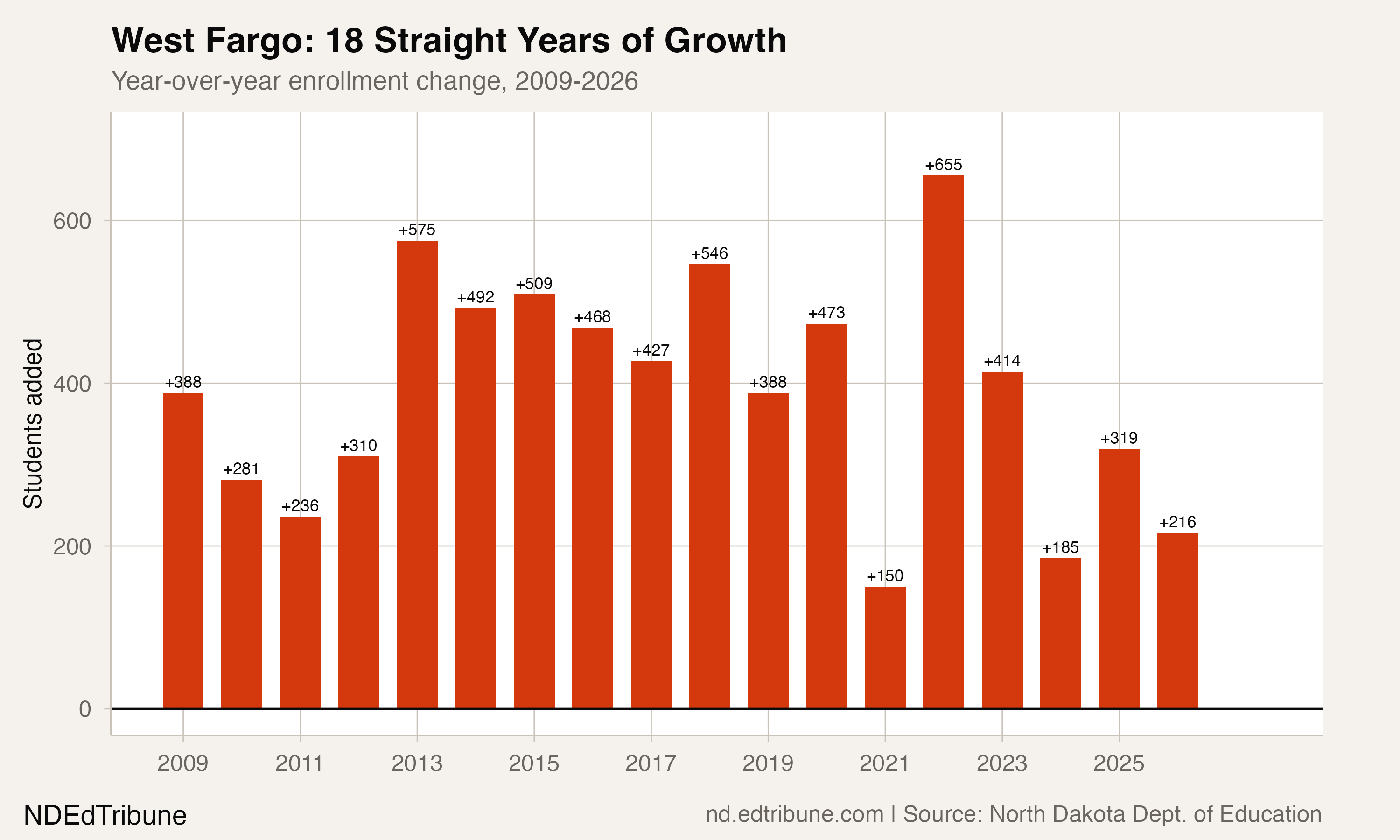
What stands out is the consistency. West Fargo grew every single year from 2009 through 2026, 18 consecutive annual gains. No other large North Dakota district comes close. The annual additions ranged from 150 (2021, the pandemic year) to 655 (2022), but the direction never changed.
Building a district in real time
Growing this fast is expensive. In 2024, enrollment consultant RSP & Associates projected the district would reach approximately 14,255 students by 2028-29, adding more than 1,300 over five years. In February 2025, voters approved a $99.6 million bond referendum to expand Horace High School, Heritage Middle School, and remodel South Elementary. The district opened a new Meadowlark Elementary in August 2024.
The growth is concentrated in the southern suburbs. Horace, which falls within West Fargo's attendance boundaries, has 45 new subdivisions under development and expects to reach 11,600 residents by 2031. Starter homes in new developments list for $450,000 to $500,000.
"At the rate that we're growing, we're going to fill some of these subdivisions quicker than what was anticipated." Jace Hellman, Horace community development director, InForum, June 2024
The pattern is basic suburban expansion. New housing goes up on the metro's southern fringe. Young families move in. Their children enroll in West Fargo schools. Fargo is not losing families to West Fargo so much as new arrivals to the metro are choosing West Fargo's geography.
What stalled Fargo
Fargo peaked at 11,382 students in 2020. Six years later it enrolls 11,165, down 217, or 1.9%. The eight-year view is more telling: Fargo went from 11,320 to 11,165, a net loss of 155 while West Fargo added 2,800.
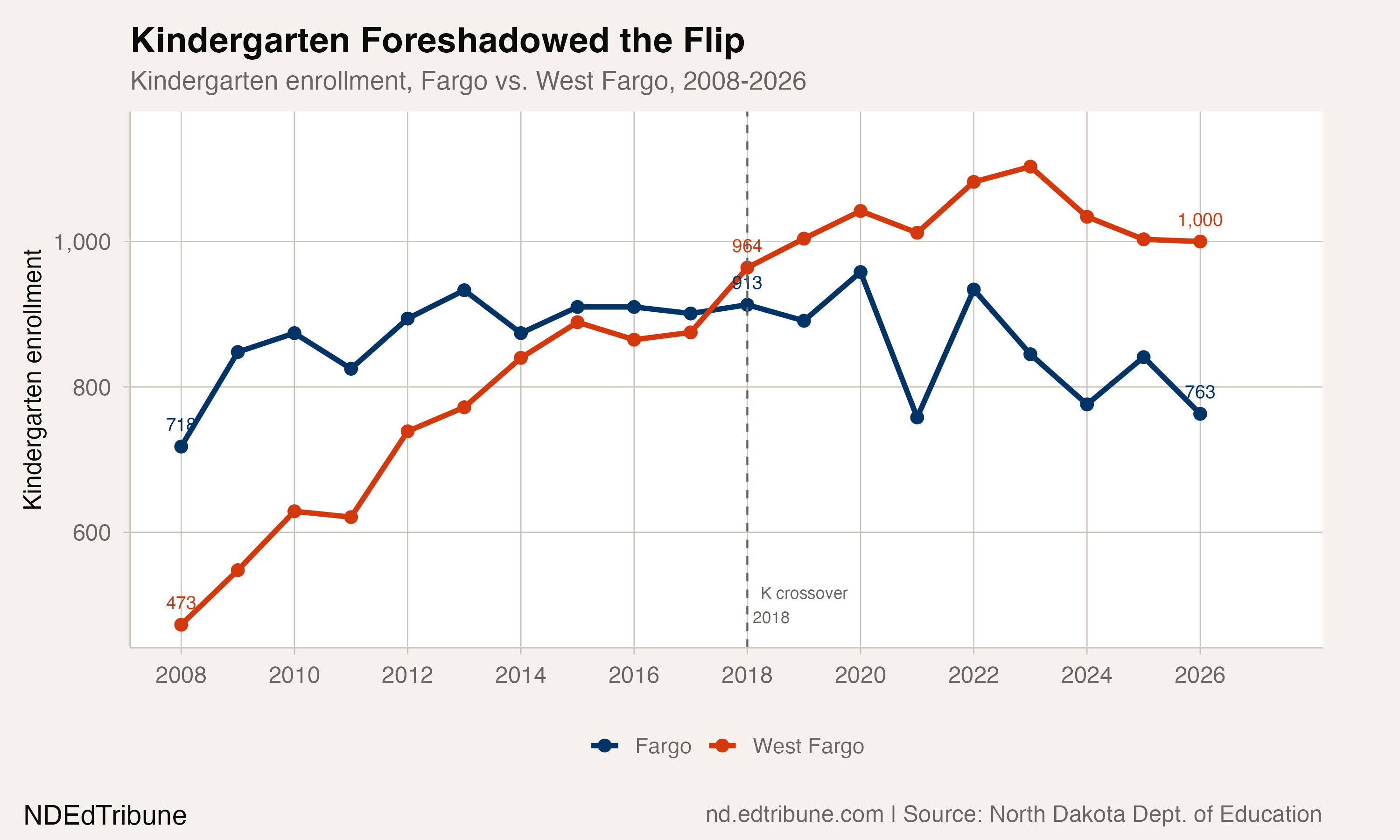
Fargo is not hemorrhaging students. It is flat. And the explanation shows up in kindergarten. Fargo enrolled 958 kindergartners in 2020; in 2026, it enrolled 763, a 20.4% drop. West Fargo's kindergarten class, by contrast, has held above 1,000 for most of the past decade. The kindergarten crossover happened in 2018, three years before the total enrollment crossover, a leading indicator of the structural shift beneath the headline number.
By January 2026, the district's own enrollment consultant flagged the pipeline.
"There is kinda this bubble of students moving through our schools." Robert Schwarz, CEO of RSP & Associates, InForum, Jan. 2026
That quote was about West Fargo, but the dynamic applies to Fargo too: smaller birth cohorts feeding smaller kindergarten classes. The difference is that West Fargo has enough new housing to offset the shrinkage. Fargo, largely built out, does not.
Fargo Public Schools Superintendent Dr. Cory Steiner framed Fargo's trajectory as structurally constrained rather than declining. Fargo opened the 2025-26 school year with 11,263 students and Steiner said enrollment has been "overall stable for the last five years." The district's own enrollment projections report forecasts FPS to grow by about 150 students over the next five years, with 841 kindergarteners expected for 2026-27. Steiner attributed the limited upside to factors the district does not control: Cass County live births have been declining since 2015, families are having fewer children, and housing development within FPS attendance boundaries has slowed.
The boundary lines themselves help explain the divergence. North Dakota's legislature established the district borders in the 1960s, and the West Fargo Public School District includes portions of the City of Fargo along with the cities of Harwood and Horace. FPS, by contrast, is constrained to a boundary with limited room for new housing. "The City of West Fargo and the other towns that WFPS serves are growing," Steiner noted. "Fargo Public Schools' district boundary is limited in its areas for housing growth."
Steiner also clarified the timing of the crossover. West Fargo surpassed Fargo in enrollment during the 2020-21 school year, he said, "well before I became the FPS superintendent in July 2025."
The big three, reshuffled
In 2008, North Dakota's top five districts were Bismarck, Fargo, Grand Forks, Minot, and West Fargo, in that order. West Fargo was fifth. By 2026, the ranking is Bismarck (13,677), West Fargo (13,211), Fargo (11,165), Grand Forks (7,559), and Minot (7,243). West Fargo leapfrogged three districts.
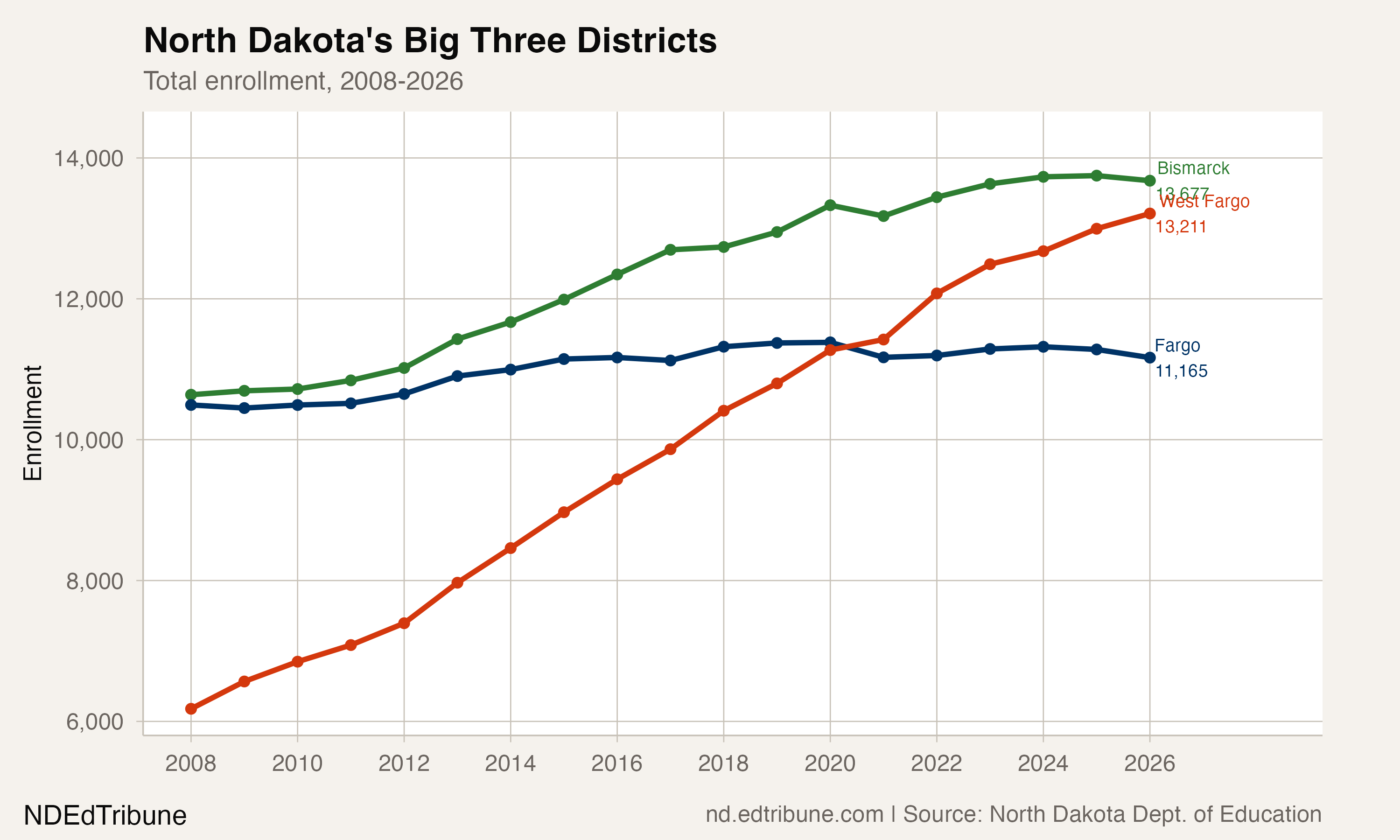
The Fargo metro as a combined unit now enrolls 24,376 students, 20.9% of the state total, up from 17.7% in 2008. But the internal composition has inverted. In 2008, Fargo was 62.9% of the metro's enrollment and West Fargo was 37.1%. In 2026, West Fargo is 54.2% and Fargo is 45.8%.
The shift matters for money. North Dakota's funding formula sends dollars based on enrollment. West Fargo's growth means more state aid, which it needs for the buildings, staff, and programs that 7,032 additional students require. Fargo faces the opposite problem: maintaining infrastructure built for a bigger student body without the enrollment growth to pay for it.
Signs the growth is slowing
Even West Fargo's streak is cooling. The district added 655 students in 2022, 414 in 2023, 185 in 2024, 319 in 2025, and 216 in 2026. The average annual gain from 2009 to 2020 was 424 students. From 2021 to 2026, it is 323.
Smaller kindergarten classes explain part of it. West Fargo enrolled 1,103 kindergartners in 2023 but only 1,000 in 2026. The 12th-grade class, meanwhile, has grown from 360 in 2008 to 970 in 2026, up 169.4%. As those large upper classes graduate and smaller K classes enter, the net narrows. RSP & Associates noted in January 2026 that middle and high schools would grow fastest over the next five years while elementary growth flattens.
West Fargo's housing pipeline still has room for an estimated 8,000 units over the next decade, and the Fargo-Moorhead Diversion project could unlock 2.5 square miles of developable land by 2027. Bismarck leads by 466 students. At the rate the gap has narrowed over the past three years, the crossover could come as soon as 2029.
Fargo has no equivalent pipeline. Its kindergarten enrollment sits at 763, the lowest in the dataset. The district's response has been operational -- boundary changes at northside elementary schools to redistribute students among buildings designed for cohorts that are not coming back. West Fargo is building for growth. Fargo is rearranging the furniture.
Detailed code that reproduces the analysis and figures in this article is available exclusively to EdTribune subscribers.
Discussion
Sign in to join the discussion.
Loading comments...