North Dakota used to graduate students at a rate above the national average. Not anymore. The state's four-year graduation rate has fallen every year since 2020, dropping from a peak of 89% to 82.4% in 2024, a 6.6 percentage-point slide that now places it below the national average of roughly 87% for the first time in over a decade.
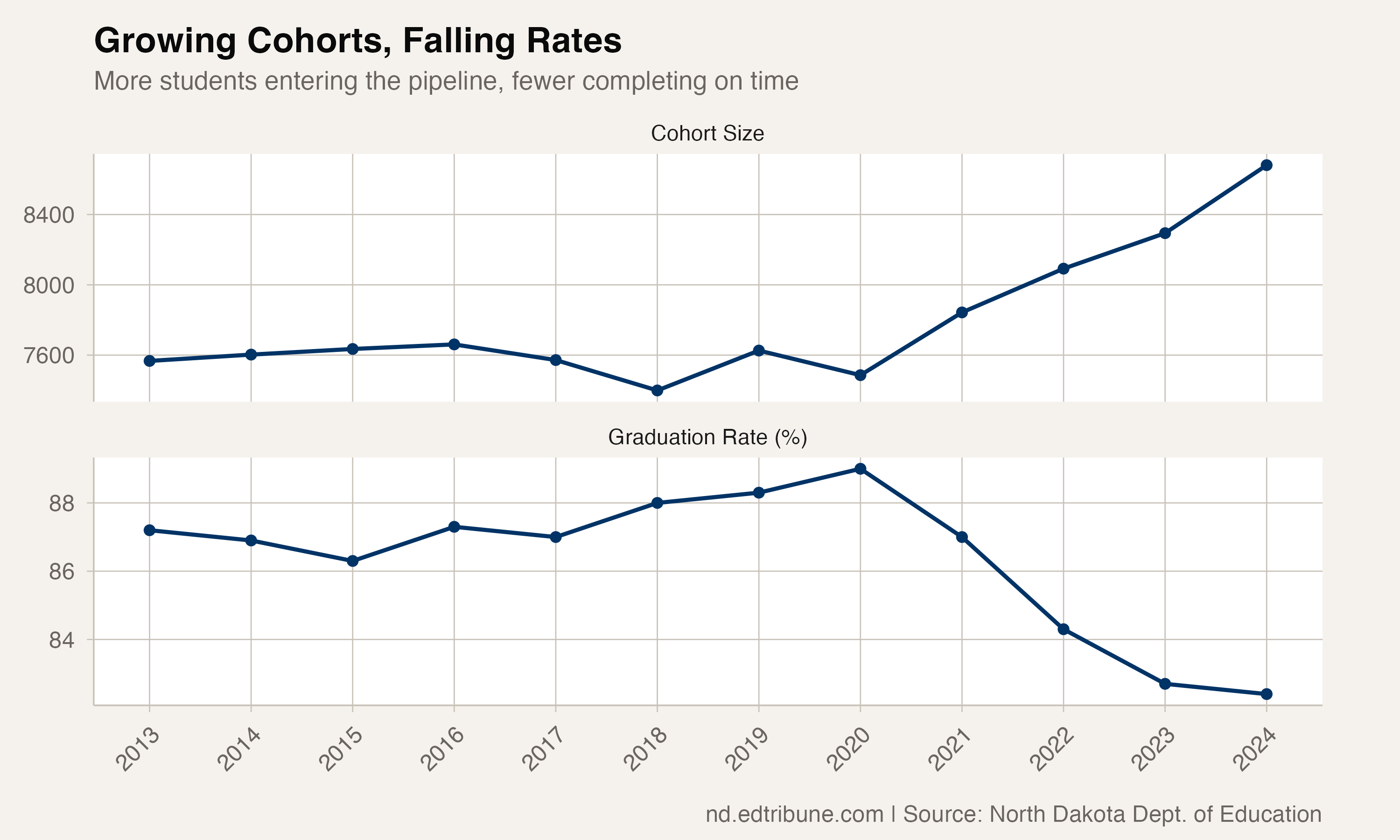
The decline is the longest sustained drop in the state's data history, and it comes against an unusual backdrop. North Dakota's graduating cohort has actually grown 14.7% over the past 12 years, from 7,567 students in 2013 to 8,681 in 2024. The state has more students entering high school than ever. Fewer of them are finishing on time.
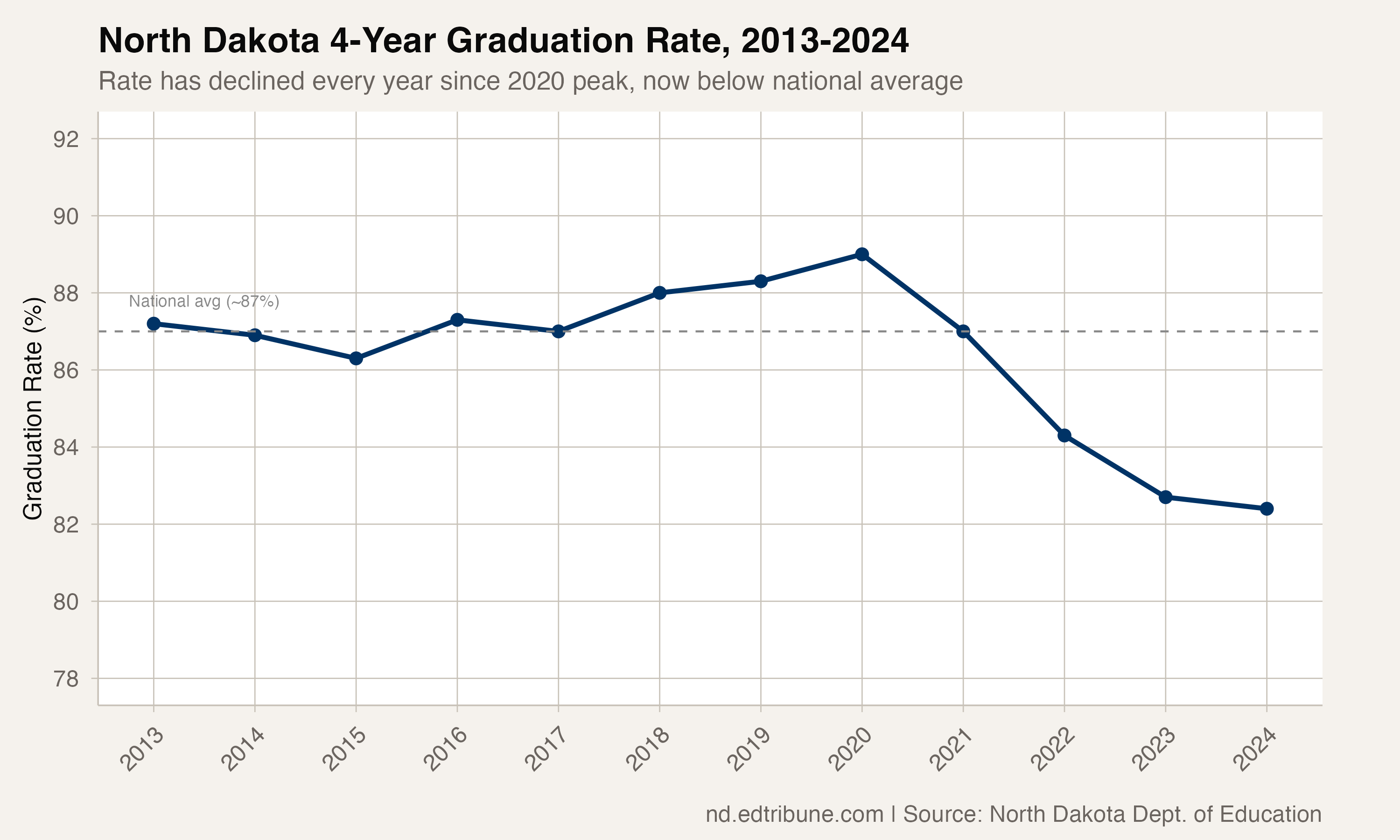
The four-year slide
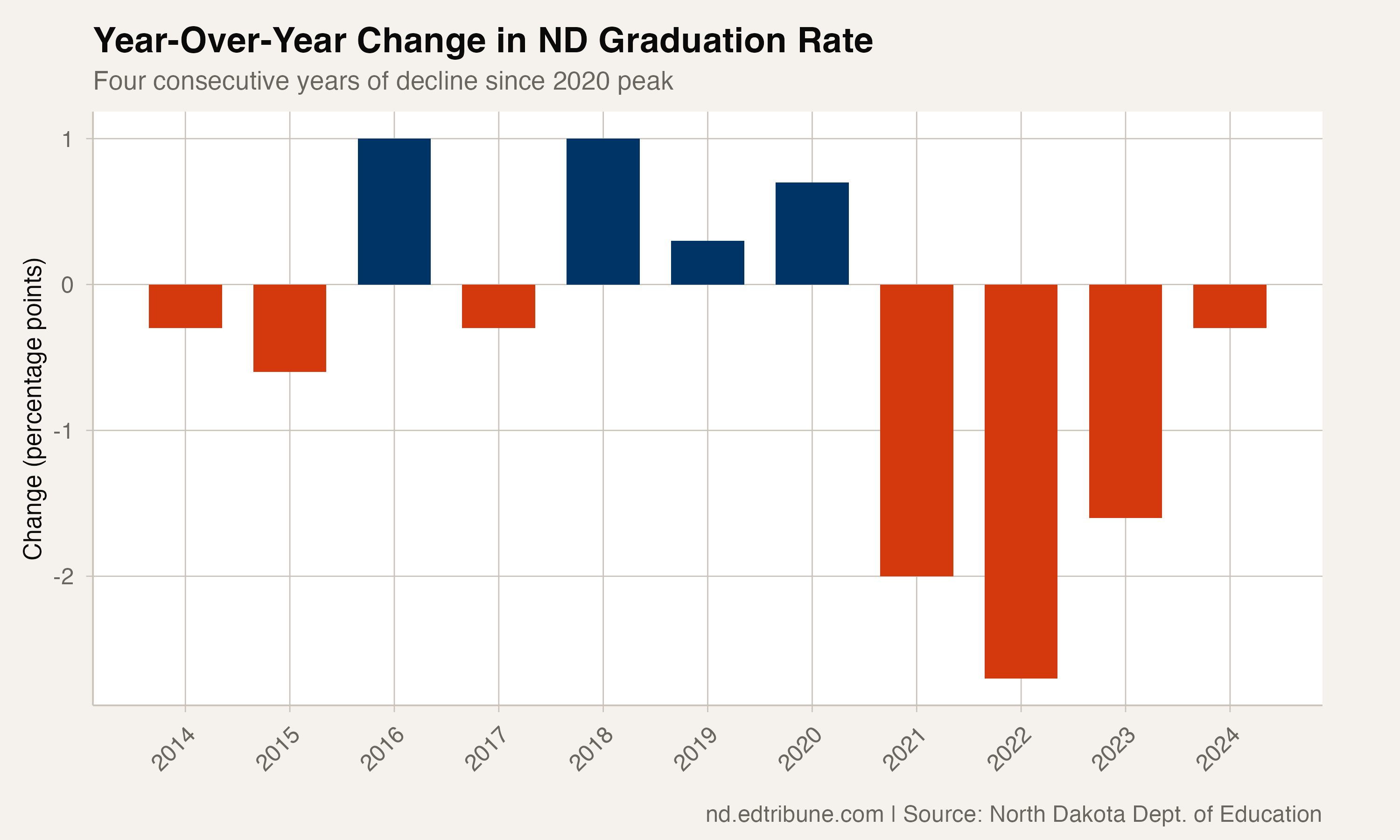
The decline accelerated after the 2020 peak. In 2021 the rate dropped 2 percentage points, then another 2.7 in 2022, 1.6 in 2023, and 0.3 in 2024. The 2020 rate itself may have been inflated by pandemic-era accommodations, when many states relaxed graduation requirements and credit recovery programs expanded. But even measured against the pre-pandemic high of 88.3% in 2019, the current rate is nearly 6 points lower.
North Dakota uses a "Choice Ready" accountability framework under ESSA, with graduation rate as one of several indicators alongside test scores, English learner achievement, and college, career, or military readiness by graduation. The four-year rate captures students who complete within their expected graduation year. The state does not report a five-year extended rate, meaning students who take an extra year to finish are counted as non-completers.
More students, fewer graduates (proportionally)
The paradox at the center of North Dakota's graduation story is mathematical. More students are graduating in raw numbers: about 7,153 in 2024, up from roughly 6,598 in 2013. But at the 2020 peak rate, the 2024 cohort would have produced 7,726 graduates, a gap of 573 students in a single year. Over the four years of decline, roughly 1,633 students who would have earned diplomas under the peak rate did not.
In a state where the high school graduate count is projected to keep growing through 2034, the falling rate means the gap between potential and actual graduates will widen with each passing year.
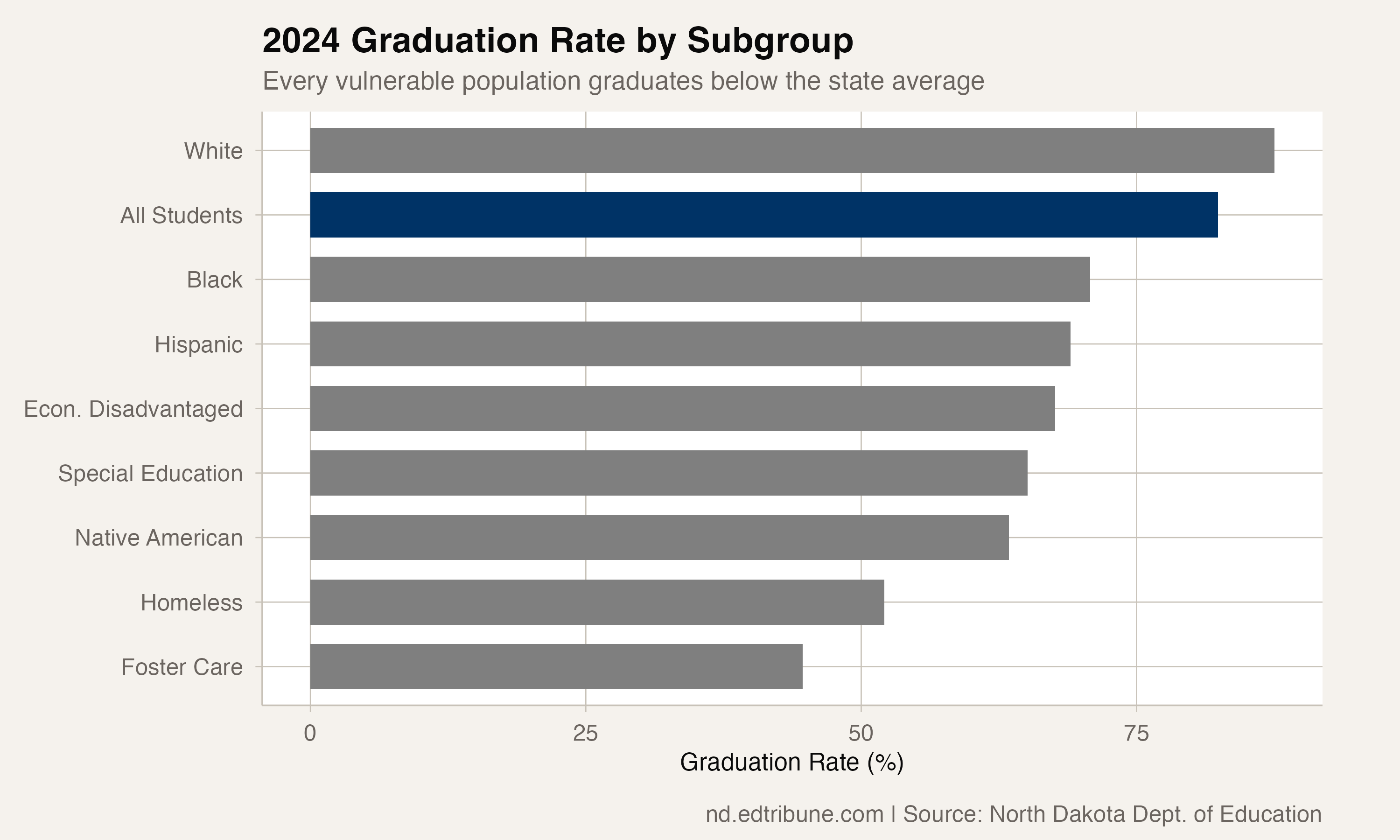
Every gap has widened
The statewide decline has not fallen evenly. White students graduated at 87.5% in 2024, 5.1 points above the state average. Every other subgroup fell further behind.
Native American students, the state's largest minority group with 939 in the cohort, graduated at 63.4%, a gap of 19 percentage points from the state average. Hispanic students graduated at 69%, Black students at 70.8%, and economically disadvantaged students at 67.6%. Special education students graduated at 65.1%.
The most alarming rates belong to the state's most vulnerable populations. Students who are currently homeless graduated at 52.1%, and youth in foster care at just 44.7%, both well below the already grim national averages for those groups. Nationally, about 65% of youth in foster care graduate by age 21. North Dakota's 44.7% falls 20 points below even that benchmark.
What changed after 2020
Several forces converged. The 2020 peak likely reflected COVID-era grade inflation and relaxed requirements rather than genuine academic gains. As those accommodations ended, the underlying challenges surfaced. At the same time, North Dakota's cohorts were growing more diverse. The Native American cohort expanded 45.8% since 2013, from 644 to 939 students, and the Hispanic cohort more than tripled from 150 to 542. Both groups graduate at rates well below the state average, meaning demographic shifts alone account for some of the statewide decline.
But demographics do not explain the full picture. The white graduation rate also fell, from 92.2% in 2020 to 87.5% in 2024. The decline is broad-based enough to suggest systemic factors beyond changing student composition.
Looking ahead
North Dakota is one of few states projecting more high school graduates in the coming decade, not fewer. If the graduation rate stabilizes at its current 82.4%, the growing cohorts will at least produce more diploma-holders in absolute terms. But the gap between what the state achieves and what it could achieve at prior performance levels will grow larger each year.
At 82.4%, North Dakota now sits 4.6 points below the national average, after spending most of the previous decade above it. In Fargo↗ET, where oil-boom migration and refugee resettlement have pushed cohorts larger, and in the reservation-area districts of the northwest, the 573-student annual gap is not an abstraction. It is a growing number of students who started ninth grade expecting to walk at graduation and did not.
Data from the North Dakota Department of Public Instruction. Graduation rates represent four-year cohort rates on a 0-1 scale, converted to percentages for analysis. All years use the end-year convention (2024 = class of 2024).
Detailed code that reproduces the analysis and figures in this article is available exclusively to EdTribune subscribers.
Discussion
Sign in to join the discussion.
Loading comments...