In 2020, North Dakota graduated 89% of its seniors on time. If that rate had held, the class of 2024 would have produced 7,726 diploma-holders. Instead, with the rate at 82.4%, about 7,153 students finished, a difference of 573.
That gap is not rounding error. In a state where the entire graduating cohort is under 9,000, 573 students is the size of a large high school's senior class. And it is growing every year.
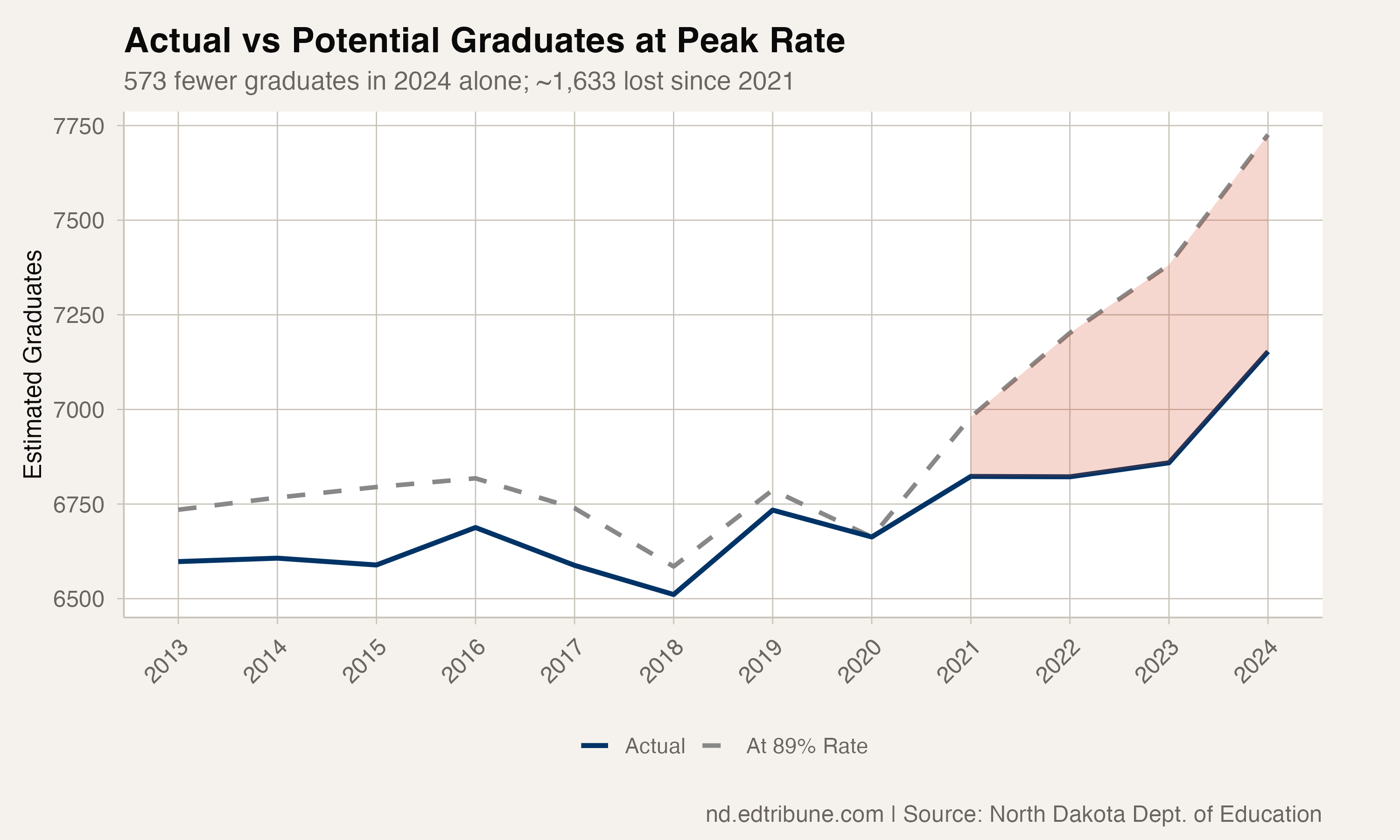
The cumulative cost
The gap is not a one-year phenomenon. Since the graduation rate began declining in 2021, the annual shortfall has grown each year as both the cohort size increases and the rate continues to fall. In 2021, the gap was 157 students. In 2022, it was 380. In 2023, it reached 523. And in 2024, 573.
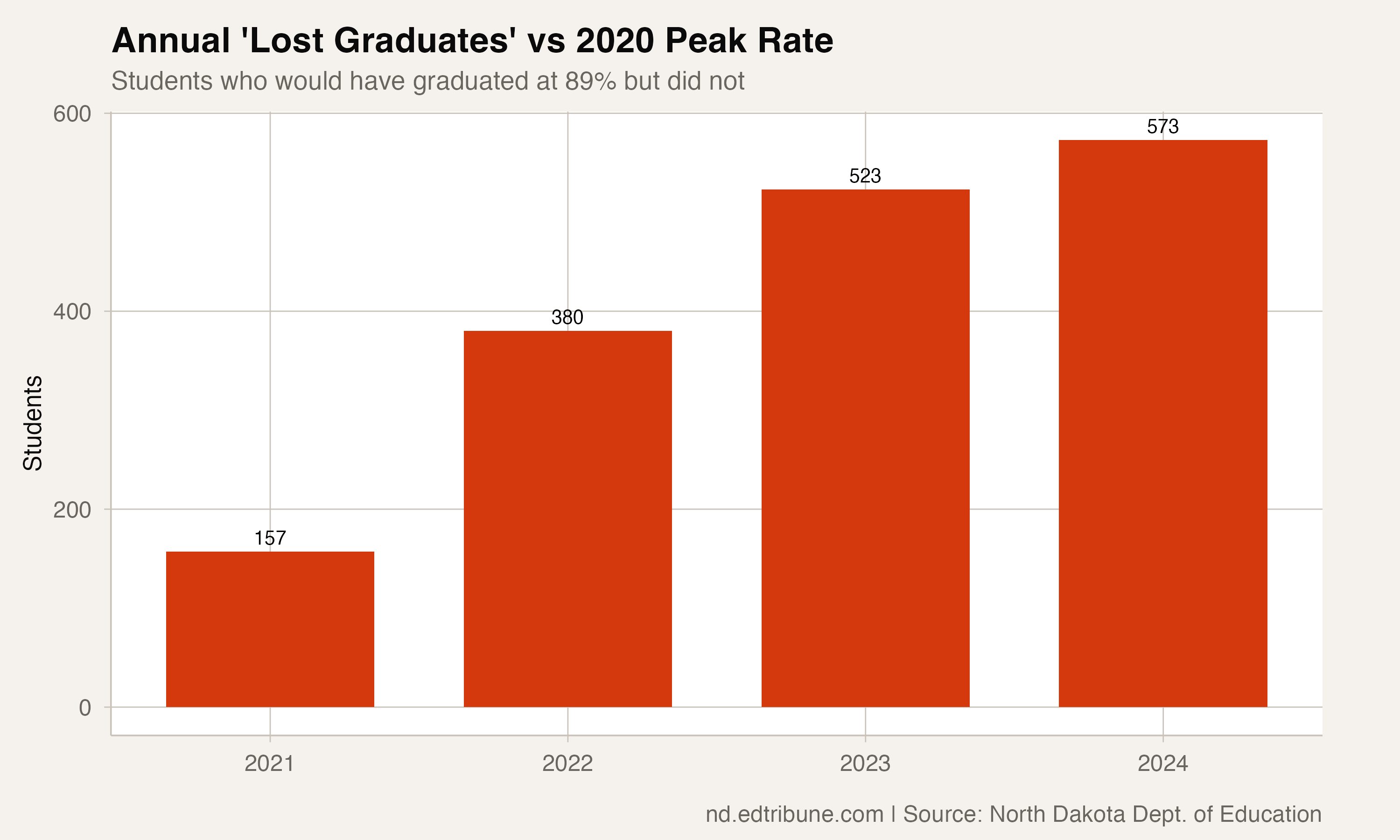
Over those four years, the cumulative gap amounts to approximately 1,633 students who would have graduated under the 2020 rate but did not. These are students who entered the workforce, enrolled in community college without a diploma, or simply stopped out of the education system. In a state with a total graduating cohort under 9,000, losing 1,633 students over four years represents a meaningful share of an entire generation.
Growing cohorts, declining output
North Dakota is one of a handful of states where high school cohorts are growing rather than shrinking. The four-year cohort expanded from 7,567 in 2013 to 8,681 in 2024, a 14.7% increase driven by population growth in the Fargo metro, oil country, and refugee resettlement communities.
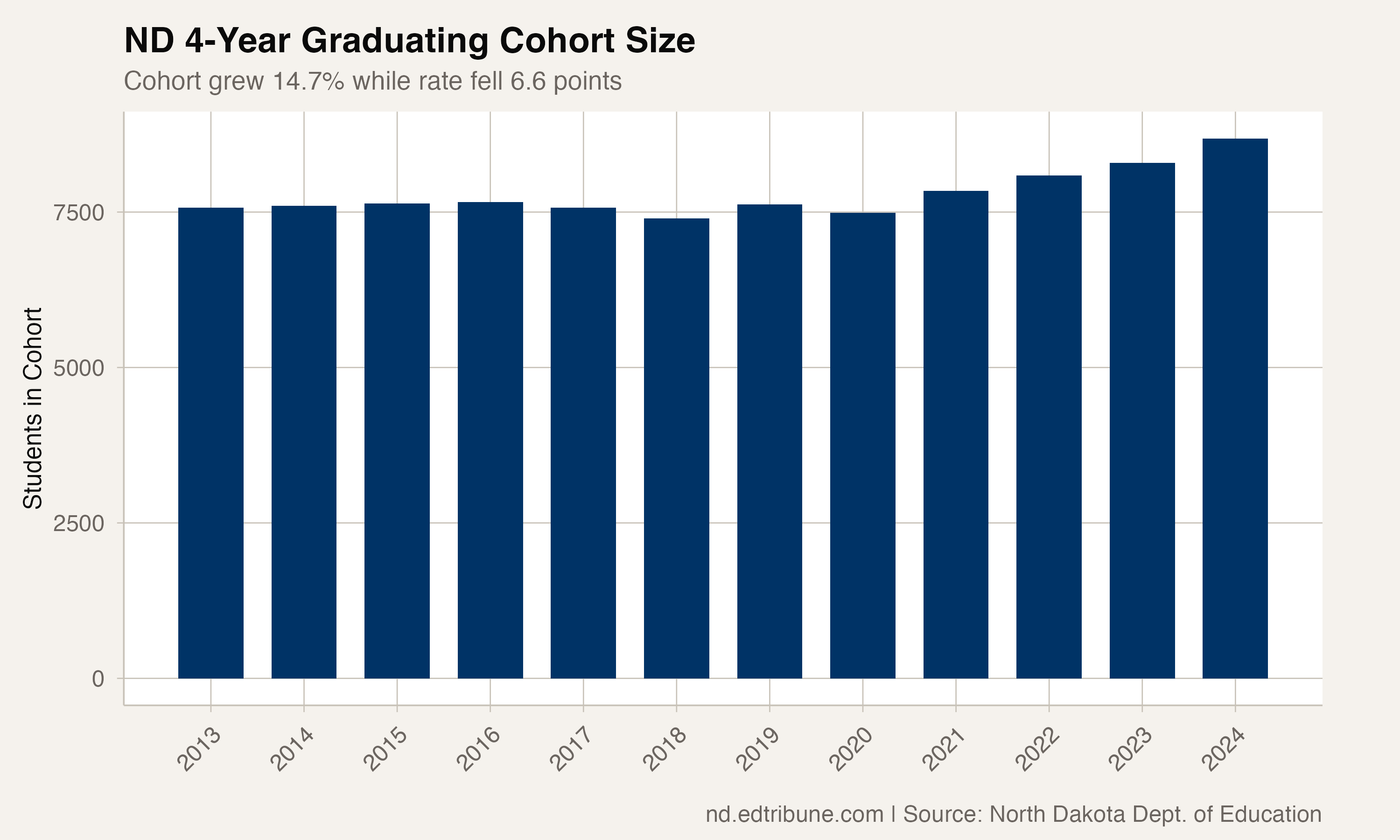
In absolute terms, North Dakota is producing more graduates now (approximately 7,153) than in 2013 (approximately 6,598). The cohort growth has more than offset the rate decline in raw numbers. But the efficiency of the pipeline has deteriorated. In 2013, the state converted 87.2% of its cohort into graduates. In 2024, it converted 82.4%, the lowest rate in the 12-year data history.
The projection problem
Western Interstate Commission for Higher Education projections show North Dakota's high school graduate count continuing to grow through at least 2034, making it one of a small number of states expecting more graduates in the coming decade, not fewer. This is unusual. Most states are projected to see their graduating cohorts shrink as their school-age populations decline.
For North Dakota, the demographic tailwind creates both opportunity and risk. If the graduation rate stabilizes or recovers, growing cohorts will produce substantially more diploma-holders. But if the rate continues to decline, the growing cohort means the absolute number of non-completers will grow as well. At the 2024 rate, each additional 100 students in the cohort produces only 82 graduates and 18 non-completers.
What 573 students means
There is an abstraction problem with graduation rate statistics. A 6.6-point decline from 89% to 82.4% sounds modest. Expressed as 573 students per year, it becomes harder to ignore. These are individual students in Fargo↗ET, Minot↗ET, Bismarck↗ET, and Williston↗ET who entered ninth grade expecting to graduate in four years and did not.
Some will take a fifth year. Some will earn a GED. Some will not return. The state does not track a five-year extended rate, so there is no way to know how many of the 573 eventually earn a credential. For the purposes of the four-year cohort measure, though, they represent the distance between where North Dakota is and where it was.
With cohorts projected to keep growing through 2034, each percentage point of graduation rate carries more weight than it did a decade ago. A single point now means roughly 87 students. Four points means 347. The math only gets more expensive.
Data from the North Dakota Department of Public Instruction. Graduation rates represent four-year cohort rates. Graduate estimates computed from cohort size multiplied by graduation rate. All years use the end-year convention (2024 = class of 2024).
Detailed code that reproduces the analysis and figures in this article is available exclusively to EdTribune subscribers.
Discussion
Sign in to join the discussion.
Loading comments...