Thirty-eight students. That was the size of North Dakota's foster care graduating cohort in 2024. Seventeen of them received a diploma on time.
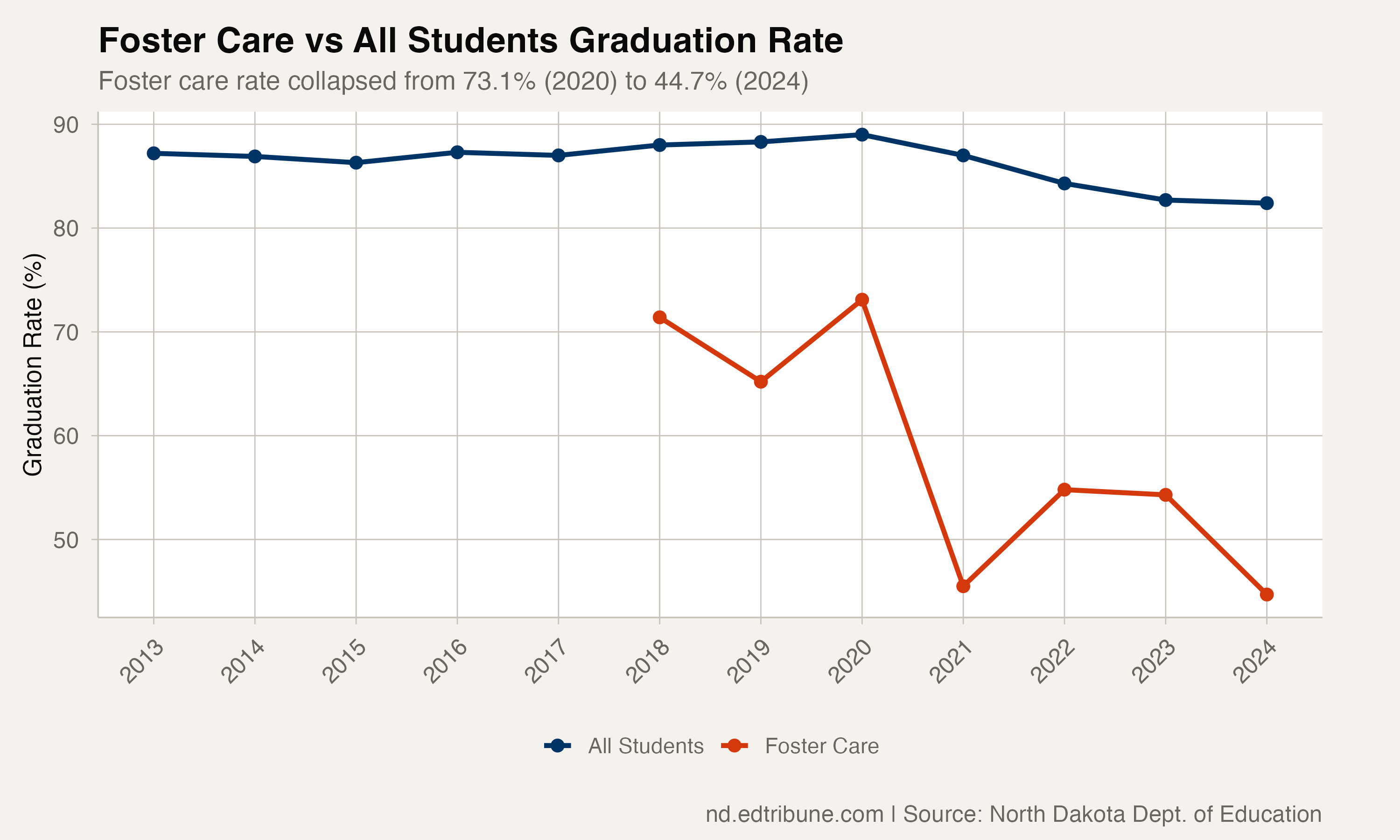
The 44.7% graduation rate for youth in foster care represents the lowest figure since the state began tracking this subgroup in 2018, and it marks a 28.4 percentage-point drop from just four years earlier. In 2020, 73.1% of students in foster care graduated on time. By 2024, fewer than half did.
The steepest decline of any subgroup
No population in North Dakota's graduation data has lost more ground, more quickly, than youth in foster care. The 28.4-point decline from 2020 to 2024 exceeds the drop for Native American students (9.3 points), students who are currently homeless (roughly 10 points), and the statewide average (6.6 points).
The year-by-year trajectory offers no ambiguity: 73.1% in 2020, then 45.5% in 2021, 54.8% in 2022, 54.3% in 2023, and 44.7% in 2024. The modest recovery in 2022-2023 proved temporary. The 2024 rate is not just the lowest in the data, it is lower than any prior year by more than 10 points.
Thirty-eight students, thirty-eight stories
The cohort is small enough that individual outcomes shift the rate significantly: five more graduates in 2024 would have pushed the rate above 57%, a 13-point swing. But the pattern across seven years is not volatility. It is a trend. The foster care graduation rate has been below 55% for four of the last five years. The 73.1% figure in 2020, which itself was preceded by rates of 71.4% (2018) and 65.2% (2019), increasingly looks like an anomaly rather than a baseline. Pandemic-era accommodations, including relaxed credit requirements, may have temporarily boosted completion rates for a population particularly sensitive to academic disruptions.
Below even the national average for youth in foster care
Nationally, approximately 65% of youth in foster care graduate by age 21, according to research compiled by the Annie E. Casey Foundation. That figure is itself a crisis, representing a 20-point gap from the general population. North Dakota's 44.7% falls 20 points below even that grim benchmark.
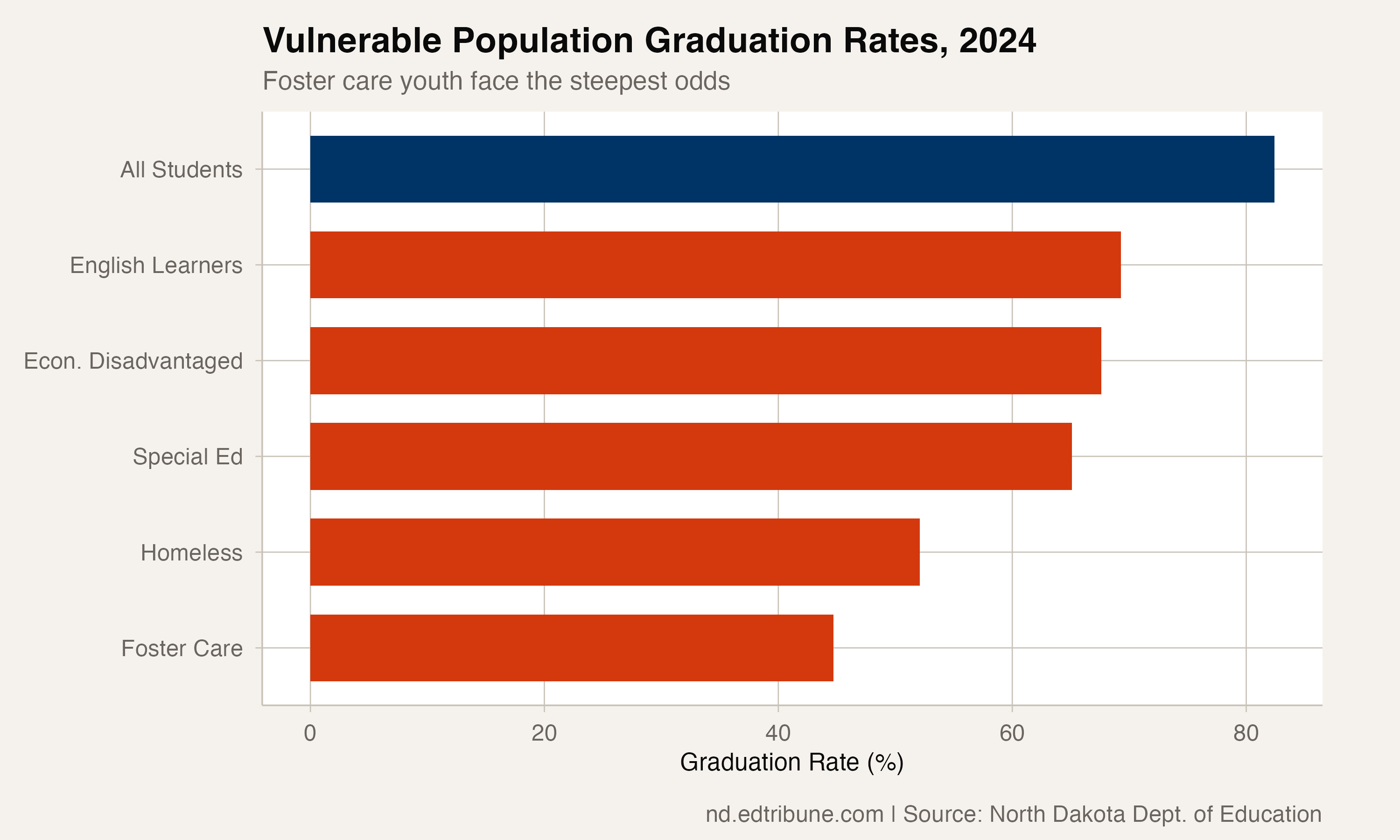
Youth in foster care in North Dakota graduate at a lower rate than students who are currently homeless (52.1%), special education students (65.1%), English learners (69.3%), and economically disadvantaged students (67.6%). They face the steepest odds of any tracked subgroup in the state.
The reasons are well documented in education research. Students in foster care change schools at high rates, disrupting credit accumulation and social connections. They frequently lack a consistent adult advocate who can navigate graduation requirements on their behalf. Trauma, housing instability, and the administrative complexities of the foster care system itself all compound the challenge.
A growing cohort
The foster care graduating cohort has increased modestly, from 26 students in 2020 to 38 in 2024. As the state identifies more students under the foster care definition, the population being tracked grows larger and, potentially, more representative of the true scope of the challenge.
With 38 students spread across a state of 70,000 square miles, North Dakota's foster care cohort is small enough that a dedicated intervention program could reach every individual. The school liaisons, credit recovery programs, and cross-agency coordination between child welfare and education that exist on paper have not produced results in the data. In Bismarck↗ET and Fargo↗ET, where most foster placements concentrate, the gap between what these systems promise and what the graduation numbers show has only grown wider.
Data from the North Dakota Department of Public Instruction. Graduation rates represent four-year cohort rates. Foster care data available from 2018. All years use the end-year convention (2024 = class of 2024).
Detailed code that reproduces the analysis and figures in this article is available exclusively to EdTribune subscribers.
Discussion
Sign in to join the discussion.
Loading comments...