Fargo↗ET. West Fargo↗ET. Minot↗ET. Dickinson↗ET. Bismarck↗ET. Williston Basin↗ET. Wahpeton↗ET. Seven large North Dakota districts posted the worst graduation rate they have recorded -- at the same time.
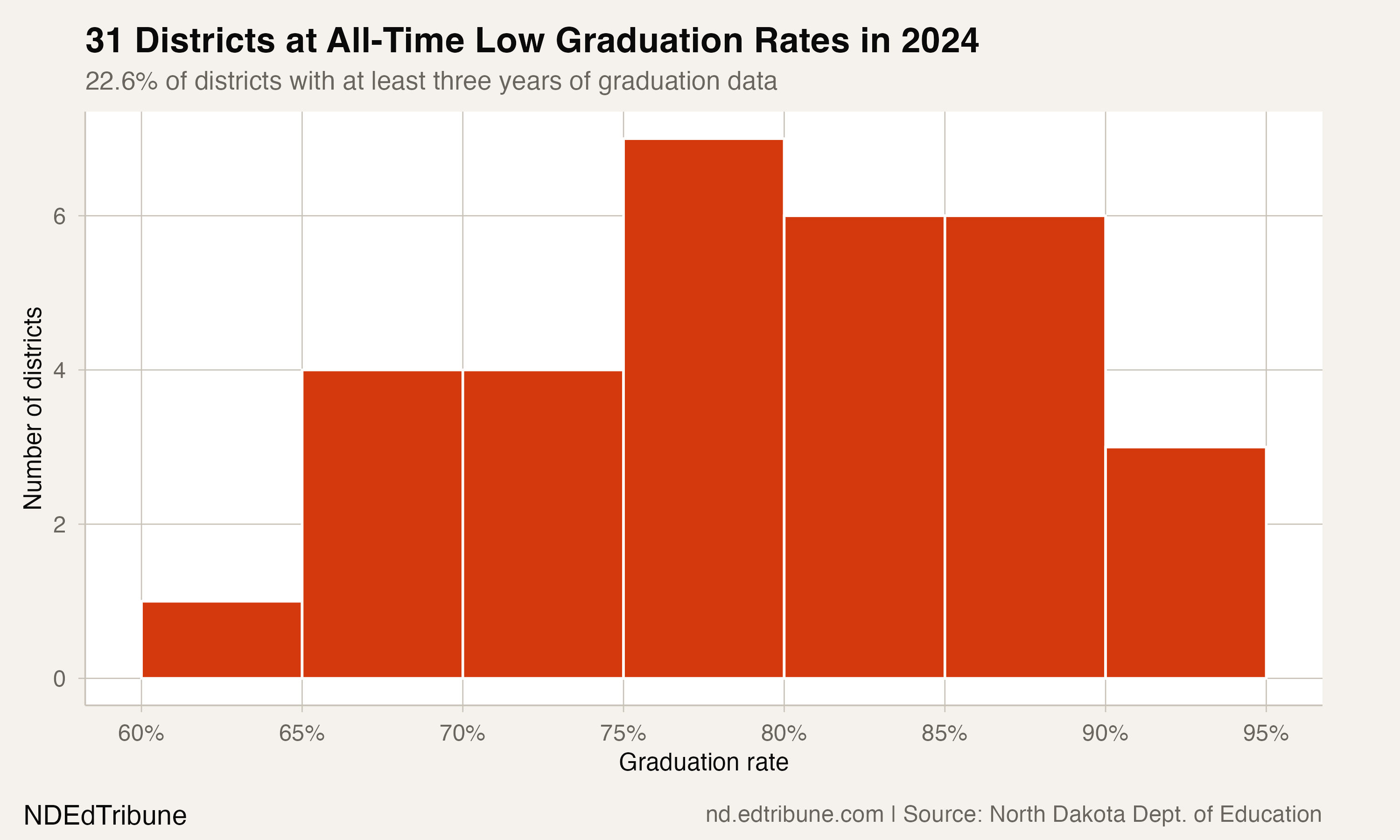
They are not alone. Out of 137 districts with at least three years of graduation data, 31 posted their lowest-ever rate in 2024. That is nearly one in four. The list reaches from the capital to the oil patch to the Red River Valley, and the names on it are not the ones anyone would have predicted a decade ago.
The largest districts
Among districts with cohorts of 100 or more students, seven were at all-time lows. Williston Basin led at 68.6% with 366 students. Minot followed at 69.9% with 559. Dickinson posted 78% with 296 students. Wahpeton recorded 79% with 119.
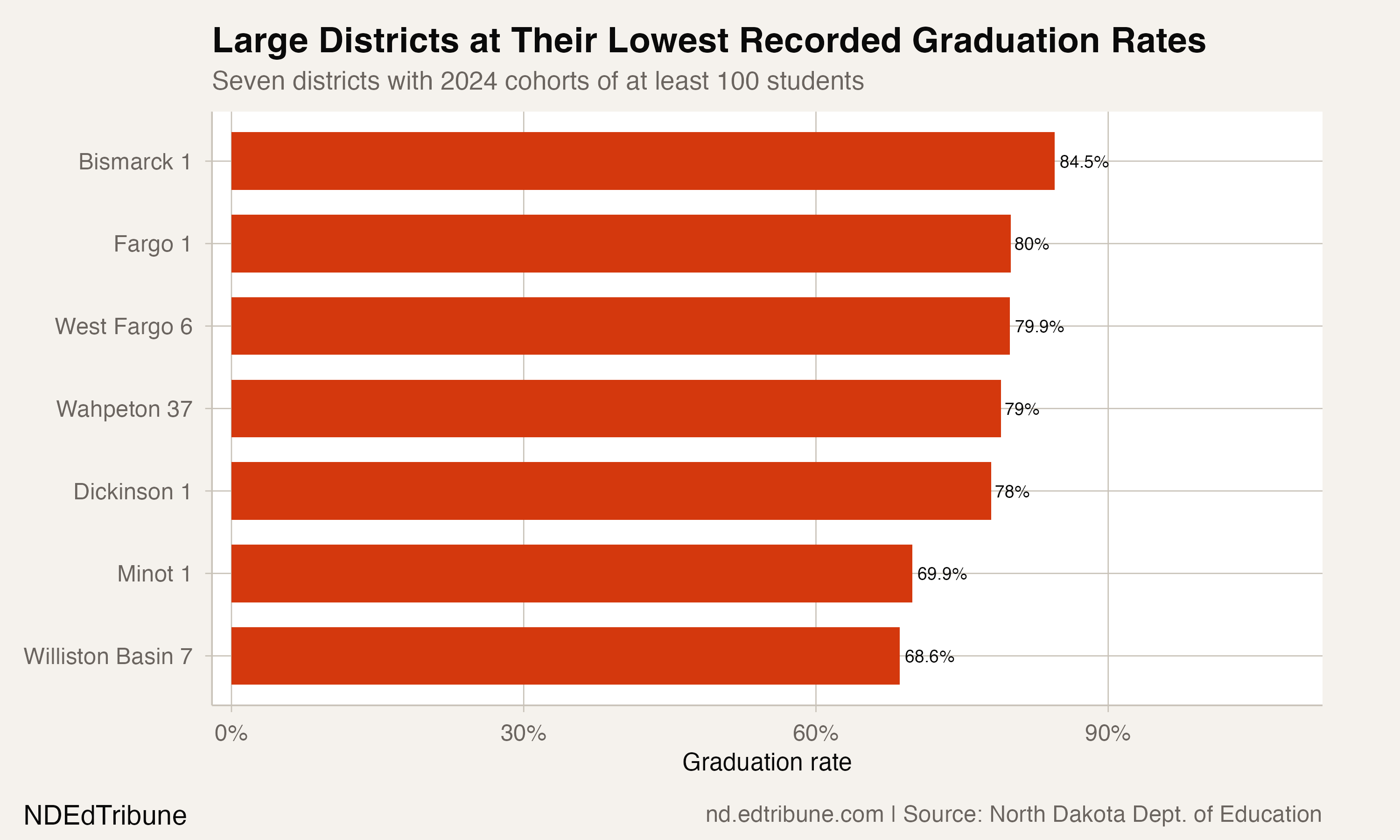
Fargo, at 80% with the state's second-largest cohort of 949, and West Fargo, at 79.9% with the third-largest at 884, sat just below the state average. Even Bismarck, the state's largest district at 1,057 students, was at its own floor with 84.5%. Bismarck's rate was higher than the state average, but it was still the lowest the capital has posted.
Together, these seven districts accounted for 4,230 students in their 2024 cohorts -- 48.7% of the state's entire cohort. When that many of the largest population centers are at historic lows at the same time, the statewide average of 82.4% is not some abstract number. It is the sum of many local declines happening at once.
Small districts at the extremes
The 24 smaller districts on the list span a wide range of rates. Some are deeply alarming: Fairmount↗ET at 63.6% with 11 students, Montpelier↗ET at 66.7% with 12, Midkota↗ET at 70% with 10. In those three districts, a single student's outcome changes the rate by 8.3 to 10 percentage points, so individual years should be read with caution.
But the list also includes mid-sized districts where the numbers carry more weight. Grafton↗ET posted 79.7% with 74 students. Valley City↗ET recorded 83.3% with 84. South Prairie↗ET hit 83.3% with 48. These are cohorts large enough that an all-time low reflects more than a one- or two-student swing.
When districts hit their floor
2024 stands out as a historically bad year. More districts hit their all-time low graduation rate in 2024 than in any other year in the data.
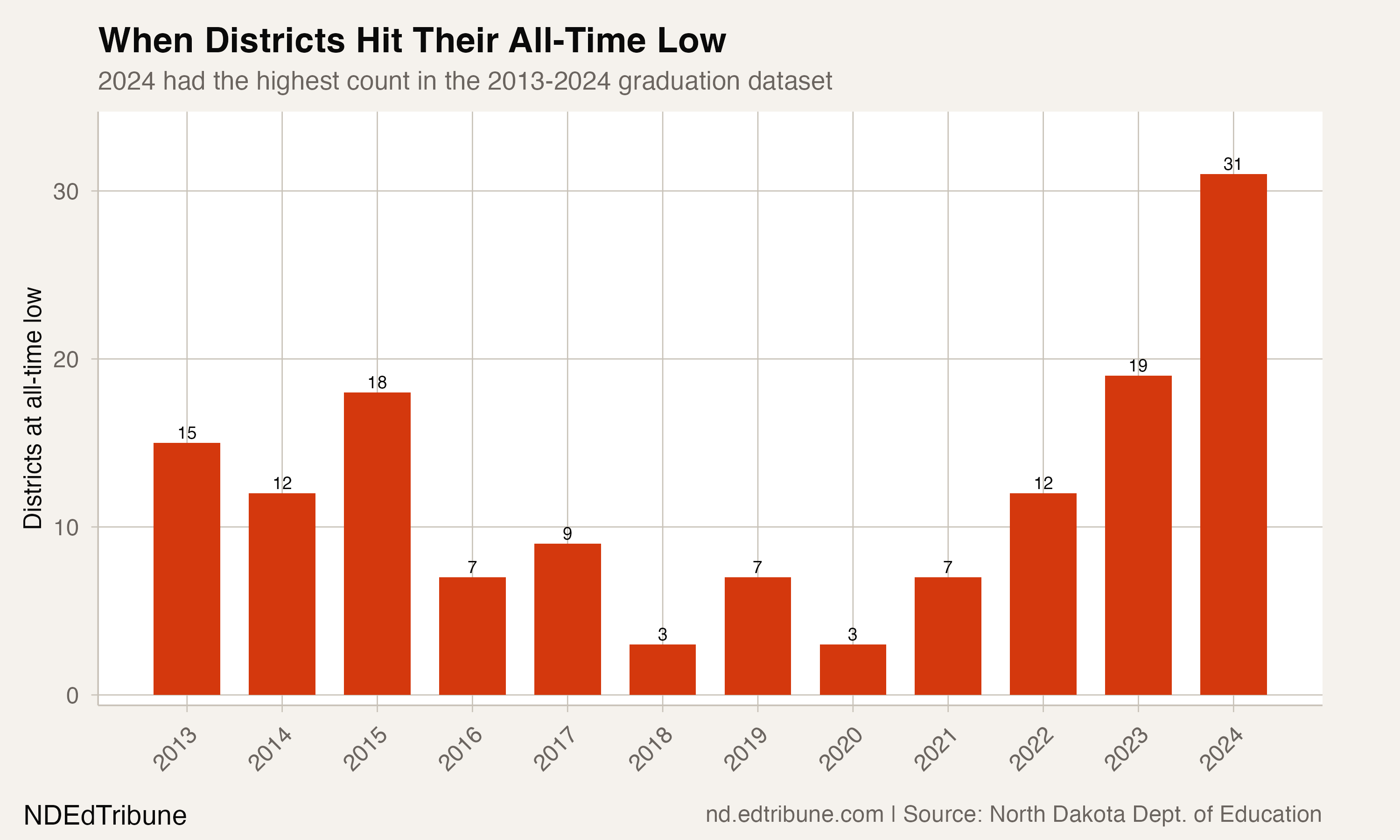
The concentration in 2024 is hard to miss. Some districts hit their lows in the 2013-2016 period, and the count rose from 12 in 2022 to 19 in 2023 and 31 in 2024. The statewide rate also fell in each year from 2021 through 2024 after peaking in 2020, so the 2024 district cluster is part of a statewide slide rather than a single outlier year.
What the list does not include
The 31-district count uses a conservative definition: only districts with at least three years of data, and only those where the 2024 rate equals the lowest rate in that district's own record. Three districts tied an earlier low rather than setting a new one. Districts with fewer than three years of data, including some that were reorganized, are excluded.
The count is still a warning light, not a complete diagnosis. It excludes nine districts with shorter histories, and it does not say why any district hit its low. But the statewide decline to 82.4% is not a story about a handful of outliers dragging down an otherwise healthy system. The 2024 lows include large city systems, oil-country systems, Red River Valley districts, and small rural districts.
Data from the North Dakota Department of Public Instruction. Graduation rates represent four-year cohort rates. All years use the end-year convention (2024 = class of 2024).
Detailed code that reproduces the analysis and figures in this article is available exclusively to EdTribune subscribers.
Discussion
Sign in to join the discussion.
Loading comments...