North Dakota was one of the first states in the country to get students back in classrooms. By December 2020, 98% of the state's schools were operating in person. By August 2021, every school was open five days a week. The expectation, reasonable at the time, was that reopening early would mean recovering early.
Four years later, one in five North Dakota students is still chronically absent, and the rate has not budged in two years.
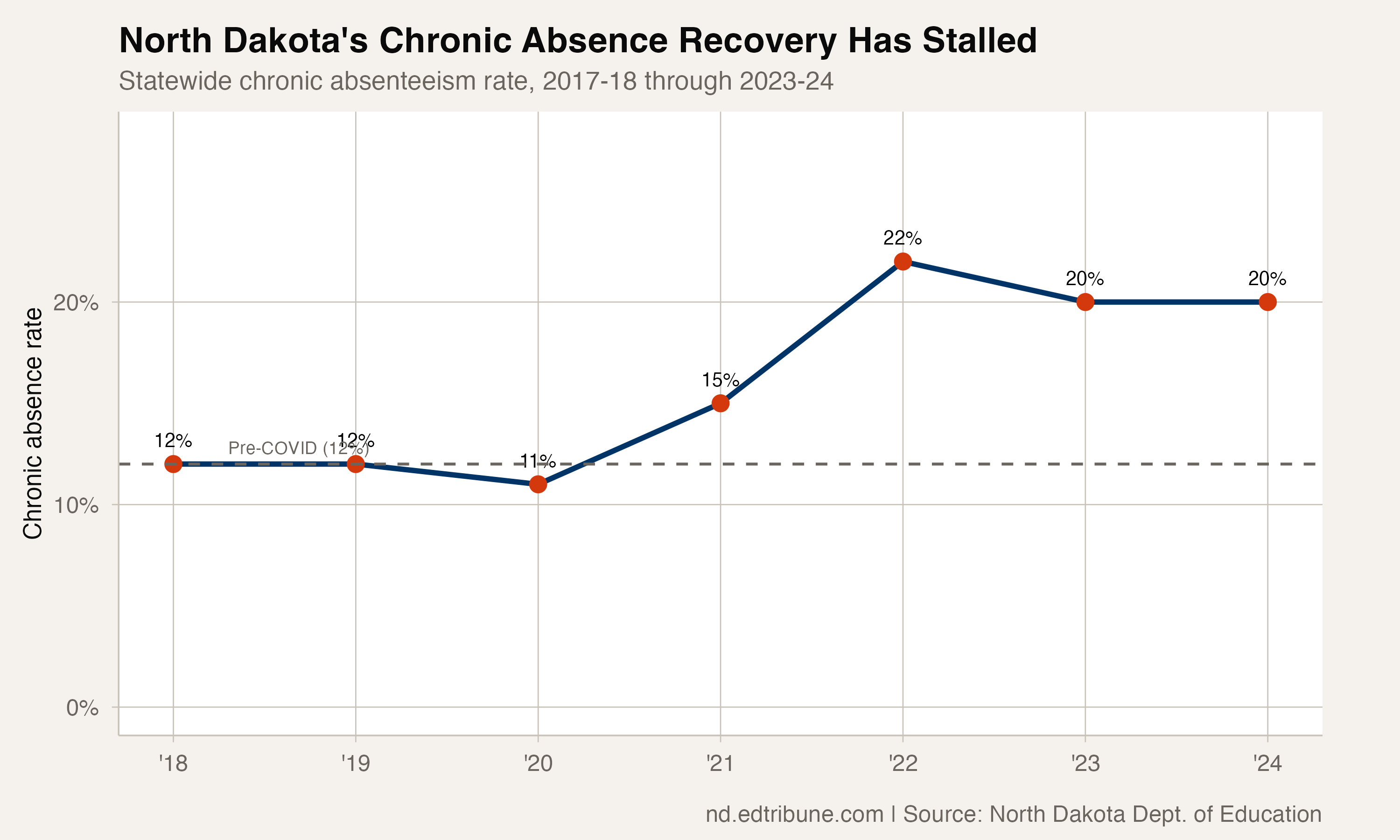
The state's chronic absenteeism rate hit 22% in 2021-22, the first full post-pandemic school year. It dropped two percentage points to 20% in 2022-23. And then it stopped. In 2023-24, the rate was 20% again, unchanged. North Dakota has recovered exactly 20% of the way back to its pre-COVID baseline of 12%.
The plateau nobody planned for
Before the pandemic, about 12% of North Dakota students missed more than 10% of school days, a figure that held steady in both 2017-18 and 2018-19. COVID pushed the rate to 15% in 2020-21, then to 22% the following year even as schools were fully open. The two-point drop in 2022-23 looked like the beginning of a recovery arc.
It was not.
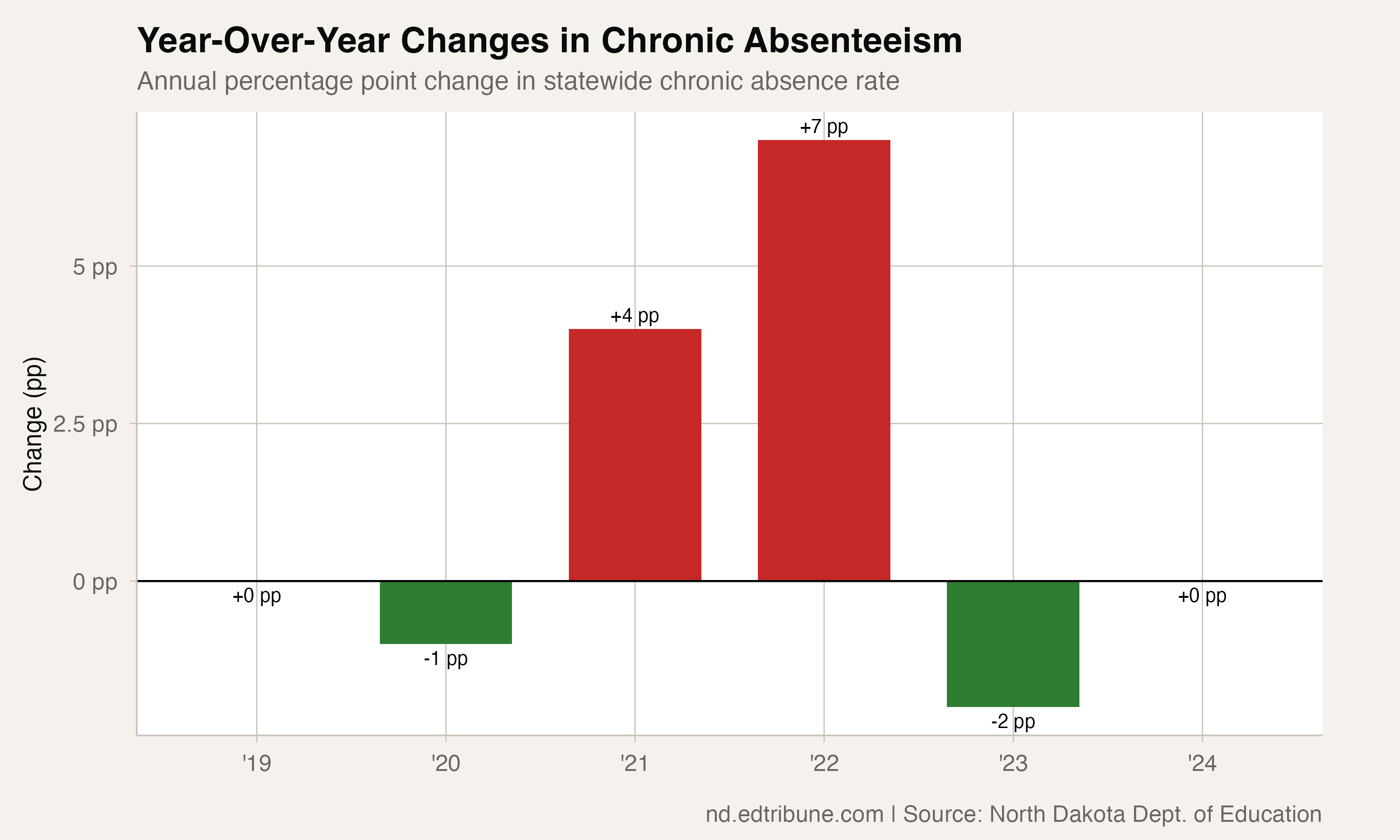
The zero movement in 2023-24 suggests that whatever drove the initial two-point improvement -- re-established routines, attendance campaigns, the fading of acute COVID disruptions -- has run its course. What remains is structural. Students have settled into new patterns of absence that the pandemic amplified but did not create.
At the current pace, which is no improvement at all, North Dakota will not return to its pre-pandemic 12% until it finds an entirely different approach. Even the optimistic scenario -- resuming the one-point-per-year decline from 2022 to 2023 -- would push full recovery to roughly 2032.
The crisis behind the number
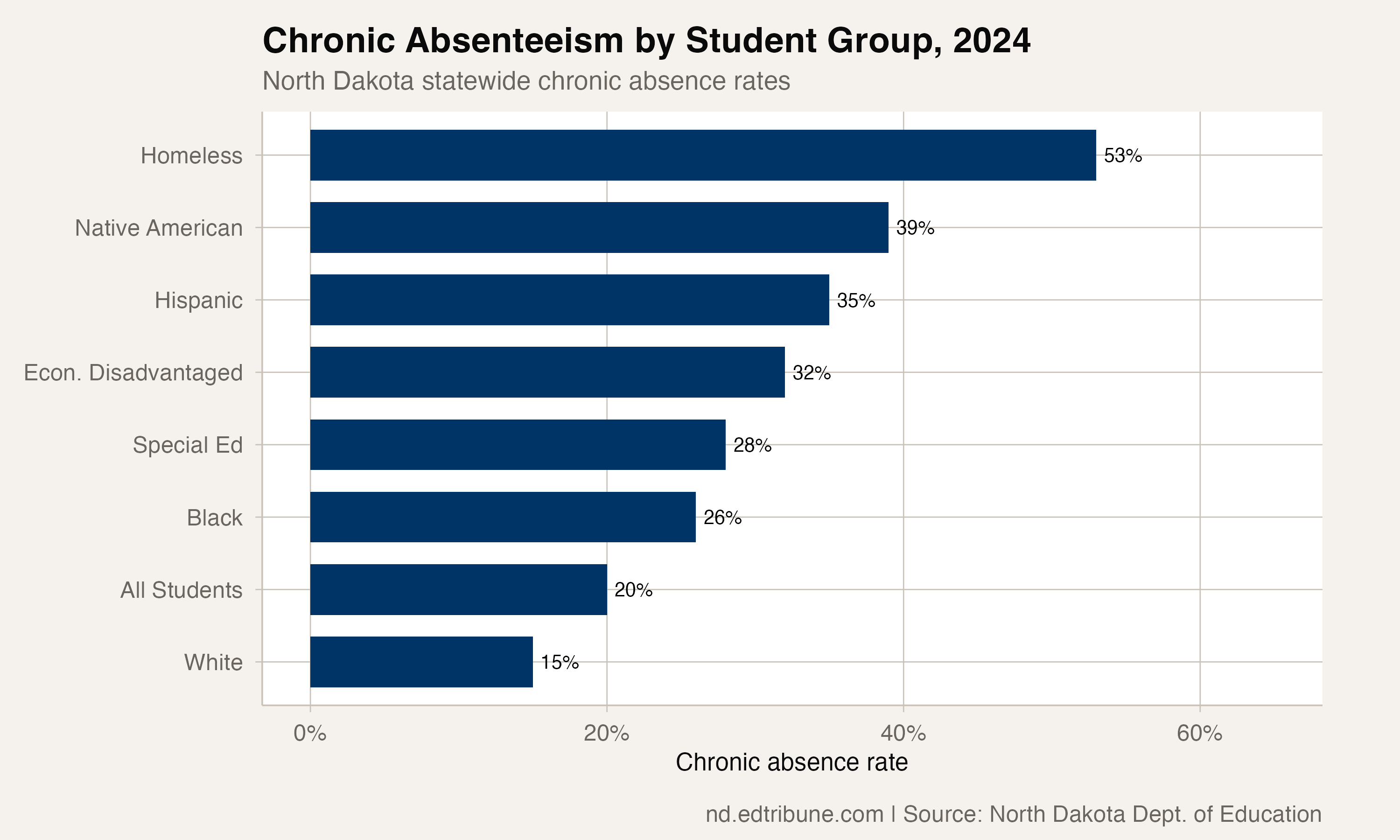
The 20% statewide figure masks disparities that are far worse. Students who are currently homeless have a 53% chronic absence rate -- a majority missing more than a month of school every year. Native American students are at 39%. Hispanic students sit at 35%, and economically disadvantaged students at 32%.
White students, who make up the large majority of North Dakota's enrollment, have a 15% chronic rate. That figure is itself three percentage points above the pre-COVID level of 12% for all students. Even the state's least-affected population has not returned to normal.
The gap between the highest and lowest subgroups is 38 percentage points. It has widened since the pandemic, not narrowed.
What 20% means in practice
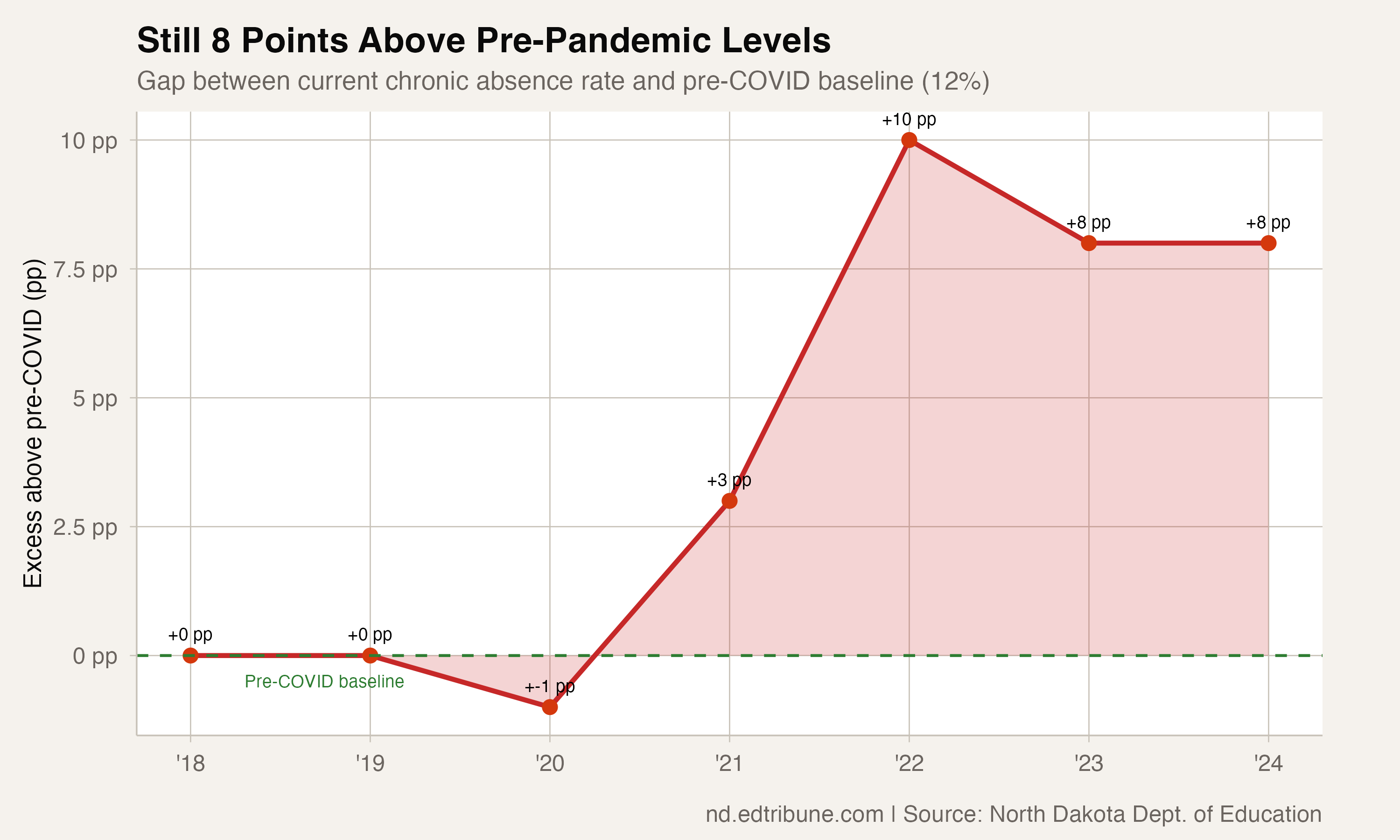
North Dakota's roughly 115,000 public school students include about 23,000 who are chronically absent at the current 20% rate. Before the pandemic, that number was closer to 14,000. The state has approximately 9,000 more chronically absent students than it did five years ago, and the flow of students back toward regular attendance has stopped.
North Dakota funds schools based on Average Daily Membership, counting enrolled students whether they show up or not. Districts do not lose per-pupil revenue when students miss school, removing one lever that attendance-linked funding states use to push improvement.
The mental health dimension
Thirty-five percent of the state's high schoolers reported feeling sad or hopeless in 2023, and 18% seriously considered suicide. The school counselor ratio falls below the American School Counselor Association's recommended level, with 87% of students underserved.
Students dealing with anxiety, depression, or trauma miss more school. Whether North Dakota's attendance plateau reflects an unaddressed mental health crisis, a workforce shift that has parents less available to enforce attendance, or a cultural change in how families treat daily school presence is unclear. What is clear is that reopening schools was not enough, and eight percentage points of excess chronic absenteeism show no sign of resolving on their own.
Detailed code that reproduces the analysis and figures in this article is available exclusively to EdTribune subscribers.
Discussion
Sign in to join the discussion.
Loading comments...