The Bakken oil formation transformed western North Dakota's economy over the past two decades, bringing thousands of workers, rapid population growth, and billions in tax revenue. It also brought volatility, the kind that follows families who move to chase opportunity and leave when the wells slow down.
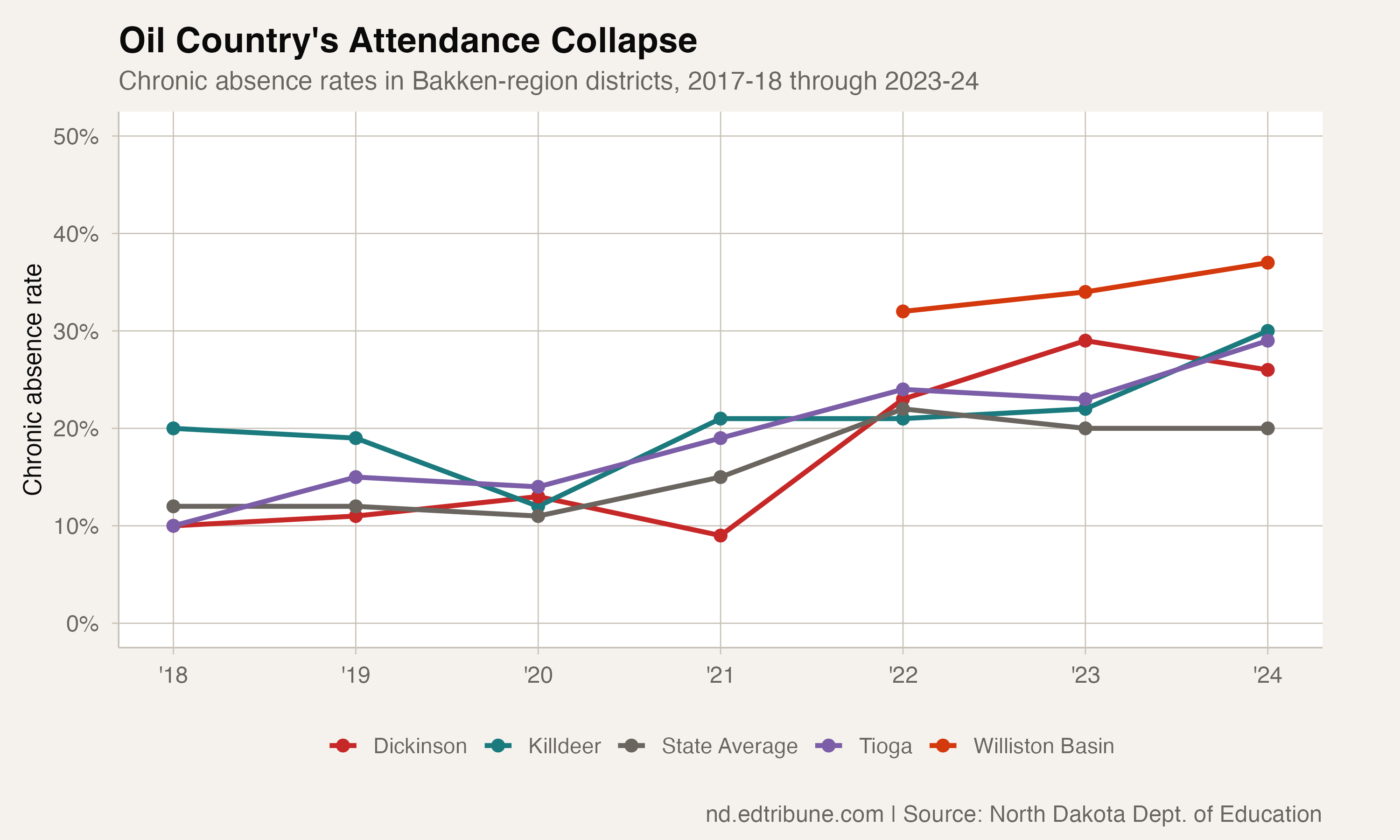
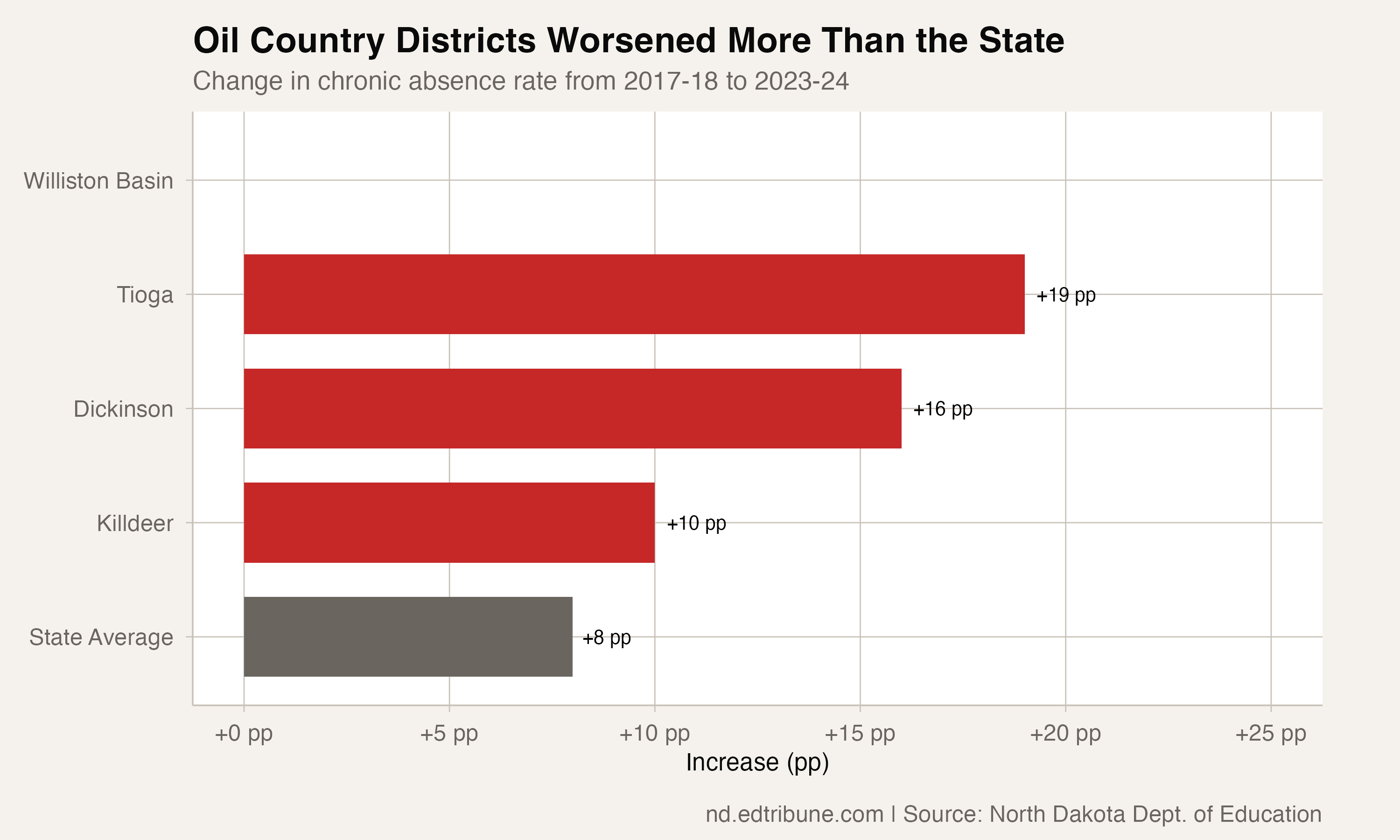
Now that volatility is showing up in the attendance data. Dickinson, the hub of the southern Bakken, has seen its chronic absenteeism rate surge from 10% in 2017-18 to 26% in 2023-24, a 16-percentage-point increase that doubles the state's 8-point rise over the same period. Across the oil patch, the pattern repeats.
A regional pattern
Dickinson is not an isolated case. Tioga, a small district in Williams County, jumped from 10% to 29%, a 19-point increase. Killdeer, in Dunn County, climbed from 20% to 30%. Williston Basin, the district at the geographic center of the oil boom, has reported 37% chronic absence since data became available in 2022, the highest rate in the region.
Every one of these districts exceeds the state average. The state went from 12% to 20%, an 8-point change. Dickinson and Tioga each worsened by 16 to 19 points.
Why oil country is different
The connection between oil field economics and school attendance is not direct in the way that, say, poverty or homelessness affects attendance. But the mechanism is real.
Oil boom-bust cycles create transient populations. Families arrive when drilling activity is high and leave when it slows. Students who change schools mid-year, who lack stable housing, or whose parents work irregular shift schedules are more likely to miss school. The mobile student subgroup, those who changed schools during the year, has a 48% chronic absence rate statewide.
Western North Dakota experienced population surges during the 2012-2014 and 2018-2019 oil booms that strained housing, infrastructure, and school capacity. When oil prices collapsed in 2020 alongside COVID, districts faced the dual shock of pandemic disruption and economic contraction. The post-pandemic attendance recovery that some eastern North Dakota districts have achieved has not materialized in oil country, where the economic disruption was compounding rather than parallel.
Dickinson up close
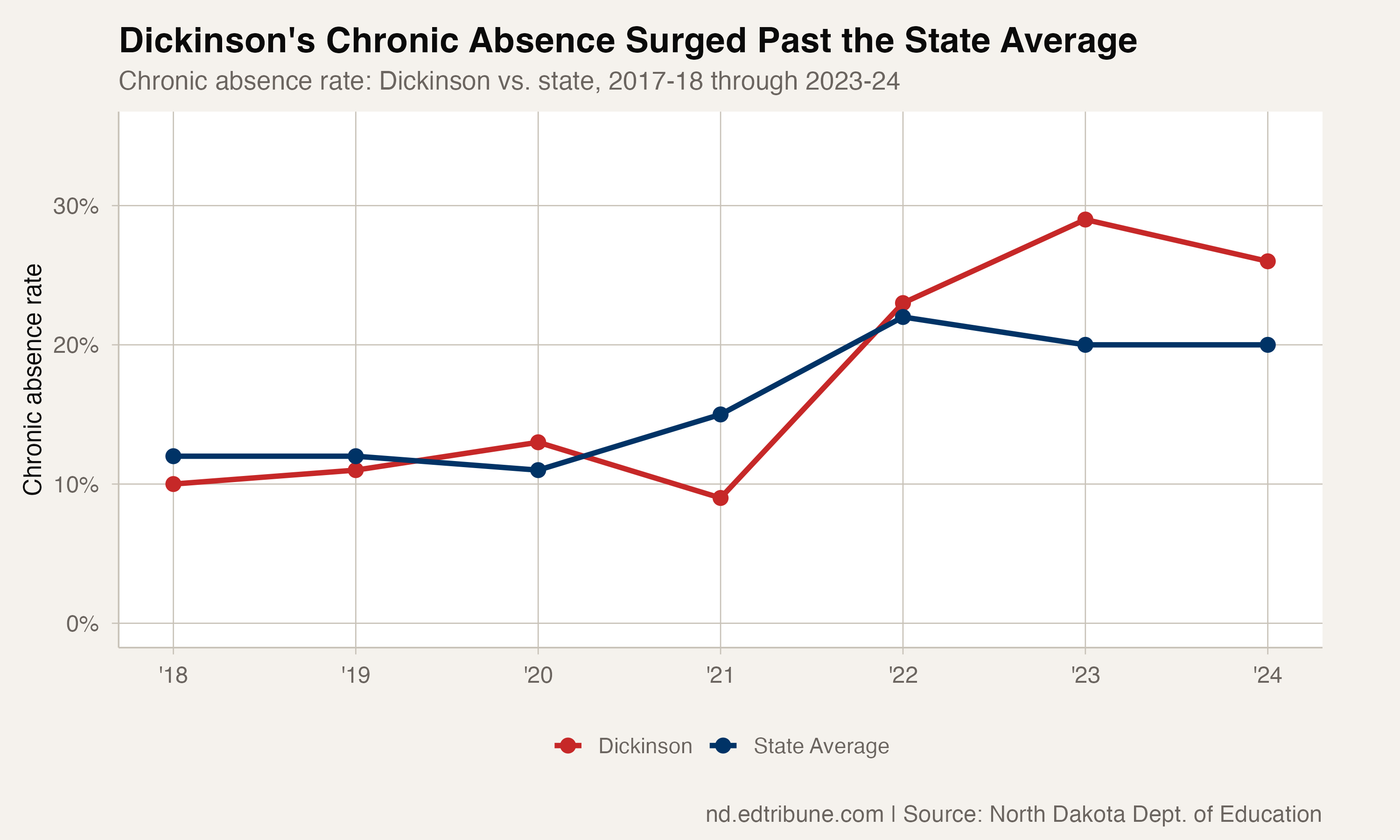
Dickinson's trajectory is particularly striking because the district started from a low baseline. At 10% in 2018, Dickinson was below the state average. By 2024, at 26%, it exceeds the state by 6 points. The crossover happened around 2021, and the gap has widened since.
The district's economically disadvantaged students, mobile students, and students of color all face rates above the overall district number. The concentration of elevated absence in already-vulnerable populations suggests that oil country's economic volatility hits hardest the families with the least buffer against disruption.
The Bakken attendance map
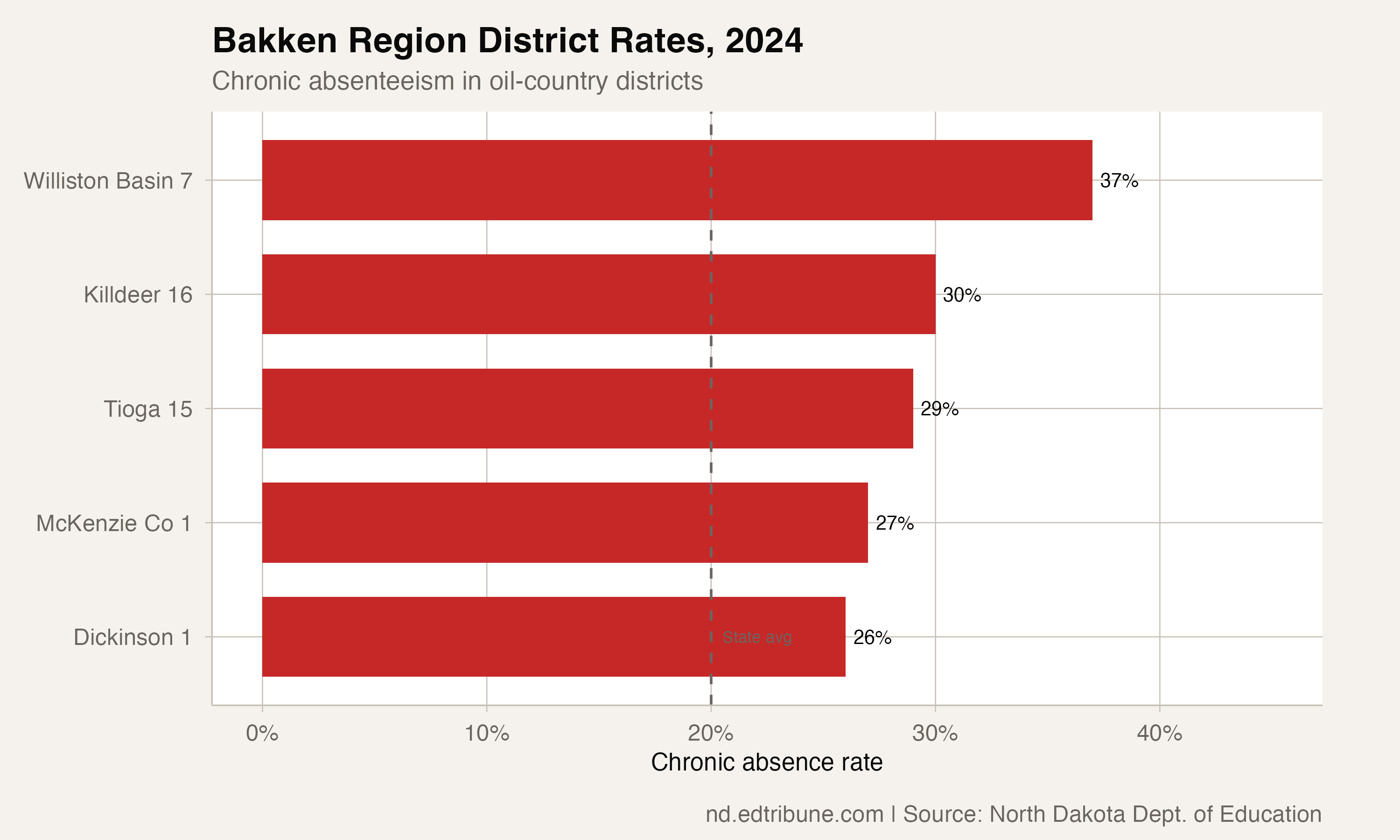
Across the Bakken region in 2024, no district with available data has a chronic rate below the state average. The lowest-rate oil country district still exceeds 20%. The highest, Williston Basin at 37%, is approaching the territory where more than a third of students are chronically absent.
These are not reservation districts, where historical underinvestment and geographic isolation create long-standing attendance barriers. These are communities with relatively high incomes and new school buildings -- places where the economic fundamentals suggest attendance should be easier, not harder. The oil patch proves that stability matters as much as prosperity. Boom towns create their own kind of disruption, and Dickinson's six consecutive years of worsening attendance show no sign of reversing.
Detailed code that reproduces the analysis and figures in this article is available exclusively to EdTribune subscribers.
Discussion
Sign in to join the discussion.
Loading comments...