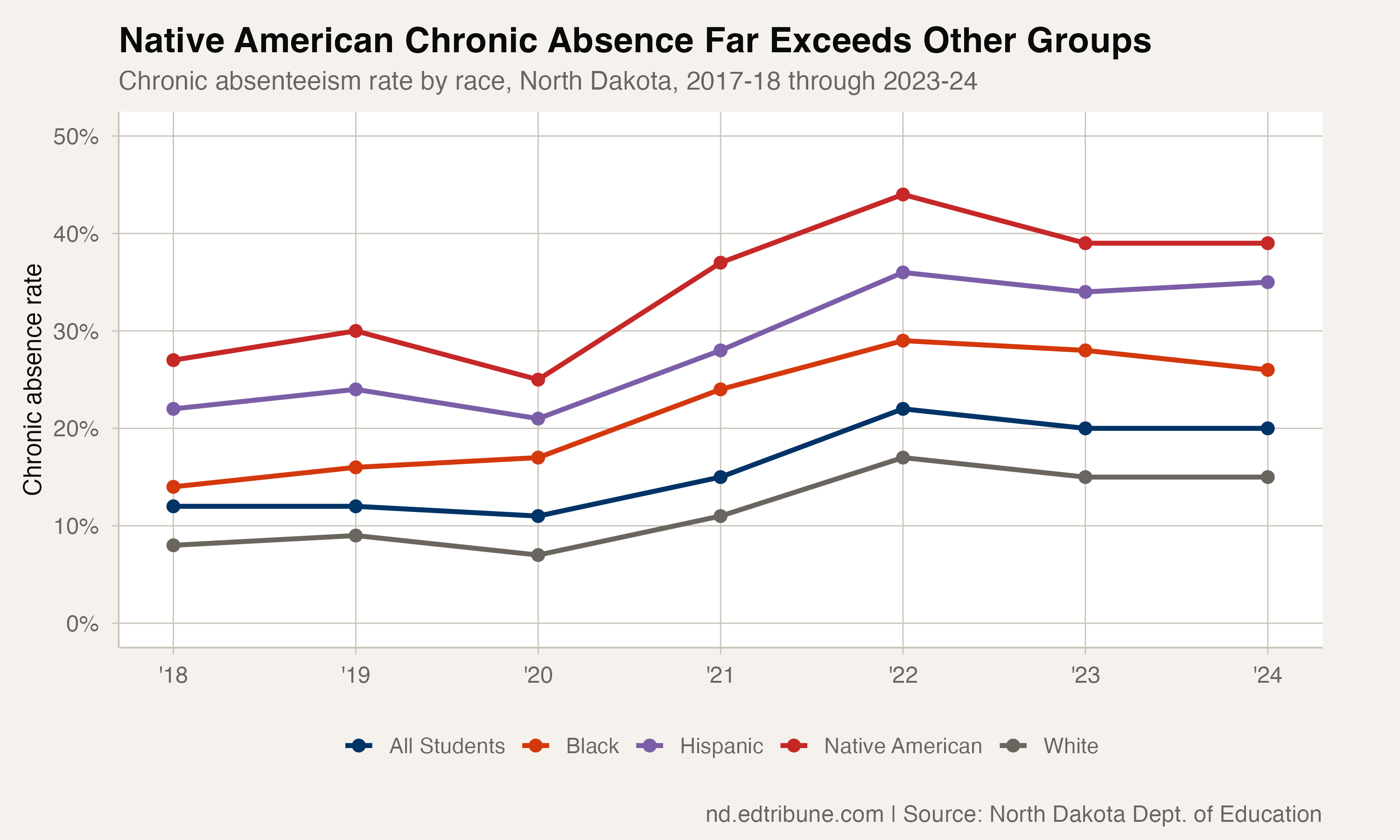
The number is 39%. That is the share of Native American students in North Dakota who are chronically absent -- missing more than 10% of the school year. In a classroom of ten Native American students, nearly four are missing so much school that research says their academic outcomes are at serious risk.
The rate peaked at 44% during the pandemic and has come down only five points in three years. White students, by comparison, have a 15% chronic absence rate. The 24-percentage-point gap between the two groups has widened since before the pandemic, when it stood at 21 points.
A gap that COVID made worse
Before COVID, chronic absence rates ranged from 9% for white and Asian students to 30% for Native American students. The pandemic blew those rates upward, but not equally. Native American students went from 30% to 44%, a 14-point increase. White students went from 9% to 17%, an 8-point increase. The absolute gap between the two groups grew from 21 percentage points in 2019 to 27 in 2022, and has only partially narrowed to 24 points in 2024.
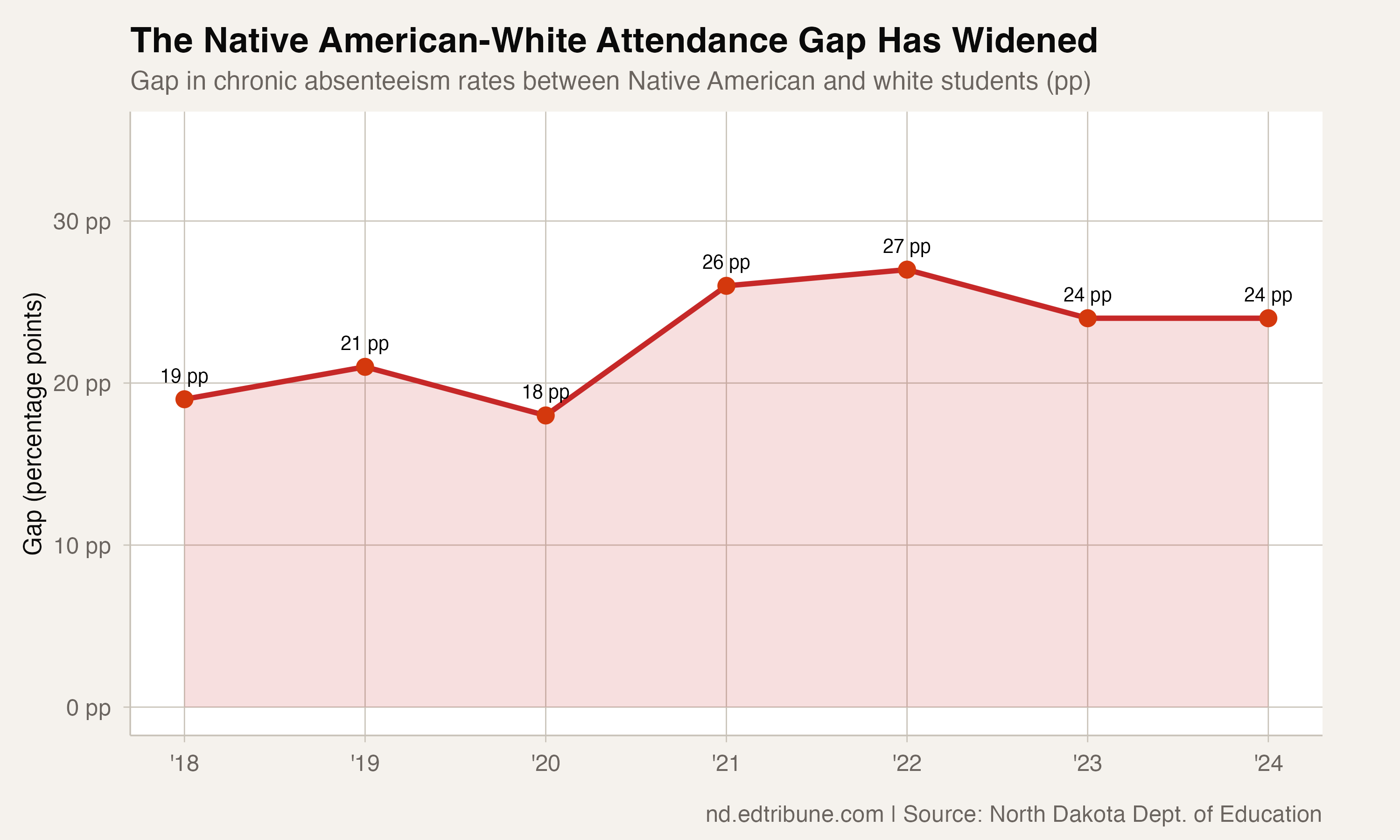
The widening is not unique to the Native American-white comparison. Black students have a 26% chronic rate, up from 16% pre-COVID, with an 11-point gap above white students that has grown since 2019. Hispanic students are at 35%, with a 20-point gap that has expanded by 5 points. But the Native American disparity is the largest in both absolute terms and human impact, given that Native American students make up a meaningful share of North Dakota's enrollment, particularly in western and north-central districts.
Where the crisis concentrates
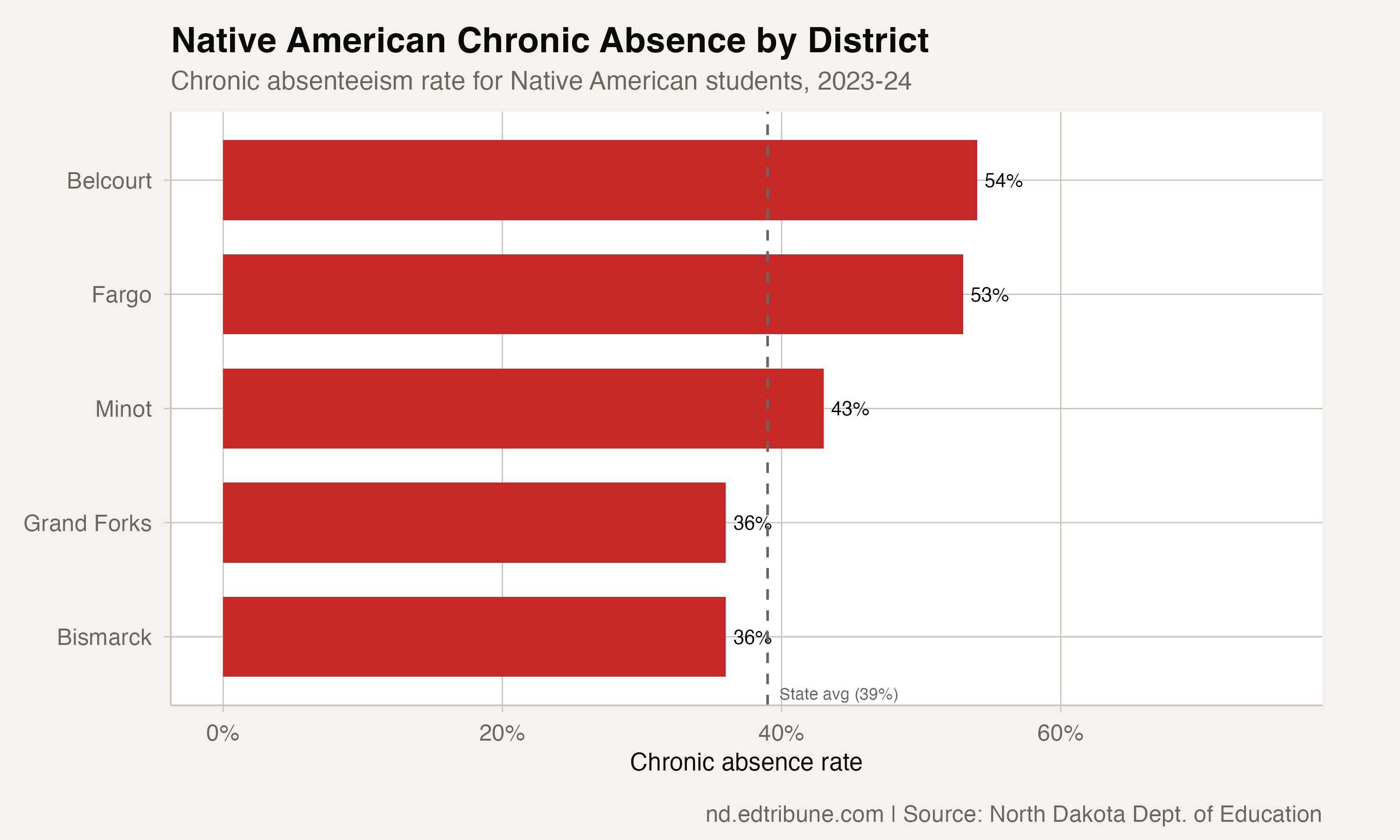
At the district level, the numbers become starker. In Fargo, the state's largest district, 53% of Native American students are chronically absent. That is more than double Fargo's overall 26% rate. In Belcourt 7, the district serving the Turtle Mountain Band of Chippewa reservation, the overall rate is 54%, and Native American students make up the vast majority of enrollment.
Williston Basin reports a 48% Native American chronic rate. Mandan sits at 45%, Devils Lake at 44%, and Minot at 43%. Even in Grand Forks, where the district has implemented a new attendance policy that reduced overall absences, Native American students remain at 36%.
The geographic pattern reveals two distinct crises. On reservations, chronic absence is a community-wide phenomenon driven by historical underinvestment, health disparities, and the lasting impact of tribal mandates that kept students out longer during COVID due to higher health vulnerability. In urban districts like Fargo and Minot, Native American students face the additional challenge of being a small minority in large systems not designed around their needs.
The scale of the disparity
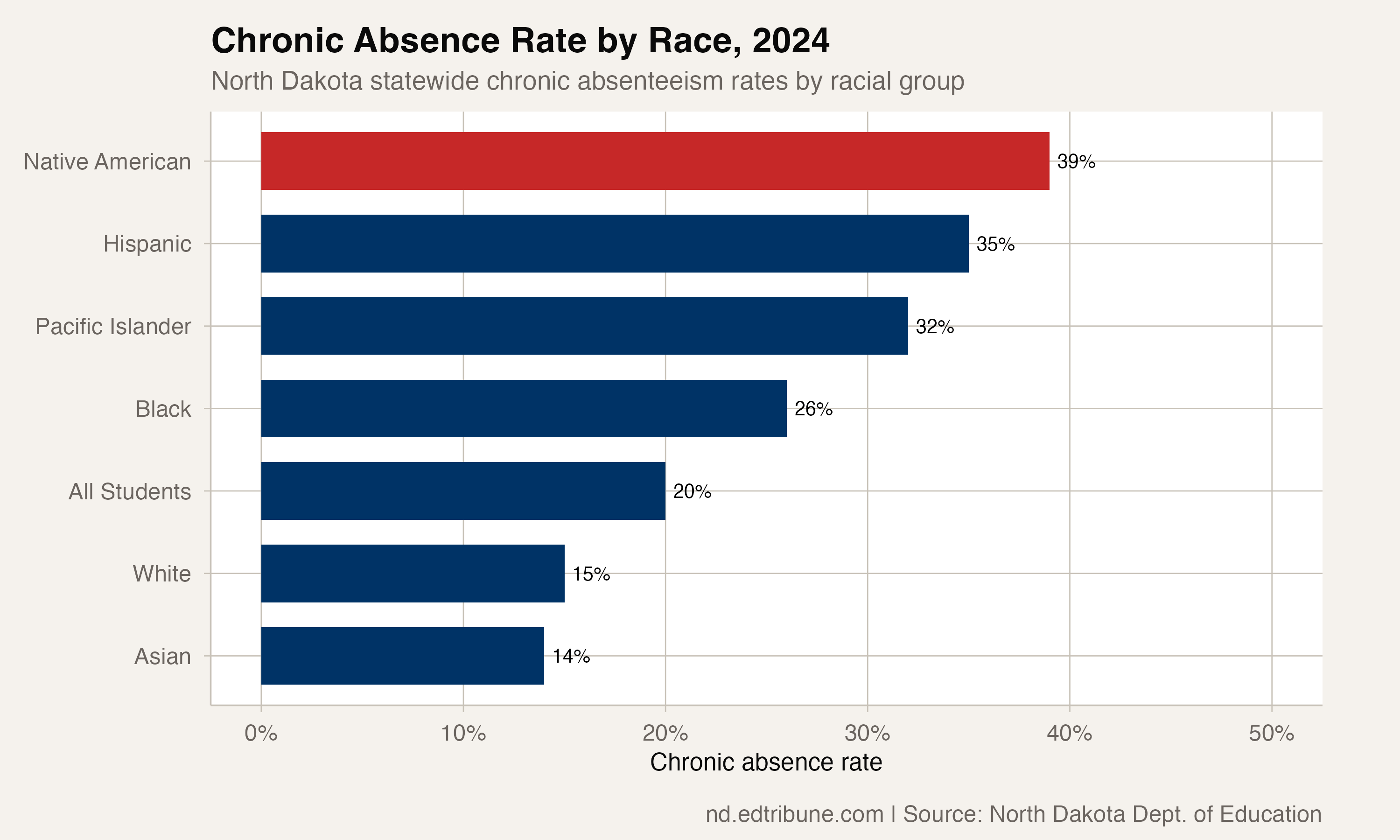
Among all racial subgroups reported statewide in 2024, Native American students have the highest chronic absence rate at 39%. Hispanic students follow at 35%, then Black students at 26%. White students, who make up the majority of enrollment, sit at 15%. Asian students have the lowest rate at 14%.
The 39% rate means that for every ten Native American students who started the school year, roughly four accumulated enough absences to be classified as chronically absent by year's end. For white students, that figure is closer to one or two.
These are not marginal differences in attendance. They represent fundamentally different educational experiences happening within the same state system. A Native American student in North Dakota is 2.6 times more likely to be chronically absent than a white student, and that ratio has increased since 2019.
Transportation, trauma, and trust
The data measures who is absent. It does not explain why. Tribal educators point to transportation barriers on reservations, where distances are long and public transit does not exist. Health disparities play a role: Native American communities in North Dakota face higher rates of chronic illness and mental health challenges that affect both students and their caregivers. And the legacy of forced assimilation through boarding schools has left a distrust of educational institutions that attendance letters and incentive programs were not designed to address.
North Dakota's attendance crisis is, at its core, an equity crisis. The gap was bad before COVID, and five years of recovery efforts have made it worse.
Detailed code that reproduces the analysis and figures in this article is available exclusively to EdTribune subscribers.
Discussion
Sign in to join the discussion.
Loading comments...