When a student lacks a stable place to sleep, showing up to school every day becomes an act of extraordinary determination. In North Dakota, the data suggests that determination has its limits.
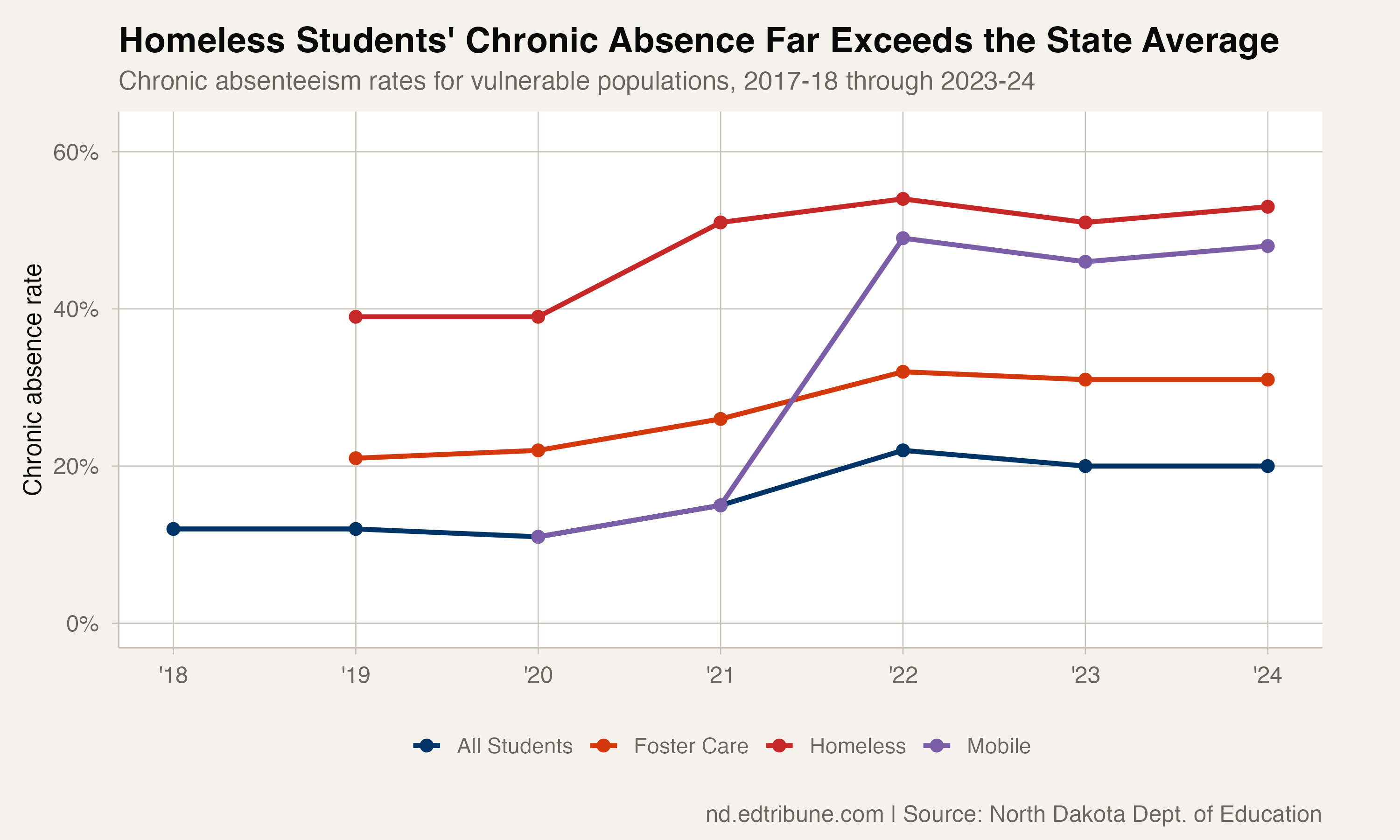
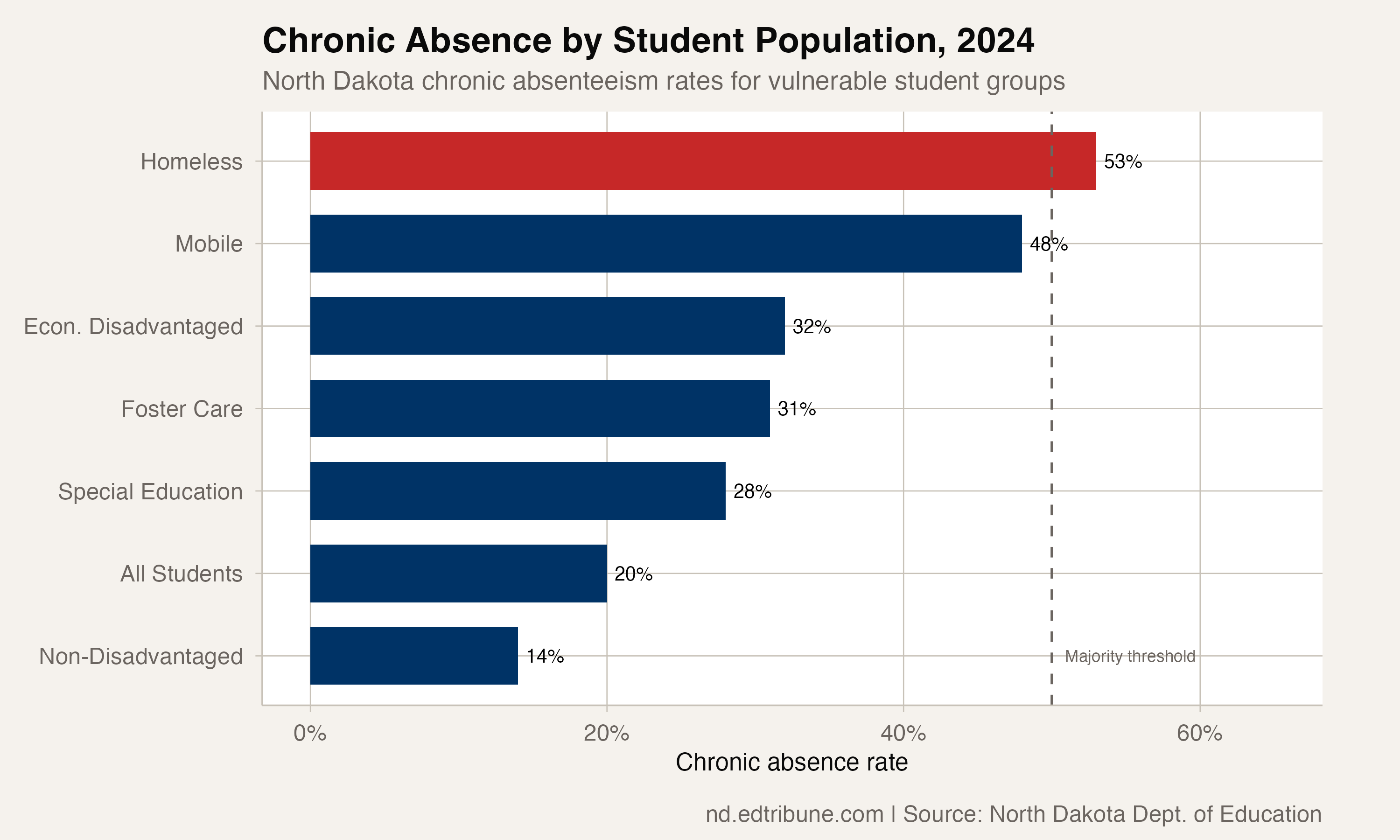
Fifty-three percent of the state's students who are currently homeless are chronically absent, meaning they miss more than 10% of school days in a year. That is not a troubled minority within a struggling group. It is the majority. More students who are currently homeless in North Dakota miss too much school than attend regularly.
The rate has barely moved from its 54% peak in 2021-22, dropping just one percentage point in two years. Before the pandemic, students who are currently homeless had a 39% chronic absence rate, already deeply concerning. COVID pushed it to 51% in 2020-21, then to 54%, and it has essentially stayed there.
A cluster of crises
Students who are currently homeless are not the only vulnerable population facing extreme absence rates. Students in foster care have a 31% chronic absence rate, up from 21% pre-COVID. Students who changed schools during the school year, sometimes called mobile students, are at 48%. Students who are economically disadvantaged sit at 32%, more than double the 14% rate for their non-disadvantaged peers.
The pattern across all these groups points to a common thread: housing and economic instability are among the strongest predictors of chronic absence, and COVID amplified every one of those instabilities without creating mechanisms for recovery.
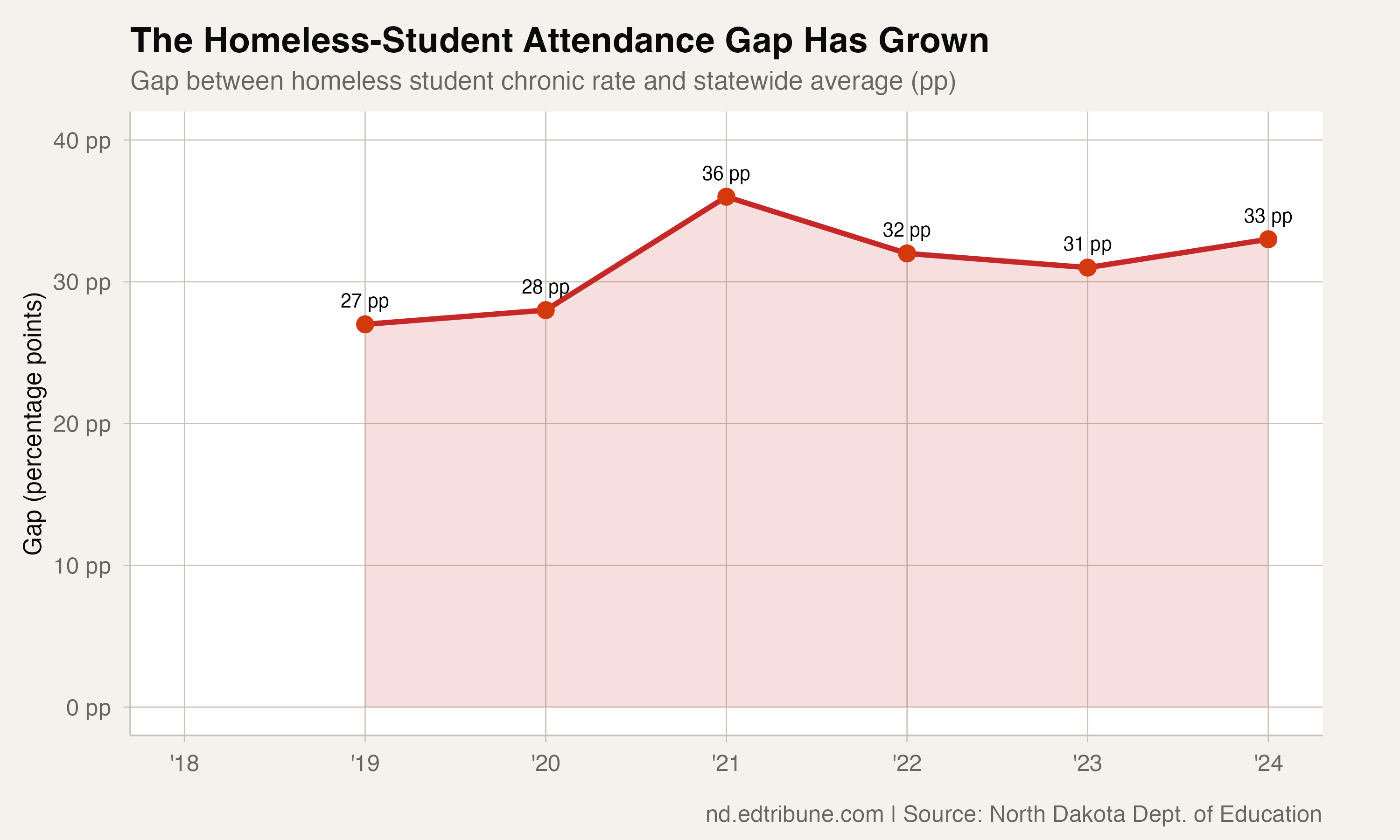
The gap between students who are currently homeless and the statewide average has grown from 27 percentage points in 2019 to 33 points in 2024. That widening means the crisis is not just persistent, it is getting relatively worse. While the overall rate fell from 22% to 20% between 2022 and 2024, the homeless rate barely moved from 54% to 53%.
Before and after
The before-and-after comparison is striking across every vulnerable group. Students who are currently homeless went from 39% to 53%, a 14-percentage-point increase. Students in foster care jumped from 21% to 31%. Students who are economically disadvantaged rose from 22% to 32%. The statewide average increased from 12% to 20%.
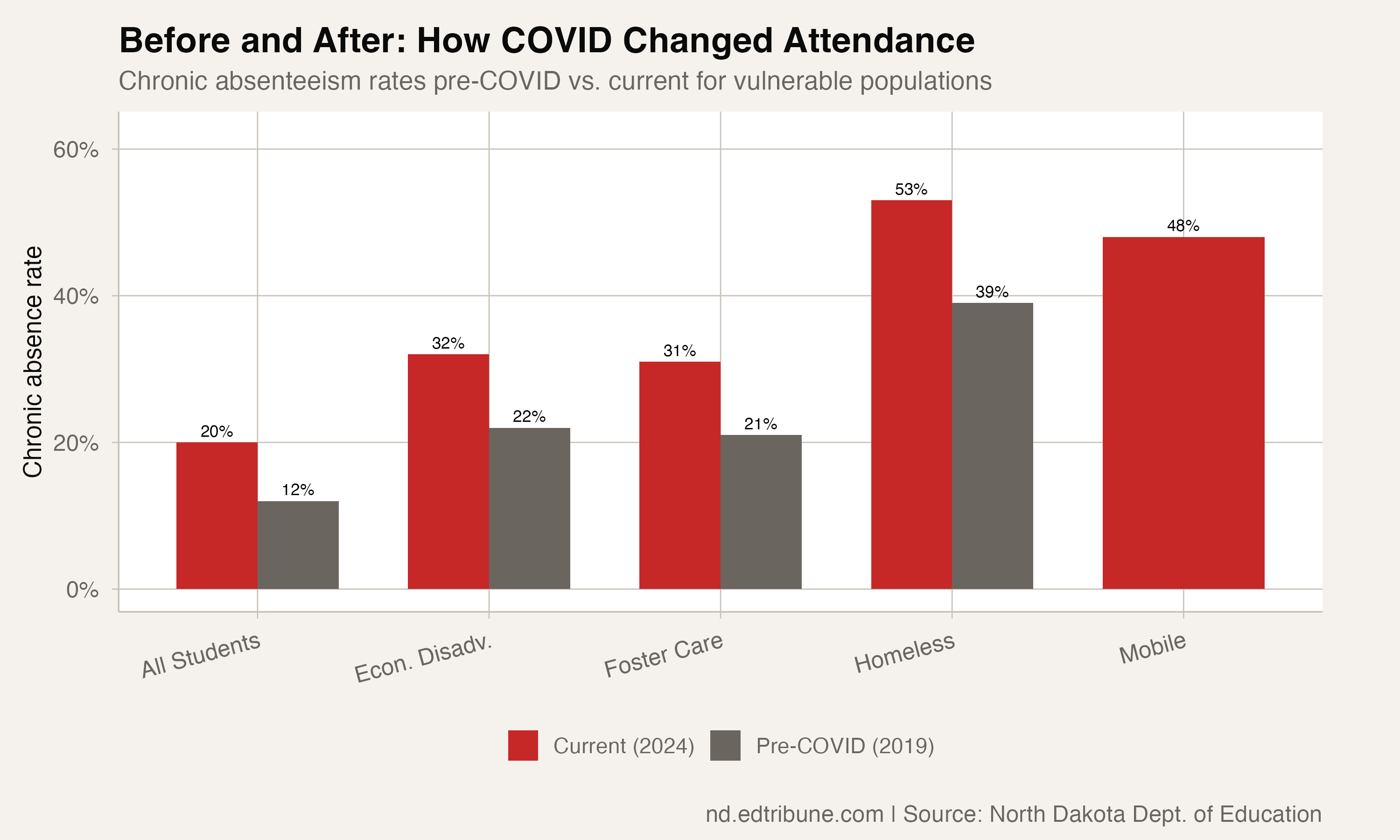
In each case, the vulnerable group's rate increased by more than the statewide rate, meaning the gaps widened. The pandemic did not hit every student equally, and the recovery, such as it is, has not reached every student equally either.
What the numbers demand
A 53% chronic absence rate means the state's attendance interventions, whatever they are, have functionally failed for students who are currently homeless. Standard approaches like attendance letters, parent phone calls, and incentive programs assume a baseline of stability that families experiencing homelessness do not have. A student sleeping in a car, a shelter, or a different relative's house each week faces transportation barriers, enrollment delays, and emotional distress that a robocall cannot fix.
North Dakota's school counselor shortage compounds the problem. With 87% of students underserved relative to recommended counselor ratios, the adults who might identify and support students who are currently homeless are stretched impossibly thin.
The state's McKinney-Vento liaisons, the federally mandated positions responsible for identifying and supporting students who are currently homeless, are the front line. But two years into a plateau with the majority still chronically absent, the current system of supports is plainly not adequate to the scale of the problem.
Detailed code that reproduces the analysis and figures in this article is available exclusively to EdTribune subscribers.
Discussion
Sign in to join the discussion.
Loading comments...