Correction (July 23, 2026): An earlier version misstated two of the four big-district comparisons. Bismarck's chronic absence rate went from 8% to 16%, an 8-point increase, not from 9% to 21%. Grand Forks peaked at 27%, not 23%, before improving to 23% in 2024.
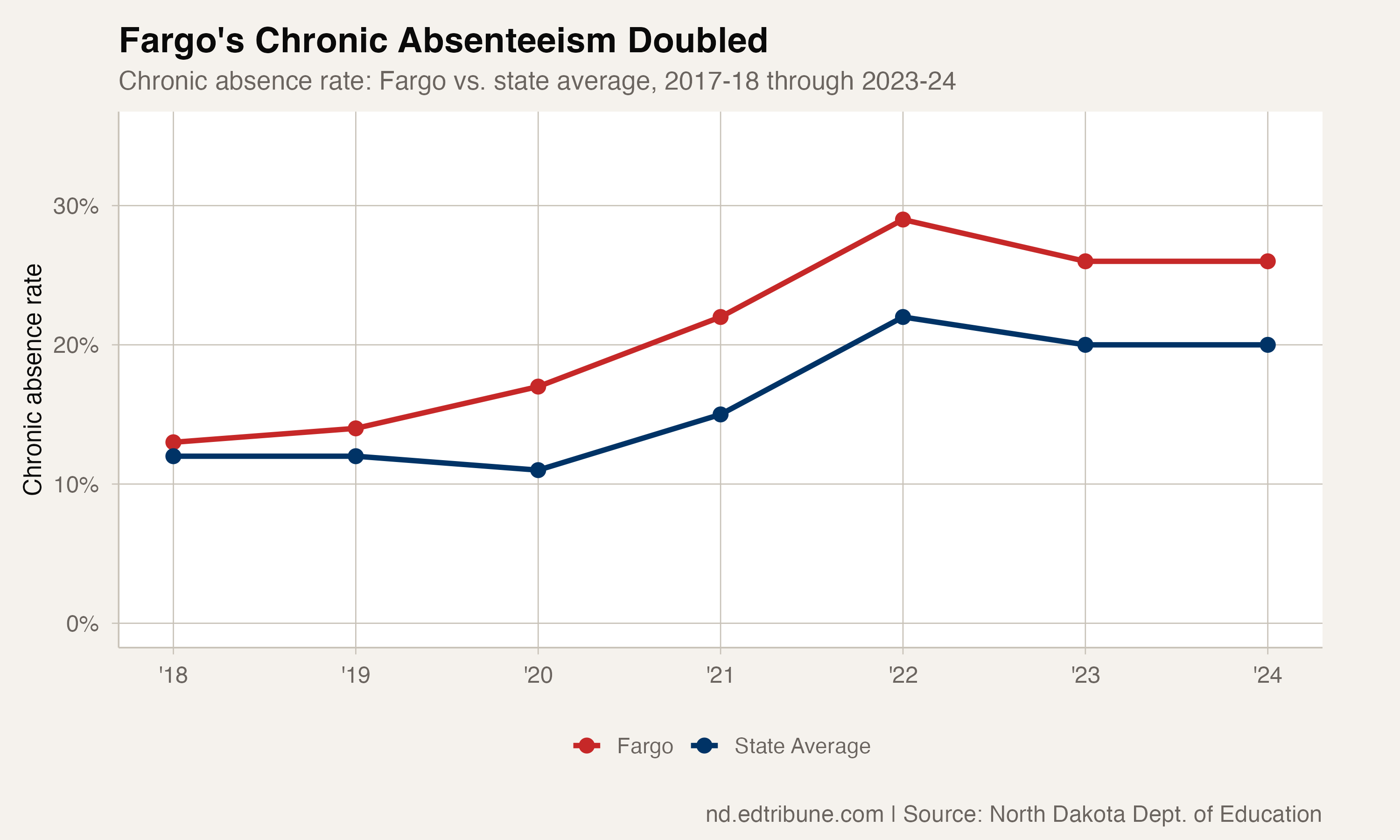
Fargo Public Schools is the largest district in North Dakota, and its chronic absenteeism problem is the largest in proportion. The district's overall rate has gone from 13% in 2017-18 to 26% in 2023-24, an exact doubling over six years.
One in four Fargo students now misses more than 10% of the school year. The district's peak of 29% came in 2021-22, and the three-point improvement since then has left it still double where it started.
A district of two experiences
The 26% district average conceals enormous variation from school to school. Excluding alternative programs like Dakota High, Fargo's school-level chronic rates range from around 5% at the lowest to 37% at the highest. That is a 32-point spread within a single district.
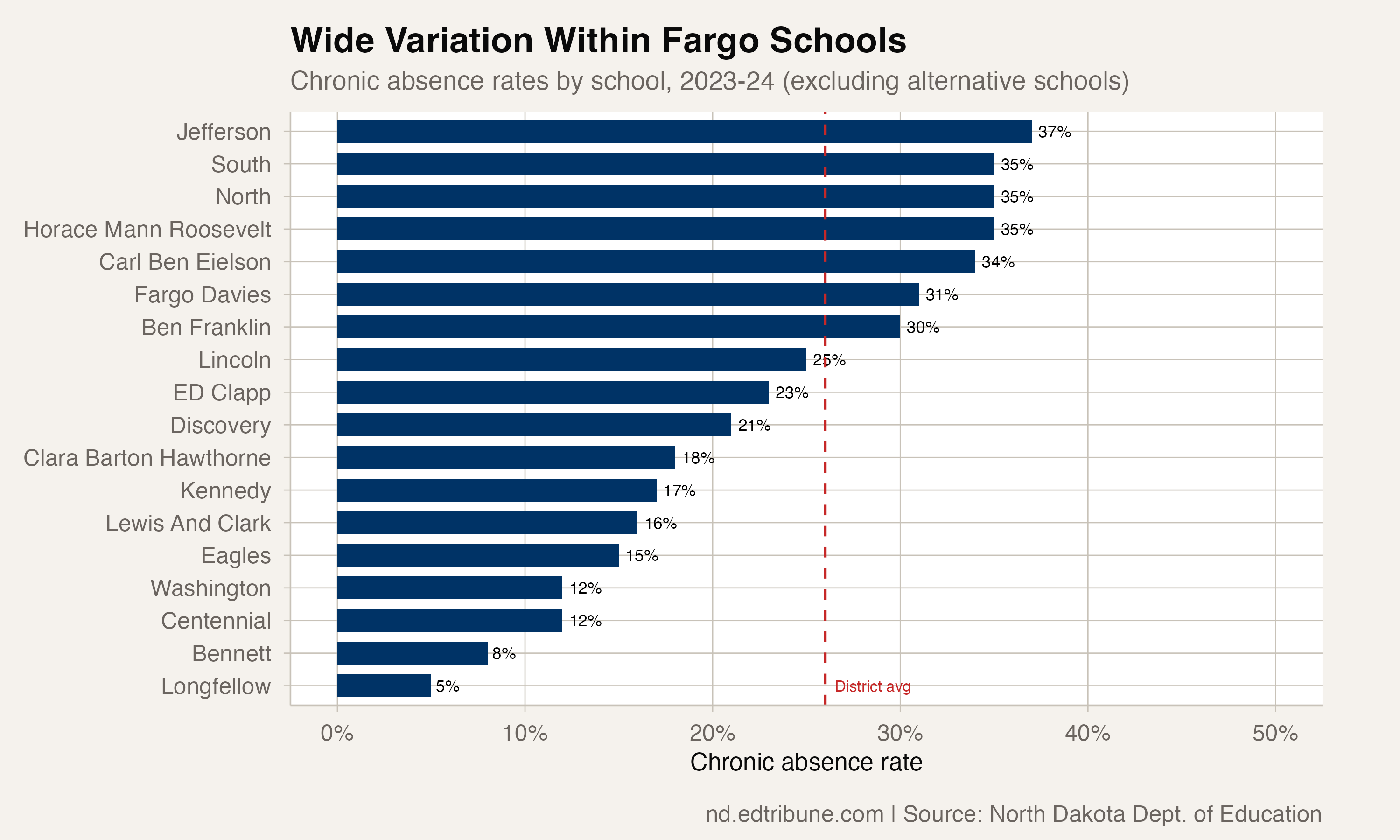
The pattern is predictable. Schools with higher concentrations of poverty and more students of color tend to have the highest rates. Schools in more affluent neighborhoods tend to have rates at or below the pre-pandemic statewide average. A Fargo student's likelihood of being chronically absent depends heavily on which school they attend, and which school they attend depends heavily on where they live.
Dakota High, Fargo's alternative school, has a 92% chronic rate. That number, while extreme, reflects the population the school serves: students who have already struggled in traditional settings, many with histories of chronic absence that preceded their enrollment.
The equity dimension
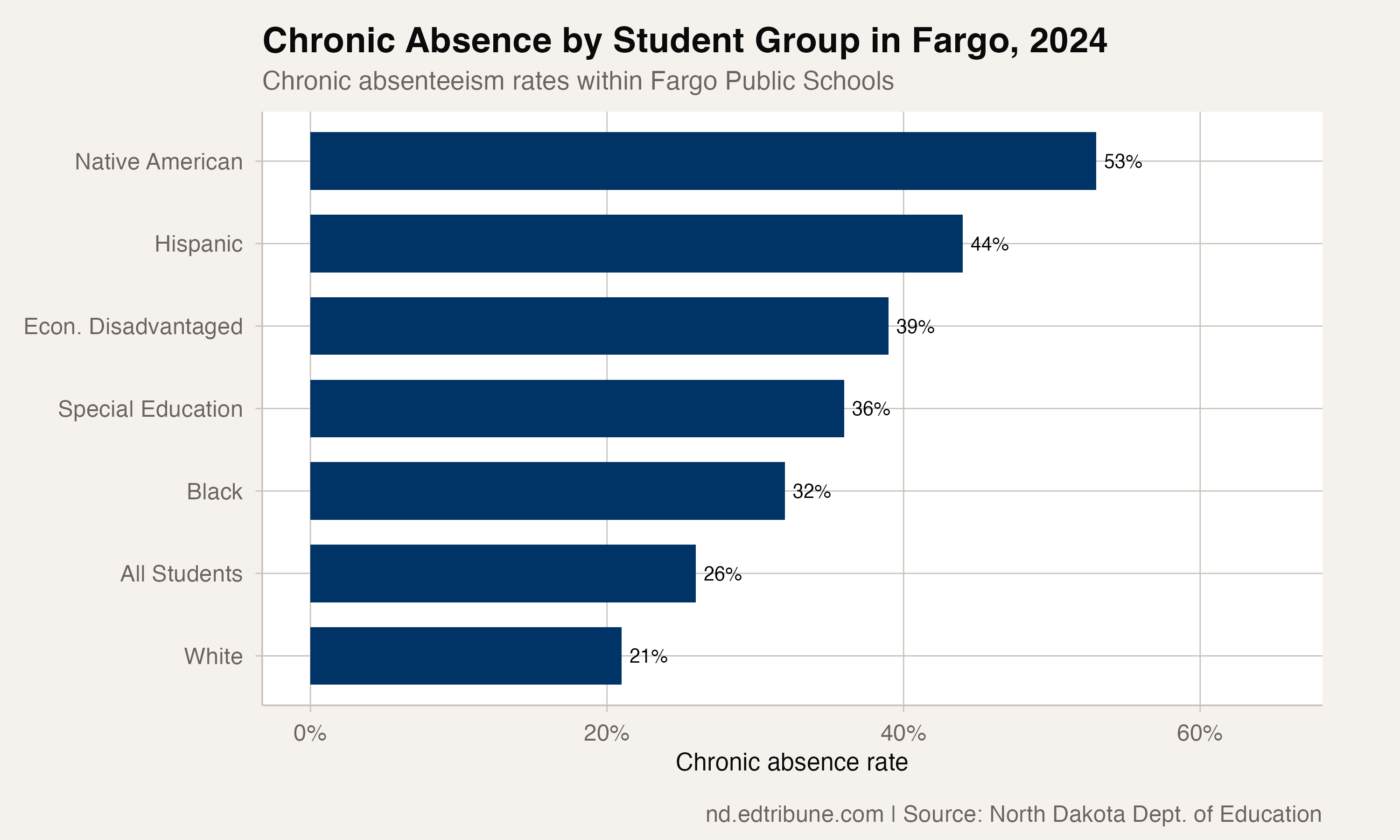
Within Fargo, the subgroup rates are stark. Native American students have a 53% chronic rate, more than double the district average. Hispanic students are at 44%, economically disadvantaged students sit at 39%, and special education students at 36%. Black students are at 32%. White students have a 21% rate, itself well above the pre-pandemic statewide average.
The Native American rate is particularly significant because it exceeds the statewide Native American average of 39%. Being a Native American student in Fargo's urban district carries a higher absence risk than being a Native American student statewide, an inversion of the usual urban-advantage pattern.
How Fargo compares
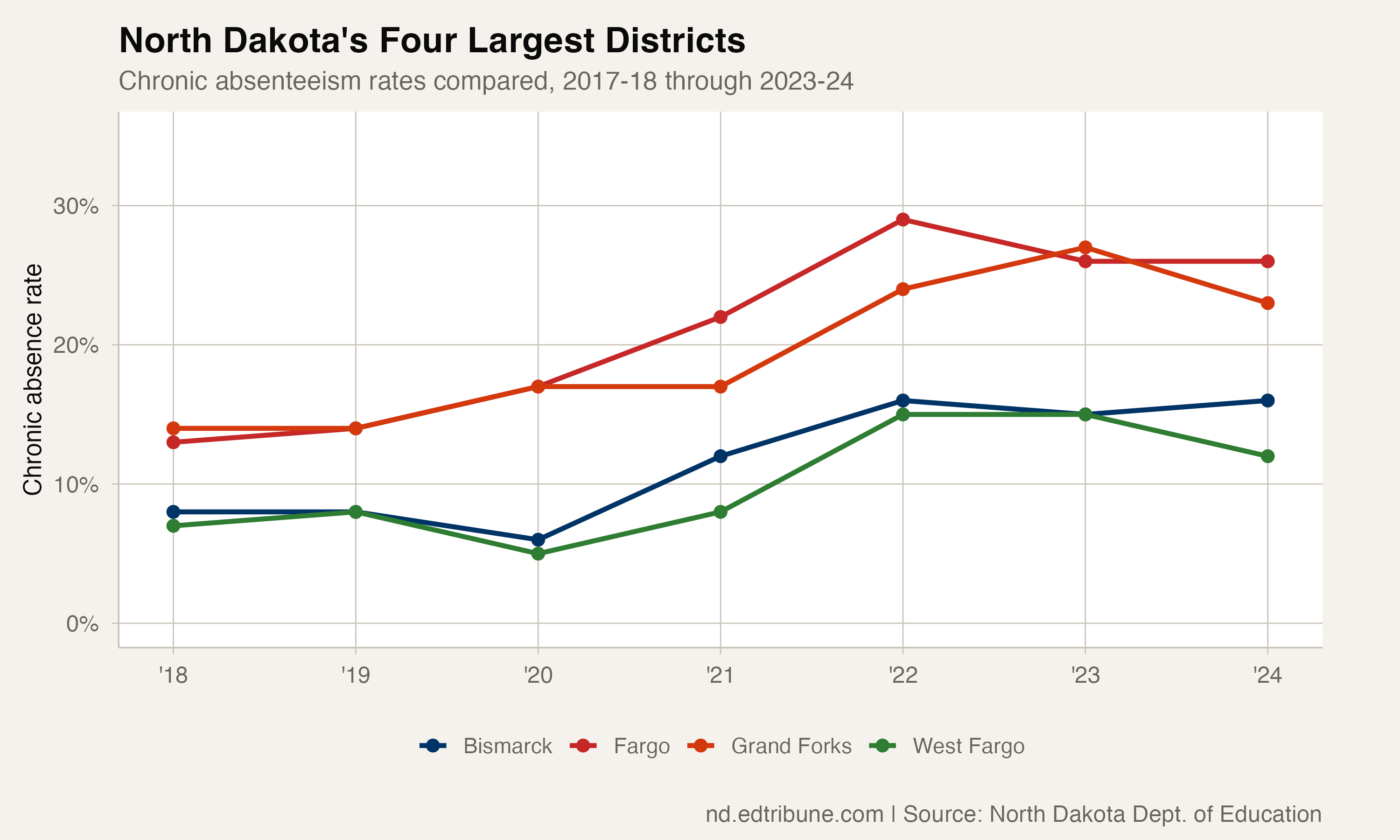
Among North Dakota's four largest districts, Fargo's trajectory stands out. Bismarck went from 8% to 16%, an 8-point increase. Grand Forks climbed from 14% to 27% at peak, then improved to 23% in 2024 after implementing a new attendance policy. West Fargo, Fargo's fast-growing neighbor, rose from 7% to 15% at peak and has already come back down to 12%.
Fargo's 26% is the highest among the four. More concerning, it has shown no improvement in two years, sitting at 26% in both 2023 and 2024 after dropping from 29% in 2022. The easy-recovery period appears to be over.
The contrast with West Fargo is hard to ignore. The two districts share a metropolitan area and draw from overlapping demographic pools. Yet West Fargo's mid-year 2024-25 data shows just 3.3% chronic absenteeism, while Fargo's mid-year rate remains at 25.2%. One district has essentially solved its chronic absence problem. The other, right next door, has not.
Detailed code that reproduces the analysis and figures in this article is available exclusively to EdTribune subscribers.
Discussion
Sign in to join the discussion.
Loading comments...