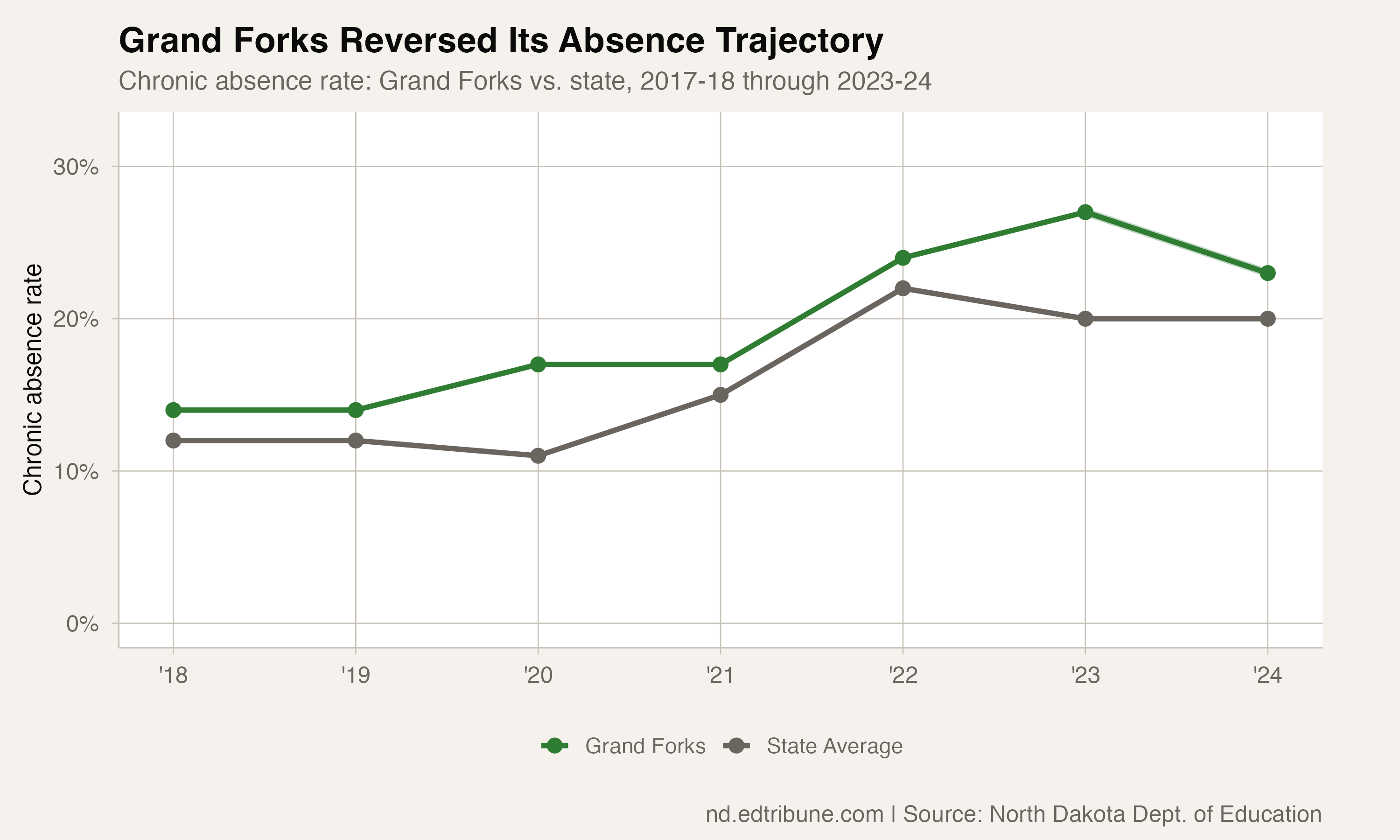
For five years, Grand Forks↗ET went without a single year of improvement in chronic absenteeism. From 14% in 2017-18 to 27% in 2022-23, the rate moved sideways or up every year, with a 7-point jump in the pandemic year doing most of the damage. Then in 2023-24, the rate dropped to 23%. It was the first year-over-year improvement since before the pandemic.
The 4-point decline did not happen by accident. Grand Forks implemented a new high school attendance policy, and the early results were dramatic. Red River High School reported a 34% decrease in total absences. Central High School saw a 43% decrease. The district has since expanded the program across all grade levels.
The trajectory before the turn
Grand Forks' chronic rate nearly doubled between 2018 and 2023. The year-over-year sequence ran 0, 3, 0, 7, and 3 percentage points: two years of standing still, two years of modest increase, and one pandemic-driven 7-point jump in 2021-22 that the district never walked back. No other large North Dakota district went five straight years without an improvement.
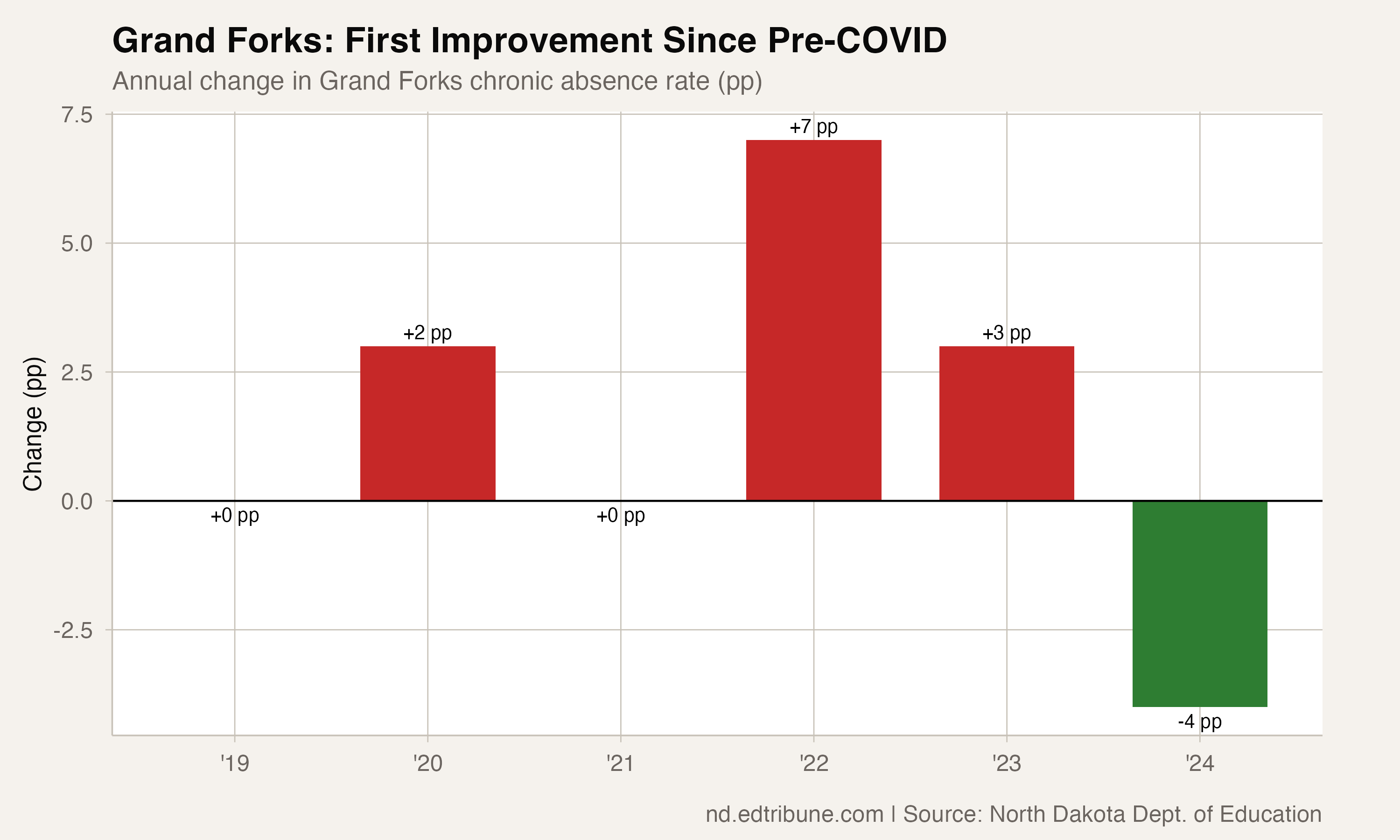
The 4-point improvement in 2024 is significant precisely because it broke that pattern. A single year of improvement does not constitute a trend, but it represents the first evidence that intentional intervention can bend the curve downward in a large North Dakota district.
How Grand Forks compares
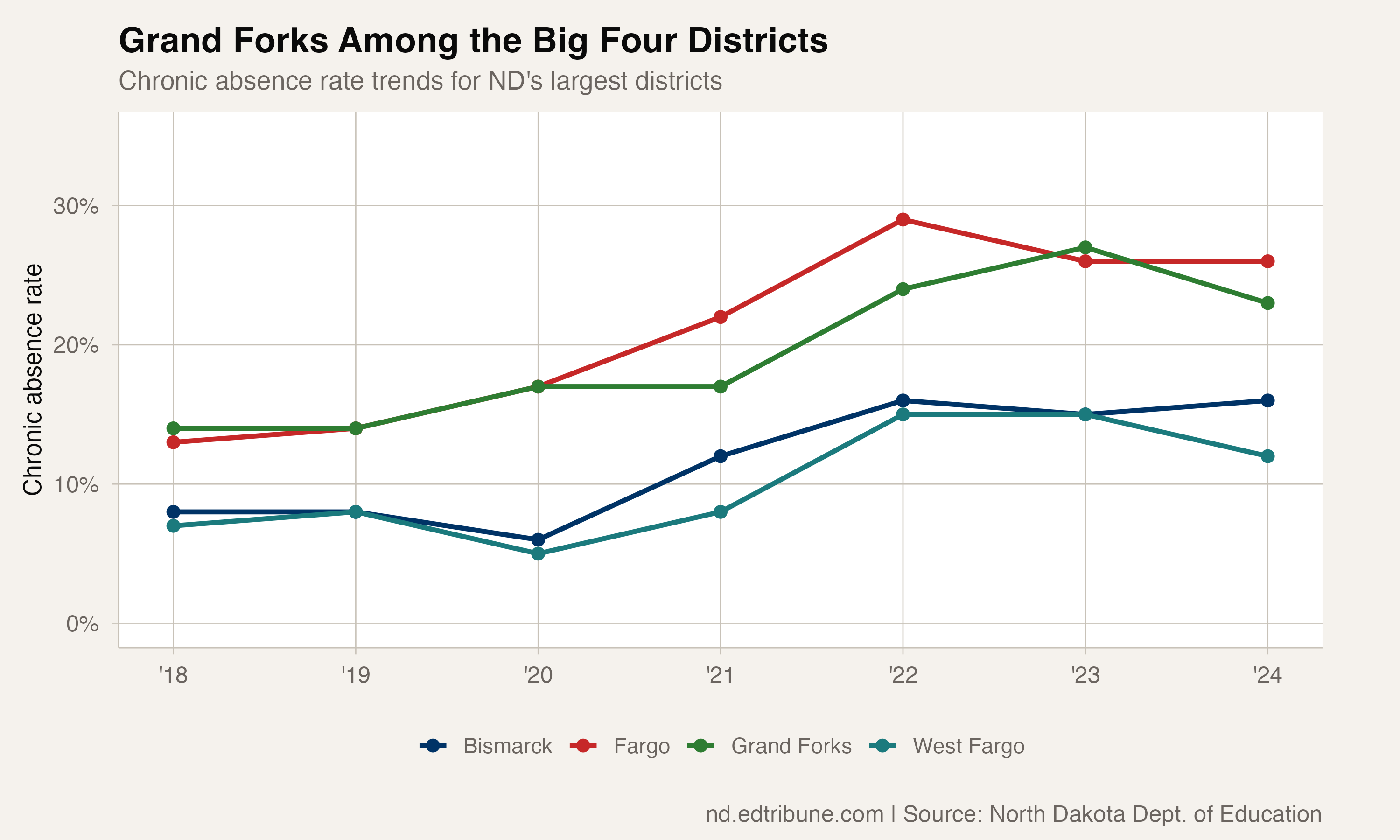
At 23%, Grand Forks is still above the state average of 20% and well above its own pre-COVID 14%. Among the four largest districts, Bismarck↗ET (16%) is doing better than Grand Forks, Fargo↗ET (26%) is doing worse, and West Fargo↗ET (12%) is the clear outlier on the positive side.
But the direction matters. Fargo has been flat at 26% for two years. Bismarck has held steady in the 15-16% range. Grand Forks moved down 4 points. If the district's new attendance approach continues to produce results in 2024-25, it could close the gap with Bismarck and pull further away from Fargo.
The equity question
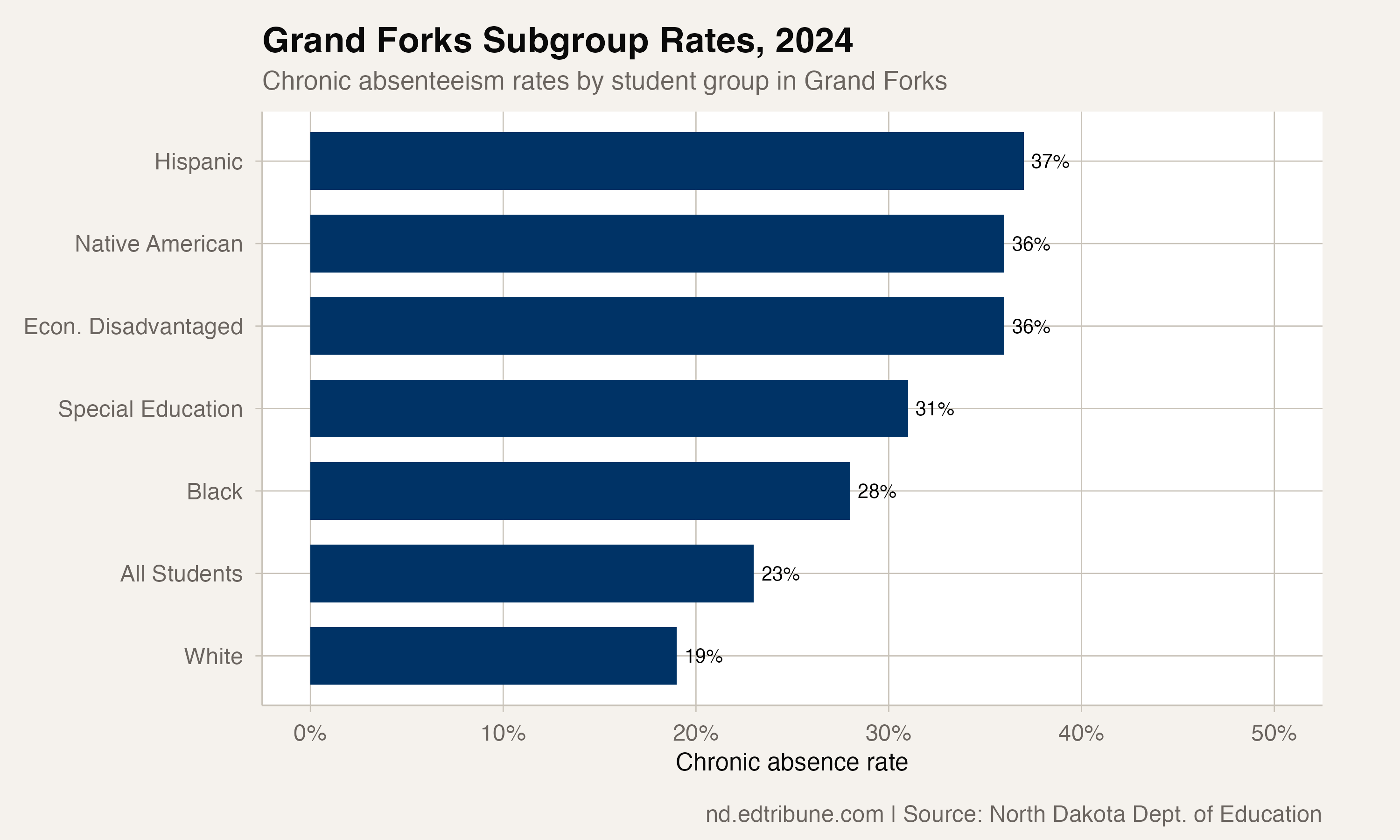
Grand Forks' overall improvement is encouraging, but the subgroup rates reveal how much work remains. Native American students still have a 36% chronic rate. Economically disadvantaged students face elevated rates. The 4-point overall drop does not tell us whether the improvement reached the students who need it most, or whether it primarily captured students who were closer to the threshold.
The attendance policy that produced the high school results focused on structure and accountability: clear expectations, consistent consequences, and parent communication. Those approaches tend to work best for students whose absences are driven by habit or low engagement rather than by structural barriers like transportation, health, or housing instability. Whether the model can reach students in the 36% Native American category as effectively as it reached the overall population will determine whether Grand Forks' improvement is equitable or selective.
Can it scale?
The Grand Forks results raise a question for every other struggling district in North Dakota: if one large district can cut absences 34-43% at the high school level through a focused attendance policy, why haven't others?
Part of the answer is that Grand Forks' results are preliminary. The 34% and 43% figures come from 2024-25 mid-year data at two high schools, and full-year data may tell a different story. The chronic absenteeism rate improvement from 27% to 23% in the 2023-24 data is more established, but it is still just one year.
The harder answer is that attention to attendance requires resources: staff time to track and follow up with families, administrative will to enforce policies, and community partnerships to address root causes. Grand Forks committed those resources. Smaller districts with tighter budgets may not have the capacity.
But in a state where fewer than one in four districts have recovered to pre-COVID absence levels (about 23%), Grand Forks is the most concrete evidence that the trajectory can be reversed. One year does not make a trend. It does, at least, prove it is possible.
Analysis uses chronic absenteeism data from the North Dakota Department of Public Instruction for the 2017-18 through 2023-24 school years. The high school attendance figures (34% and 43% reductions) are mid-year 2024-25 results reported by Grand Forks Public Schools, as covered by the Grand Forks Herald.
Detailed code that reproduces the analysis and figures in this article is available exclusively to EdTribune subscribers.
Discussion
Sign in to join the discussion.
Loading comments...