Correction (July 20, 2026): An earlier version understated the historical range of Bismarck's Native American graduation rate, inferred causes for cohort growth that the data do not identify, and incorrectly said more than 100 Native American students failed to graduate on time each year. The verified 2024 figure is about 50 of 108 students; the 36.6-point white-Native American gap is unchanged.
The North Dakota Department of Public Instruction is based in Bismarck. The state's largest graduating cohort also reports a wide racial gap.
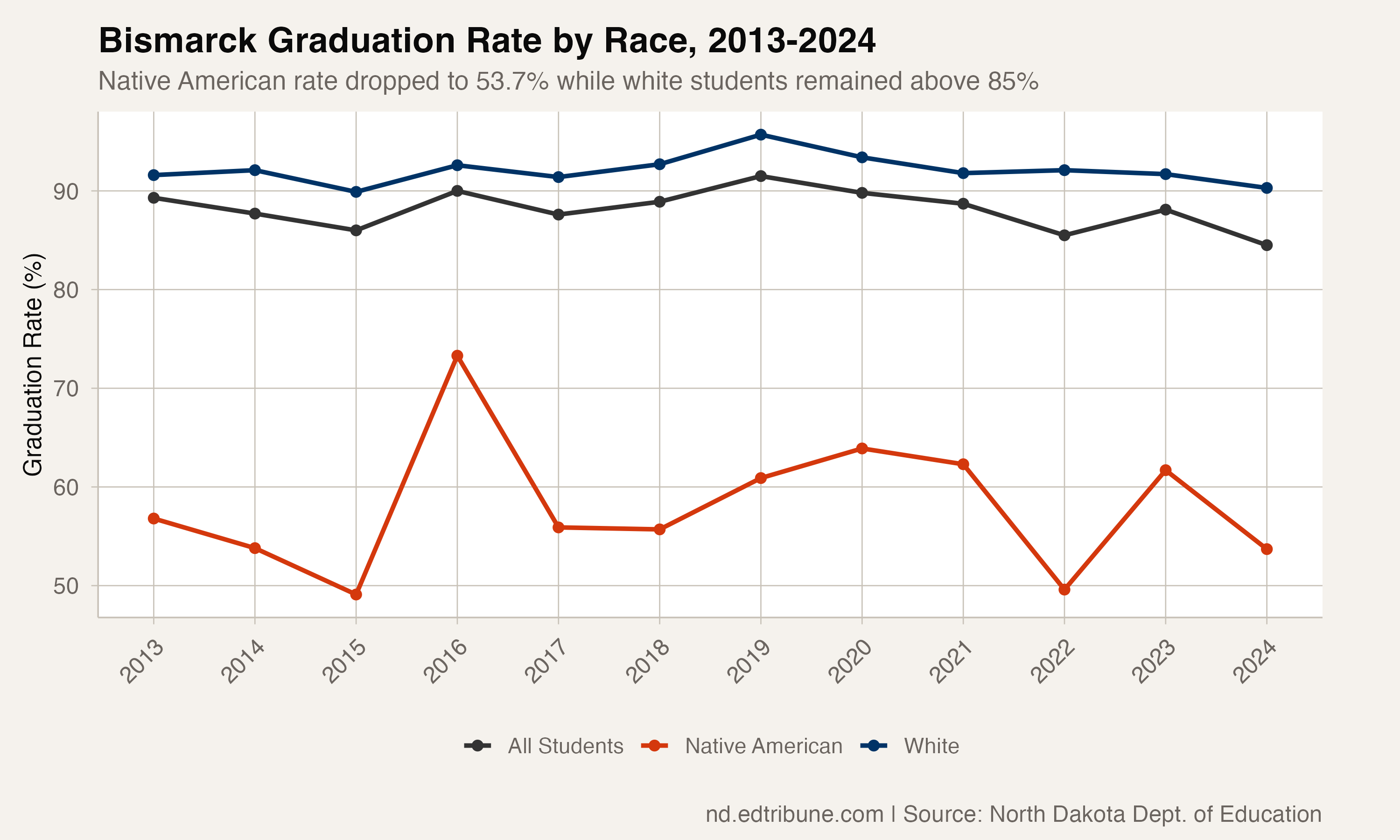
Bismarck↗ET Public Schools, the largest district in North Dakota by 2024 cohort size with 1,057 students, posted an overall rate of 84.5%, above the state rate of 82.4%. But 90.3% of white students graduated on time. For Native American students, the number was 53.7%, a 36.6 percentage-point gap within the same district.
A gap that has never closed
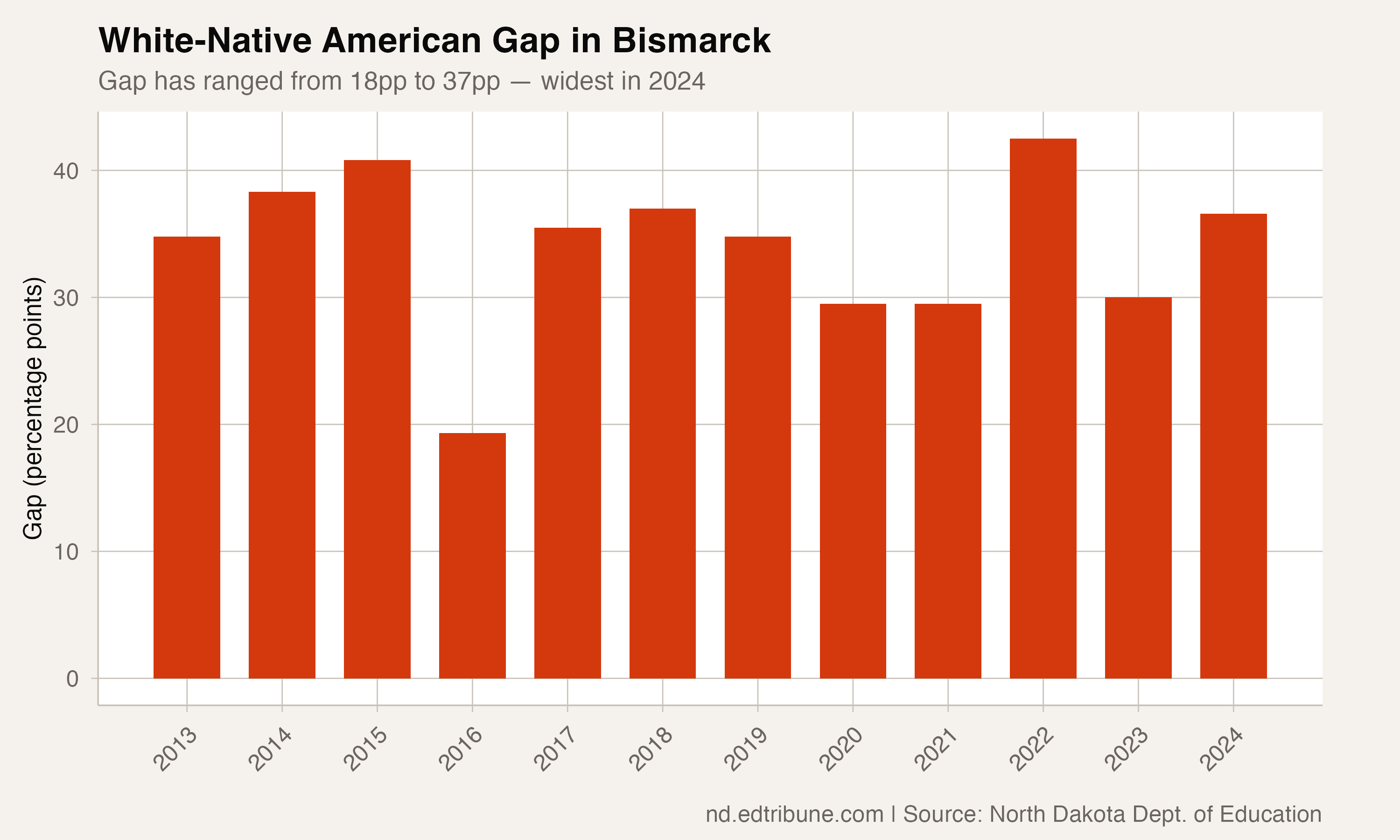
The white-Native American graduation gap in Bismarck has existed for every year in the data. At its narrowest, in 2016, it was 19.3 percentage points. At its widest, in 2022, it reached 42.5 points when the Native American rate dipped to 49.6%. The 2024 gap of 36.6 points sits toward the top of the historical range.
What makes the Bismarck gap distinct is the stability of the white rate. White students graduated above 89% in every year of the data, and above 90% in 11 of 12 years. The Native American rate ranged from 49.1% to 73.3% while the white rate moved within a much narrower band.
A larger and larger cohort
The Native American graduating cohort in Bismarck more than doubled, from 44 students in 2013 to 108 in 2024. The graduation data do not distinguish population growth from reporting or identification changes.
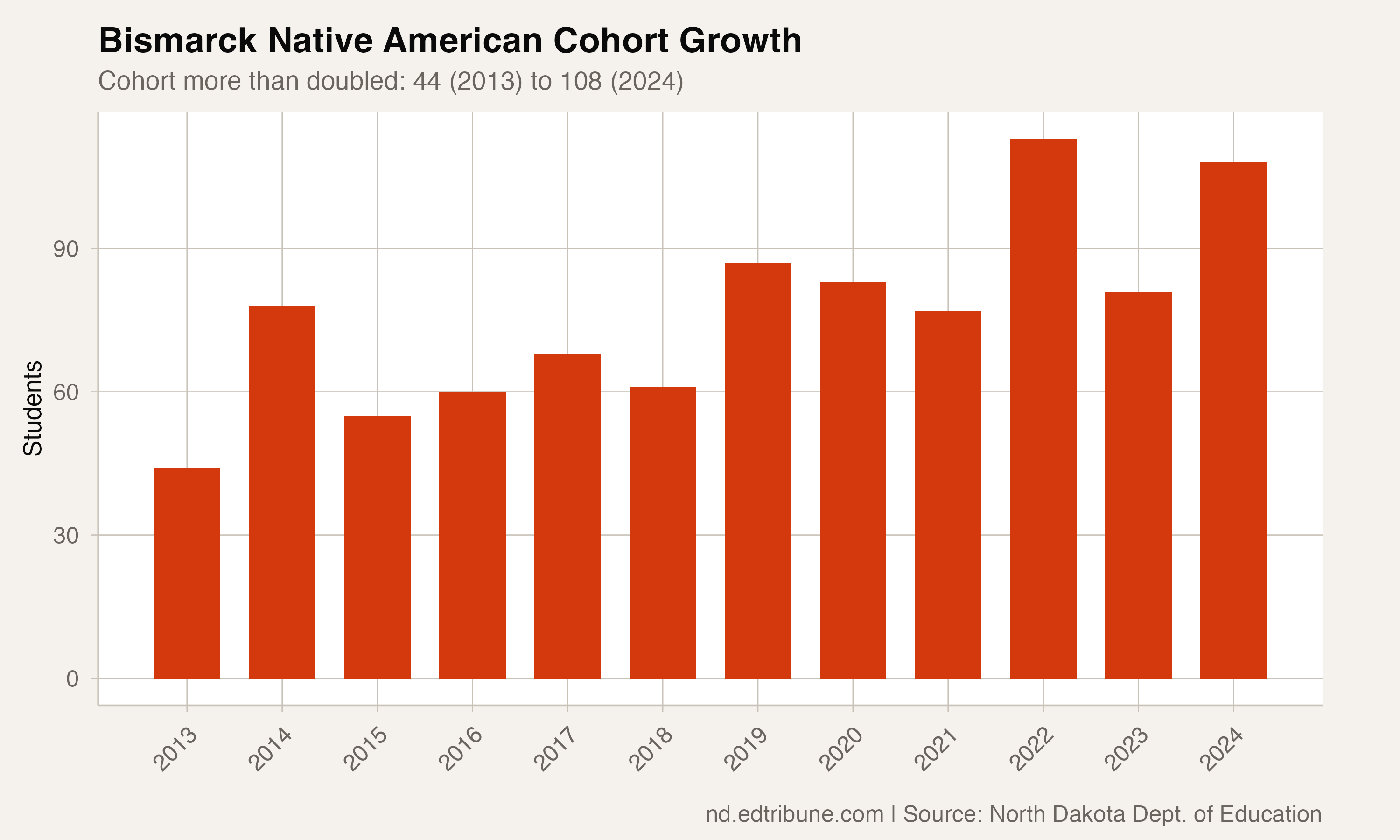
The 53.7% rate means approximately 58 Native American students graduated on time while 50 did not. A cohort of 108 is larger than in earlier years, but its changing size still matters when comparing annual rates.
The absolute number of Native American non-graduates did not rise every year. It varied from roughly 16 to 57 across the series and stood at 50 in 2024, compared with about 19 in 2013.
The broader Bismarck picture
The Native American gap is the starkest disparity in Bismarck, but it is not the only one. Students in the free- and reduced-price lunch subgroup graduated at 55.7% with a cohort of 203 students, a 28.8-point gap from the overall rate. Hispanic students posted 64.7% with 34 students. Black students graduated at 75.6% with 45 in the cohort.
The pattern shows that Bismarck's above-average headline rate coexists with large subgroup disparities. White students made up 844 of the 1,057 total cohort (79.8%) and graduated at 90.3%.
Two Bismarcks
The data suggests two school systems operating within the same district. One serves the white majority at rates above 90%, comparable to the best-performing districts in the state. The other serves Native American, low-income, and minority students at rates that would rank Bismarck among the state's worst-performing districts if measured in isolation.
This dual reality is not unique to Bismarck. Fargo↗ET shows a similar pattern, with Native American students at 48.6% and white students at 86.2%. Minot↗ET's gap is even more extreme, with Native American students at 25.9% and white students at 77.6%. But in the state capital, home to the state's education department and policy apparatus, the 36.6-point gap carries a particular weight.
United Tribes Technical College is located in Bismarck. In the city's public school district, the 2024 data indicate that about 50 of 108 Native American students in the cohort did not graduate on time.
Data from the North Dakota Department of Public Instruction. Graduation rates represent four-year cohort rates. All years use the end-year convention (2024 = class of 2024).
Detailed code that reproduces the analysis and figures in this article is available exclusively to EdTribune subscribers.
Discussion
Sign in to join the discussion.
Loading comments...